Most affiliates sign up with good intentions and then go completely silent. It’s one of the most frustrating parts of running an affiliate program, and if you’re dealing with it right now, you’re not alone. Here’s how to actually fix it.

The stat that stops most affiliate managers cold: in a typical affiliate program, around 95% of affiliates who sign up never make a single sale. Some never even log in after joining.
That’s not because they’re lazy or because your product isn’t good. Most of the time, it’s because nobody told them what to do, when to do it, or why they should bother. They signed up, got a confirmation email, maybe a link, and then… silence. So they moved on to something else.
The good news is that those quiet affiliates aren’t lost. With the right sequence of moves, you can wake a large percentage of them up. I’ve seen programs activate 20-30% of their inactive list in a single campaign. That’s real money sitting there waiting to be unlocked.
This post covers the specific strategies that work, in the order you should use them, and the common mistakes that keep affiliate managers spinning their wheels.
Why affiliates go quiet after signing up
Before you can fix the problem, it helps to understand what actually caused it. Affiliates go quiet for a handful of reasons, and they’re almost never the ones affiliate managers assume.
The most common reason: they didn’t know what to do next. This sounds almost too simple, but it’s true. You gave them a link. You maybe sent a welcome email. And then you assumed they’d figure it out. They didn’t.
The second reason is timing. They signed up during a period when they weren’t ready to promote anything. Maybe they were between launches. Maybe they had personal stuff going on. Maybe your program just wasn’t the right fit at that moment — but six months later, it might be.
The third reason is that they forgot. This one stings, but it’s reality. Affiliates are exposed to hundreds of marketing messages a day. If you signed them up and went quiet for 60 days, you’ve lost the top-of-mind position. You’re not on their radar anymore. That doesn’t mean they’re gone forever — it just means you have to earn your way back.
The fourth reason is that they tried once and it didn’t work. Maybe they sent one email, got no sales, and concluded your offer wasn’t worth promoting. This is fixable, but it requires more than a nudge. You have to show them a better path.
Understanding which of these is driving your inactivity tells you which tool to reach for first.
The first move: segment before you message

The biggest mistake in affiliate reactivation is blasting the same message to every inactive affiliate. A new affiliate who signed up two weeks ago and hasn’t promoted yet is completely different from someone who joined three years ago, ran one promotion, and disappeared. They need different messages.
Before you write a single email, segment your inactive affiliates into at least three buckets:
- New and never promoted — signed up in the last 60-90 days, never sent traffic
- Previously active, now quiet — have promoted before but haven’t in 90+ days
- Long-term dormant — signed up more than a year ago, little or no activity
Each group gets a different message and a different offer. The new-and-never-promoted group needs clarity and a quick win. The previously-active group needs a reason to come back and a reminder of what they already know how to do. The long-term dormant group needs a real reason to re-engage — a new product, a strong contest, something that didn’t exist when they last paid attention.
Most affiliate software lets you pull these segments easily. If yours doesn’t, export your data and sort by last-click or last-sale date. It’s worth the 20 minutes.
How to reactivate new affiliates who haven’t promoted yet
New affiliates who never promoted are your lowest-hanging fruit. They were interested enough to apply and get approved. The momentum just died before it turned into action.
The fix here is almost always the same: give them a specific, low-friction first step.
Send them a short email that does three things. First, acknowledge the gap without making it weird. Something like: “Hey, you joined our program a few weeks ago and I want to make sure you have everything you need to get started.” Second, give them one concrete action to take — not a list of resources, not a welcome portal tour, just one thing. “Send this email to your list this week.” Or “Post this to your Instagram Stories using these three images.” Third, tell them exactly what to expect if they do it. A specific number helps: “Last month, affiliates who sent this email averaged $340 in commissions in the first week.”
Don’t overwhelm them with options. The reason they haven’t promoted yet is almost always decision paralysis or a lack of clarity. You solve that by removing decisions, not adding them.
If you want a head start on the actual emails, the Affiliate Activation Templates give you the exact emails I use to get new and inactive affiliates moving — written and ready to customize. They cover both short-term and long-term reactivation situations.
How to win back affiliates who used to promote

Previously-active affiliates who’ve gone quiet are a different situation. They know how to promote. They’ve made sales before. Something caused them to stop, and your job is to figure out what and address it directly.
The most effective approach here is a personal outreach, not a broadcast. Pick up the phone or send a one-to-one email — not a mass campaign — to your top previously-active affiliates. Ask a genuine question: “Hey, I noticed you haven’t promoted recently. Is everything okay? Is there anything we could do differently to make it easier to promote?” You’ll get real answers, and those answers will tell you what’s actually going on.
Common responses you’ll hear: the commissions aren’t competitive anymore, the product has changed and they’re not sure it’s still a good fit for their audience, they’ve been busy and just need a nudge, or they had a bad experience with a promotion that didn’t convert. Each of those has a specific fix.
For the group as a whole, a win-back campaign works well. This is a short 2-3 email sequence sent specifically to previously-active affiliates with a compelling reason to come back. That reason should be one of three things: a new product or offer, a meaningful commission increase or bonus, or a specific upcoming promotion with a concrete opportunity window. Vague “we miss you” emails don’t move people. Specific, time-bound opportunities do.
I go deep on how to activate inactive affiliates in a full post if you want the longer playbook. The short version: make it easy, make it urgent, and make the upside concrete.
What actually motivates affiliates long-term
Reactivation campaigns are great, but if you have to run one every six months, you have a retention problem, not a reactivation problem. Long-term affiliate motivation comes from a different set of things.
Communication consistency is the biggest factor. Affiliates who hear from you regularly — not just during promotions — stay warm. They feel like they’re part of something, not just a sales channel you turn on and off. A monthly affiliate newsletter, even a short one, does more for long-term retention than any single reactivation campaign. Most programs don’t send one. That’s a big gap you can fill.
Early wins matter more than big commissions. When a new affiliate makes their first sale, especially in the first 30 days, they’re dramatically more likely to become long-term promoters. Structure your program to make that first win as easy as possible. That might mean enhanced commissions for a new affiliate’s first sale, a specific “quick win” promotion you run for new partners, or a simple welcome sequence that walks them through their first promotion step by step.
Recognition drives behavior. Affiliate leaderboards, shout-outs in newsletters, personal notes from you when someone hits a milestone — all of it signals that you’re paying attention and that their effort matters. This costs almost nothing and has a real impact on how often affiliates prioritize your program over competing offers.
The right content, delivered at the right time. Affiliates who know they’re going to receive the resources they need — good copy, strong images, a promo plan — before they need them are far more likely to actually promote. If they have to ask for stuff or hunt it down, they won’t bother. Set a standard of delivering everything early and proactively, and your active rate goes up. The Sample Affiliate Promo Plan is something I’ve shared with affiliates for years to show them exactly how to structure a full promotion and why it’s worth going all-in.
Get the EXACT Template We Give to Our Affiliates to Get Them to Promote More and Generate More Sales! Click Here to Download it Now!

Contests and incentives that actually work
Affiliate contests can be genuinely powerful motivators — but most programs run them wrong. They set up a leaderboard, offer a cash prize to whoever sells the most, and then wonder why only their top three affiliates are competing and everyone else is ignoring it.
The problem with winner-takes-all contests is that they only motivate people who think they can win. If someone is sitting at number 15 on your leaderboard looking up at the top three, they have no reason to push harder. The gap feels too big.
The contests that actually move the needle have multiple tiers and multiple ways to win. Here are the structures that work best:
- Tiered milestones: everyone who hits 10 sales gets $X, everyone who hits 25 gets $Y, everyone who hits 50 gets $Z. This gives every affiliate a reachable goal, not just the top performers.
- First-sale contests: the first affiliate to make a sale on day one wins a bonus. This is great for activating your dormant partners who’ve never promoted before — because for the first time, they have a shot.
- Activity contests: reward affiliates for sending emails, sharing social posts, or driving optins, not just sales. This is especially useful during a launch pre-sell period when you want everyone warmed up.
On prizes: tangible, specific prizes outperform cash almost every time. Cash is easy to mentally file under “bills.” A Porsche Boxster, a $1,000 gift card to Ruth’s Chris, a trip for two — those things you can picture. You can tell your spouse about them. They stick in your brain differently. If you can tie the prize to something you know a specific high-value affiliate wants, even better.
For a deeper look at building a reactivation system for evergreen programs, the post on activating inactive affiliates in evergreen programs covers the full sequence.
The role of communication in keeping affiliates active
Here’s a pattern I’ve seen hundreds of times: an affiliate manager works hard to recruit great partners, runs a successful launch, and then goes quiet. Two months later, they want to run another promotion and email their affiliate list — and barely anyone responds. The list has gone cold because there was no in-between communication.
Affiliates are exposed to 500 to 1,000 marketing messages per day. If you disappear for two months and then show up asking them to promote something, you’re competing with everything else fighting for their attention. You haven’t maintained the relationship. You’re essentially starting over.
The fix is a regular communication cadence that runs between promotions, not just during them. That means:
- A monthly affiliate newsletter with tips, results from the last promotion, and a preview of what’s coming
- Occasional personal emails to your top 20-30 affiliates, not templates — actual notes
- Social media engagement with your affiliates: comment on their posts, share their content, respond when they tag you
- A pre-promotion warm-up sequence that starts 6-8 weeks before a launch, not one week before
The affiliates who stay consistently active aren’t the ones with the best programs or the highest commissions. They’re usually the ones whose affiliate manager makes them feel like partners, not just distribution channels.
Writing all those emails takes time, which is why my team uses Affiliate Email Pro for every piece of affiliate communication we produce. It’s trained on 2,000+ high-performing affiliate emails and generates drafts in minutes. For affiliate managers running ongoing programs, it saves three to ten hours a week.

When to cut your losses and remove an affiliate
Not every inactive affiliate is worth reactivating. At some point, a decision about program hygiene matters as much as reactivation effort.
Here’s a reasonable framework: if an affiliate has been in your program for more than 12 months with zero sales and zero clicks, send a re-engagement email. Give them one specific, easy opportunity to participate. If they don’t respond or promote, remove them from active status. You can keep them in your system — but stop spending time and newsletter slots on people who aren’t engaged.
This isn’t about being harsh. It’s about focusing your energy where it’s going to produce a return. The 10 commandments of great affiliate managers include one that most people skip: make hard decisions about your affiliate roster rather than letting dead weight dilute your program metrics and your attention.
Pruning your list also has a side benefit: your email open rates and click-through rates improve, which gives you a cleaner read on what’s actually working in your communications.
Building a reactivation system, not a one-time campaign
The best affiliate managers don’t scramble to reactivate affiliates every time they want to run a promotion. They have a system running in the background all the time.
A simple version looks like this:
Day 0-7 (new affiliate onboarding): Welcome email with one specific action, follow-up on day 3 with a quick-win promotion opportunity, follow-up on day 7 with a check-in.
Day 30 (no activity check): Automated or manual email to any affiliate who hasn’t sent a click yet. Short, direct, with one ask: “Have you had a chance to promote yet? Here’s the simplest way to get started.”
Day 90 (reactivation trigger): Any affiliate with no activity in 90 days gets flagged. A brief, personal-feeling email goes out: not a newsletter, a direct note. Offer something specific — a bonus commission for their next sale, access to a new resource, a heads-up about an upcoming promotion.
Day 365 (annual cleanup): Anyone with no sales in 12 months gets one last re-engagement attempt. If no response, they move to inactive status or get removed.
Between all of those touchpoints, your monthly newsletter is doing the ongoing relationship maintenance. Combined, this system means no affiliate ever goes 90 days without hearing from you, and you’re catching the drop-offs early rather than trying to recover them a year later.
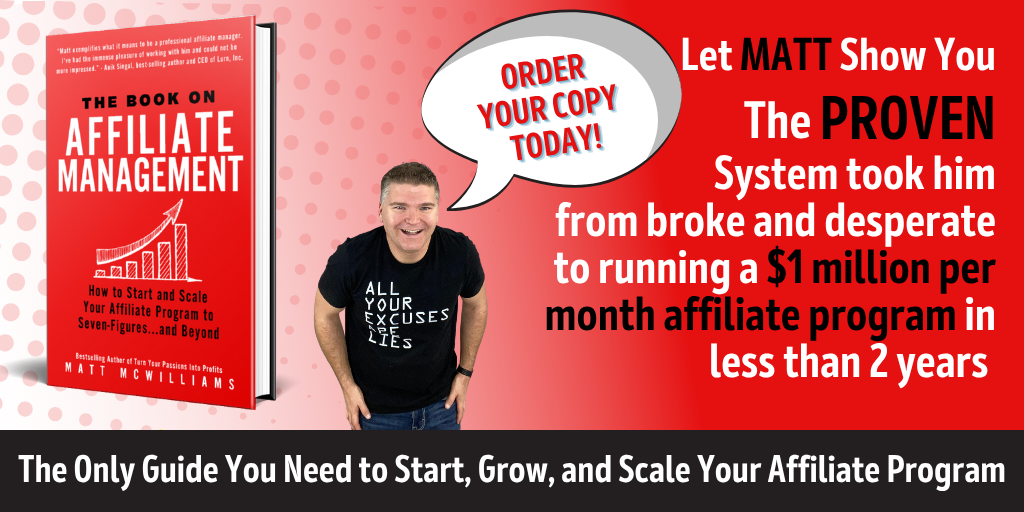
If you want to see how the most successful programs put all of this together, The Book on Affiliate Management walks through the full system — from recruiting to activation to long-term retention. It’s the complete playbook for building a program that doesn’t rely on constantly recruiting new affiliates to replace the ones who went quiet.
What to do this week
Don’t try to overhaul your entire affiliate program in one sitting. Here’s the simplest version of where to start:
Pull your affiliate list and sort it by last-click or last-sale date. Identify everyone who joined in the last 90 days and hasn’t promoted yet. Send them a short, direct email with one specific action to take this week. Then pull the list of affiliates who were active 6-12 months ago and have gone quiet. Write them a personal note — not a newsletter, an actual email — and ask what’s going on.
Those two moves alone will move the needle in the next 30 days. The system comes after you’ve proven to yourself that reactivation works for your specific program and audience. Start simple, learn what works, then build it into a repeatable process.
For more on how to motivate affiliates leading up to a promotion specifically, that post covers the pre-launch warm-up sequence in depth. And if you’re thinking about hiring an affiliate manager to own this process, that post walks through exactly what to look for and when it makes sense to bring someone on.
The affiliates you need are already in your program. They just need someone to show up and give them a reason to promote.
Or…check out some of my free reports to help you get on the right track:Questions?
Text me anytime at (260) 217-4619.