++The best affiliate software for coaches and consultants is a platform built for small, high-value rosters instead of large publisher networks. You need per-affiliate commission control, personal communication that scales, and clean referral links. AffiliateHQ handles all three, which is why it fits coaching businesses better than enterprise partner suites or bare tracking tools.
 Most affiliate software gets built for a business with 800 affiliates, 40,000 monthly clicks, and a $47 product. That business needs automation, fraud screening, and dashboards that summarize noise into a number.
Your coaching business is not that business. You have 15 affiliates, maybe 30. Your program sells $4,000 packages and $25,000 engagements, and most referrals come from someone you’ve met in person, spoken to on a podcast, or sat next to in a mastermind. The roundup posts ranking six platforms one through six never account for that.
What makes affiliate software for coaches different from regular affiliate software?
Three things: roster size, ticket price, and where the referrals come from.
Roster size changes what automation is for. With 800 affiliates, automation replaces work you couldn’t do by hand. With 15, you could email each person individually, and honestly you should. The software’s job is making that contact faster.
Ticket price changes the math. A blogger promoting a $47 ebook at 40% earns $18.80. Your peer referring one client into a $12,000 program at 20% earns $2,400. That single referral is worth 128 ebook sales. When one commission is worth that much, you’ll negotiate individually with certain people, and your software has to let you.
Referral source changes the relationship. Content-site affiliates want a link and a data feed. Your affiliates are a former client who now runs her own firm, a copywriter you refer work to, the guy who hosted you on his podcast last spring. They mention you when the situation comes up.
All three differences point at the same requirement. The software has to make a small program feel like individual relationships instead of a mailing list.
Before you pick software, get clear on who’s going to promote you. Coaching and consulting programs recruit from a completely different pool than ecommerce programs do, and the recruiting approach determines the roster you’ll be managing. How to Find Affiliates For a Coaching or Consulting Business walks through where those people come from.
Why are enterprise partner platforms wrong for a coaching business?
 You’d pay for scale you don’t have and configuration you’ll never finish.
Impact, PartnerStack, and the other enterprise partner suites run on annual contracts that start in the tens of thousands and climb from there. Some of them add a percentage of tracked revenue on top. For a business doing $40,000 a month through affiliates, that pricing eats the program’s entire margin advantage over paid ads.
The cost isn’t the worst part. These platforms exist to manage complexity: multiple brands, regional teams, publisher marketplaces, compliance workflows across dozens of partner types. I’ve watched a consultant spend three weeks in onboarding calls configuring approval hierarchies for a program with 11 affiliates. Complexity you’ll never use is a tax on your attention.
The one real reason to pay enterprise money is marketplace access, meaning affiliates you couldn’t reach on your own. Coaching referrals don’t come from a marketplace. They come from people who already know your work, so you’re paying for the part of the product you won’t use.
If you’re still deciding between running your own program and joining a network, the difference between a referral program and an affiliate program is worth understanding first, since a lot of coaching businesses want the former with the tracking of the latter.
Why isn’t a basic tracking tool enough?
Because tracking answers a question you’re not struggling with.
Rewardful, AffiliateWP, and similar tools track accurately and cost between $50 and $150 a month. If your only problem is knowing which of your 15 people sent the sale, they solve it. Go buy one.
But the problem in a coaching program is rarely attribution. It’s that eight of your 15 affiliates have never sent a click. They said yes at a conference, filled out the form, got their link, and went back to running their own businesses. The software recorded a signup and moved on.
A bare tracking tool will tell you those eight people exist. It won’t do anything about them. And with your ticket price, waking up three of those eight is worth more than doubling your traffic. In the programs I’ve audited, a first serious activation effort typically wakes up 20% to 30% of an inactive list, and those partners were already sold on you.
The other gap: bare tools give you one big send button. You get a broadcast to all 15 people that reads like a newsletter, which is the wrong register for a group where you know everyone’s kids’ names. Activating inactive affiliates is the highest-return work in a small program, and most software ignores it.
What does AffiliateHQ do for a 15-person coaching program?
 Three features carry most of the weight: segmented broadcasts with live-stat merge tags, per-affiliate commission overrides, and vanity links.
I built AffiliateHQ after twenty years of running programs where the software kept forcing me to choose between doing things personally and doing them at all. Disclosure in paragraph three instead of a footnote nobody reads.
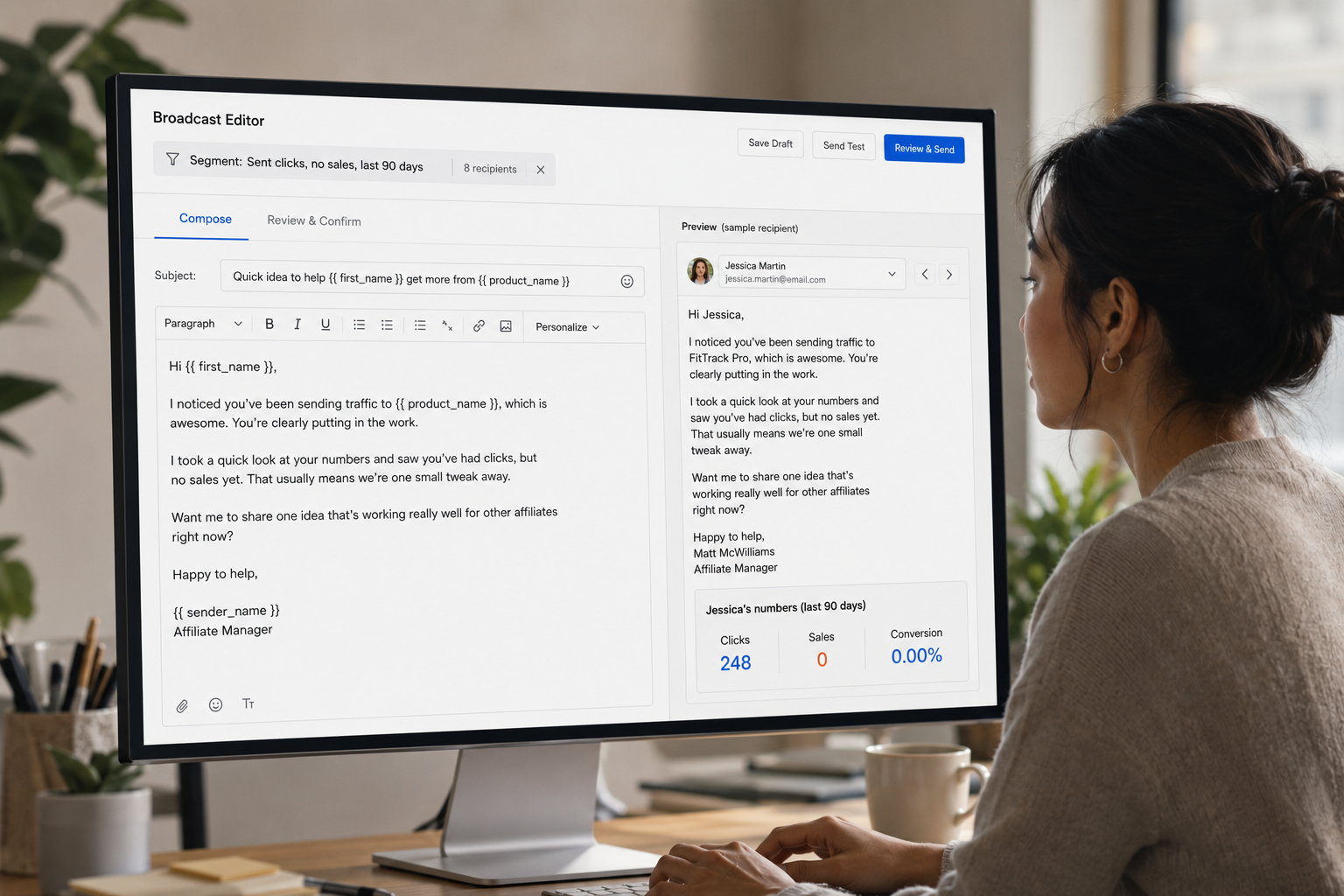
Segmented broadcasts solve the register problem. You filter by clicks, sales, revenue, signup date, or activity status, then write one message. Merge tags pull each person’s real numbers into their copy. So instead of “keep up the great work, team,” Sarah opens an email that says she’s sent 42 clicks and 2 sales this quarter and is one sale from the top three. A note to 15 people still reads one-to-one, because the specifics are hers.
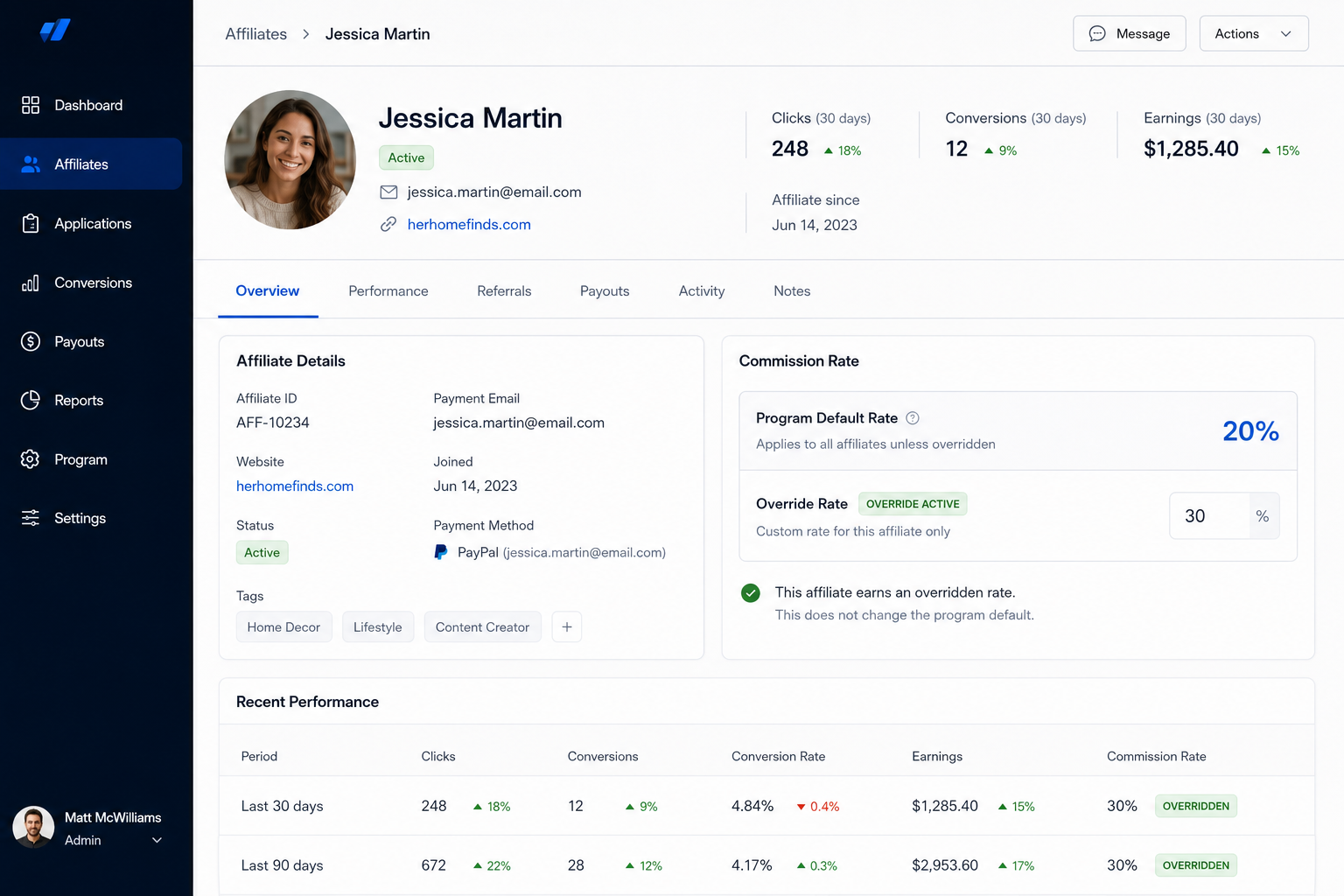
Per-affiliate overrides solve the negotiation problem. Your program pays 20%. Then the guy with the 40,000-person list who’s been sending you clients for two years asks for 30%, and he’s earned it. Set his rate to 30% without touching anyone else’s, without a spreadsheet running parallel to the software, and without your accountant finding the discrepancy in March. In a coaching program you’ll do this five or six times. Most platforms make you rebuild your whole commission structure to accommodate one person.
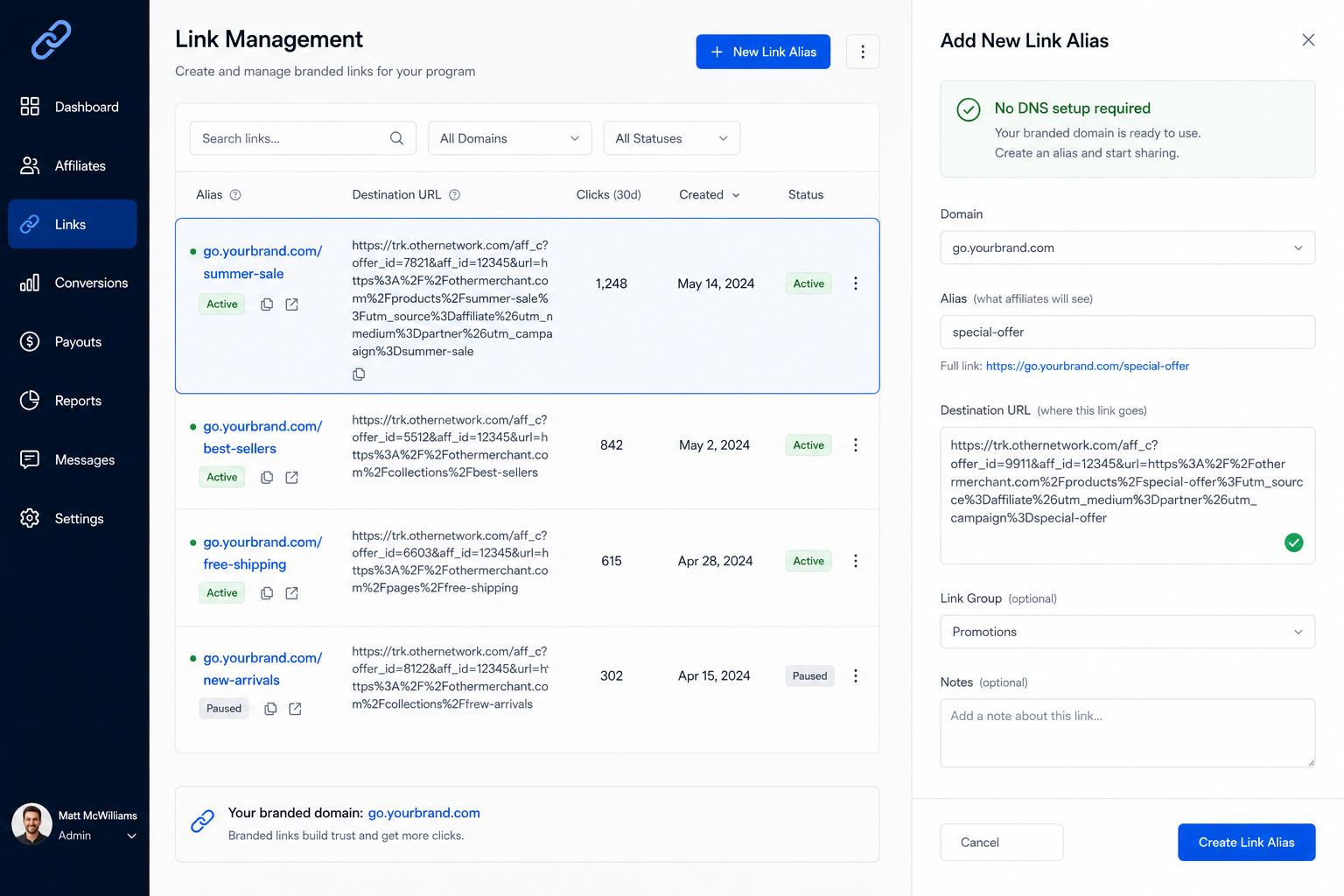
Vanity links solve the credibility problem. A referral from a colleague shouldn’t arrive as a URL carrying a tracking string and someone else’s domain. Vanity aliases run on your domain with no DNS setup and no redirect chain, so when your peer texts a client a link, it reads like a recommendation instead of an affiliate pitch. That matters more at $12,000 than it did at $47.
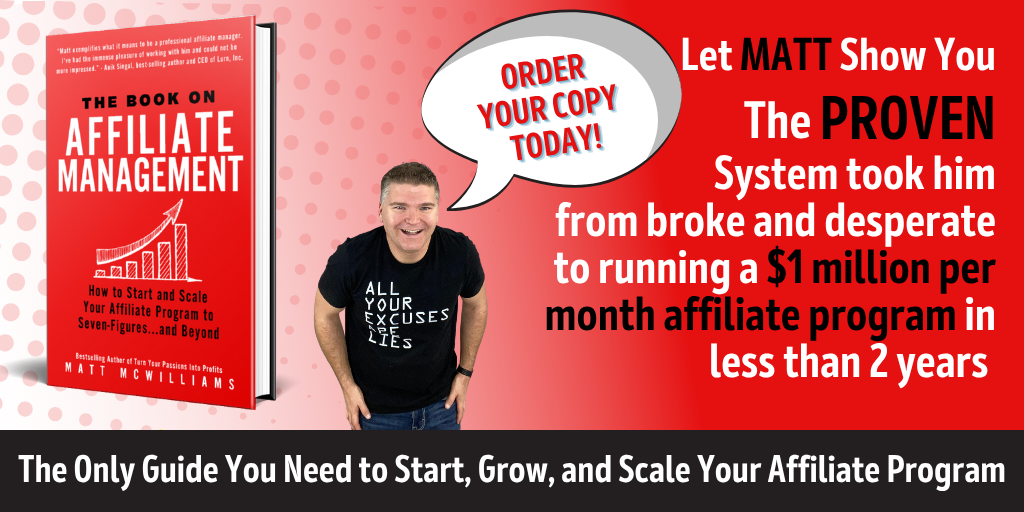
The features map directly to a method, not the other way around. If you want the full system the software was built on, it’s in The Book on Affiliate Management, three hundred pages covering how I built a $1 million per month program in under two years.
How do you set commission rates for high-ticket coaching?
Start with your delivery cost, then work backward. The more of your personal time a client consumes, the lower the percentage you can afford.
A $2,000 self-paced course with a light group call component can pay 30% to 40%. A $25,000 done-with-you engagement where you’re in the room 40 hours can’t pay more than 10% to 15% without wrecking your margin, and often the right structure there is a flat referral fee of $2,000 rather than a percentage at all.
Flat fees work better than people expect in consulting. Your engagements vary in size, your peers don’t want to do percentage math, and “$2,500 for every client you send who signs” is a sentence someone can repeat without checking a document.
Two things to decide before you turn anything on. First, does the commission apply to renewals and second engagements, or only the first sale? Most coaching relationships extend, so this is real money. Second, what’s your qualification window? A referral who books a discovery call in March and signs in July needs a cookie duration or manual attribution rule that covers it, because 30 days doesn’t survive a high-ticket sales cycle.
For the general framework, what counts as a good affiliate commission rate covers the ranges across product types. And once you’ve set it, how to pay affiliates handles the schedule side, which gets more sensitive when a single payout is four figures.
Do you need a signup page and terms for a program this small?
 Yes on terms. Probably yes on the signup page too, even if you only invite people privately.
Terms protect you in the scenario small programs run into: your affiliate refers a client, the client cancels at month four and requests a refund, and now you’re discussing a $2,400 clawback with someone you’ll see at a conference in six weeks. Written terms turn that from a negotiation into a policy.
Cover the refund window, the clawback rule, the payout schedule, what happens if a referred client comes back a year later, and whether affiliates can bid on your brand name in paid search. That last one costs coaches money constantly and few of them write it down.
The signup page matters for a different reason. When you meet someone at an event and they say they’d love to send you people, you have about 48 hours before that intention evaporates. A hosted page you can text them on the spot converts that moment. Asking them to email you so you can set them up manually does not.
Writing terms from scratch is the step that stalls most new programs for weeks. The Affiliate Terms Template gives you a starting document you can adapt in an afternoon instead of hiring a lawyer or copying a competitor’s page.
How do you keep 15 affiliates promoting without becoming their manager?
You give them something specific to send, on a specific date, and you follow up when they don’t.
The failure pattern in coaching programs is soft agreement. Someone says “absolutely, I’ll mention you to a few people,” and both of you leave the conversation feeling good, and nothing happens because “a few people” isn’t an action anyone can take on a Tuesday. Turn it into a date and a deliverable. “Can you send this to your list the week of the 14th?” gets a yes or a no, and both are useful.
Then remove the writing work. Your affiliates are running their own coaching businesses, and writing an email about your program sits below eleven other things on their list. Hand them copy they can send with light edits and the resistance disappears.
The follow-up is where software earns its money. AffiliateHQ runs activation sequences on triggers: someone joins and never gets their link, someone sends clicks but no sales, someone promoted last launch and went quiet this one. Each of those is a different conversation, and each one fires without you remembering to check.
Disagreements matter more in small programs than large ones too, because the person on the other side is a peer you’ll keep dealing with long after the commission question is settled.
What does it cost to run an affiliate program for a coaching business?
 Software runs $50 to $150 a month for a program your size. Commissions are your real cost, and they only fire when you get paid. A $2,500 referral fee comes out of a $12,000 sale that already happened, while a $2,500 ad budget leaves your account whether anyone signs or not. For consultants with lumpy revenue, that difference is the whole argument.
Budget for two things people forget. First, your time: expect three to five hours a month on affiliate communication in a 15-person program, mostly writing and following up. Second, whatever you give affiliates to send, meaning swipe copy, a landing page, maybe a short video. Build that once and it lasts a year.
Do NOT budget for a full-time affiliate manager. At this roster size that’s the wrong hire, and it usually signals that someone bought software that made a 15-person program feel like a 500-person job.
The full cost breakdown covers setup expenses across program sizes if you want the numbers in one place.
Is your coaching business ready for an affiliate program?
You’re ready if you can name six people who’d send you a client and you have a sales process that converts referred leads reliably.
The six-people test filters out most premature programs. If you can’t name them, you have a relationship problem, and no platform fixes that. Go build those relationships first.
The conversion piece matters because referrals arrive warmer than cold traffic but still need a process. If your close rate on referred discovery calls sits below 20%, fix that before you invite anyone to send you leads. Burning a peer’s referral costs you in a way that burning ad traffic doesn’t. They watch what happens to the person they sent.
One more signal: you need something for affiliates to point at. A book, a free assessment, a webinar, a low-cost entry offer. Asking someone to refer a colleague directly into a $15,000 engagement is a big ask. Asking them to send someone to a free 20-minute call is easy, and the call does the selling.
If you want the longer version of that readiness check, is my business ready for an affiliate program runs through the full list. For the mechanics of building the program itself around a service offering, how to build an affiliate program for a service business is the closest fit to coaching and consulting.
How does AffiliateHQ compare to general affiliate software?
 General platforms handle tracking and payouts well. AffiliateHQ handles those plus the recruiting, activation, training, and communication work that a coaching program lives on.
The honest comparison: if you sell software billed through Stripe and your affiliates are content sites, Rewardful is excellent and cheaper. If you sell across Shopify and WooCommerce at once, Tapfiliate’s integration count wins. Neither describes a coaching business.
What a coaching program needs is on the human side. Segmented broadcasts with merge tags. Per-affiliate overrides. Vanity links. Four built-in activation sequences with 11 trigger types. A Training Hub with completion tracking, so you know whether the person who said yes read the swipe copy. Contest mechanics that run ranked and threshold prizes at the same time, which matters when three of your 15 affiliates will compete and the other 12 need a reachable target.
Setup runs through a seven-step wizard including a hosted signup page, so you go from empty account to live program in one sitting without a developer. For a consultant whose billable hour is the constraint, that’s the number that matters.
If you want to compare the broader field first, how to choose the right affiliate program software lays out the evaluation criteria I use with clients. And how affiliate tracking works explains cookies and attribution in plain language if you’re new to the mechanics.
Software is one piece. Getting your first serious roster together is the harder part, and it’s mostly a recruiting problem. Your First 100 Affiliates is the free report on how I recruited 604 affiliates and built a $1.1M per month program in 18 months, including the email templates I used.
Frequently asked questions about affiliate software for coaches and consultants
How many affiliates does a coaching business need?
Six to fifteen active affiliates is a functional program for most coaches. Because each referral is worth thousands rather than tens of dollars, five people who send two clients a year each can produce six figures in revenue. Chasing a large roster usually costs more in management time than it returns.
Can you run a coaching affiliate program on a spreadsheet?
For your first three or four affiliates, yes. The breakdown comes when you can’t tell whether a client came from a referral or found you directly, and you’re asking the affiliate to confirm it. That conversation costs you credibility, and it happens right around affiliate five or six.
What commission should a consultant pay affiliates?
Between 10% and 20% for high-touch engagements, or a flat fee between $1,000 and $3,000 depending on your ticket size. The heavier your personal delivery time, the lower the percentage you can sustain. Flat fees are often easier for peers to remember and repeat than percentages.
Should coaching affiliates get their own commission rates?
Some of them, yes. In a small program you’ll negotiate individually with two or three people whose referrals justify a higher rate, and you need software with per-affiliate overrides so you can honor that without rebuilding your commission structure or maintaining a side spreadsheet.
How long should the cookie window be for high-ticket coaching?
Ninety days minimum, and 180 is better. A prospect who hears about you in February might book a call in April and sign in June. A 30-day window built for ecommerce will misattribute most of your referrals, and your affiliates will notice before you do.
Do referral programs and affiliate programs work the same way for coaches?
The mechanics overlap, but the framing differs. Referral programs usually reward existing clients for introductions. Affiliate programs reward anyone who promotes you, including people who never bought. Coaching businesses often want both, running through one system with different commission rates by group.
What to do next
 Write down six names. If you can’t get to six, spend the next month on relationships instead of software, and come back.
If you got to six, pick a commission structure and write your terms this week. Then set up tracking and text those six people a signup link before the conversation goes cold.
For the software itself, look at AffiliateHQ. It was built for exactly this situation: a small roster of high-value partners who need to hear from you personally, at a scale where automation should sharpen the relationship rather than replace it. Run the setup wizard and you’ll have a live program before your next client call.