You already made the decision. Somewhere between the invoice that took 20% off the top and the affiliate you couldn’t email without going through a dashboard, you decided you were done renting your program. Now you’re stuck on the boring part, which is where your program lands and what breaks on the way there.
 I’ve moved programs off networks more times than I can count, including one that was doing north of $400,000 a month at the time. The move is less dramatic than people expect and more detailed than they plan for. Below is the whole thing: the software question, the roster question, the overlap window, and the email that keeps your top partners from disappearing.
What is the best affiliate management software for taking your program in-house?
Step five of seven. Most people finish the whole wizard in one sitting.
AffiliateHQ, and I say that as the person who built it after two decades of running programs on everything else. The three things that matter in a network exit are payment control, data ownership, and time to live. AffiliateHQ connects to your own Stripe account, so commissions leave your bank and nobody takes an override. Your affiliate roster exports to CSV any time you want it, including per-affiliate rate overrides. And the setup wizard walks you through seven steps, which most people finish in one sitting.
The fourth thing that matters is what your affiliate links look like. On a network, your partner’s link points at a network redirect domain that has nothing to do with your brand. AffiliateHQ puts vanity links on your own domain, so the partner who has been sending you traffic for three years gets a link that says your company name instead of a tracking subdomain nobody recognizes.
If you want a wider comparison before you commit, best affiliate program software breaks down the main categories and where each one fits. I’d rather you pick correctly than pick mine.
Before you shop platforms, make sure you’re leaving for the right reason. Affiliate network vs. in-house program argues both sides honestly, including the cases where staying put is the smarter call. Read it if you’re at all unsure.
What happens to affiliates who found you through the network?
 They don’t come with you automatically. You have to invite them, and some of them will not accept. Plan on losing the affiliates who joined your program by clicking through a directory and never spoke to you, and plan on keeping most of the ones who have emailed you at least once.
In the programs I’ve moved, the pattern held up every time. Partners with a relationship followed. Partners with a checkbox didn’t. That sounds harsh until you look at the revenue split, because in a typical program the top 10 affiliates produce somewhere between 60% and 80% of the volume, and those 10 people know your name.
The affiliates you lose are mostly coupon sites, cashback properties, and portfolio publishers who manage 200 programs from one network login. Adding a 201st login to their workflow is friction they won’t absorb for a program producing $40 a month. Decide up front whether that traffic was worth having. A lot of it was incremental in the reports and not incremental in reality.
Your recruiting doesn’t stop being your job after the move. It becomes more of your job, since the directory is no longer feeding you applications. Recruiting affiliates who promote covers the outreach that replaces passive discovery.
Losing the directory means you need a recruiting system on day one, not month three. Your First 100 Affiliates is my free report on how we recruited 604 affiliates and built a $1.1 million per month program in 18 months, including the outreach templates. Grab it before you cut over, not after.
What can you export from your network, and what can’t you?
Mapping per-affiliate rate overrides during import, which is the field most migrations lose.
You can usually export names, email addresses, join dates, commission rates, and historical transaction reports. You usually cannot export tax documents, payment details, or the affiliate’s account credentials, and you cannot take the network’s relationship with that affiliate.
Pull these five files before you give notice, because access gets worse after you announce:
- Full affiliate roster with email addresses, approval dates, and status
- Per-affiliate commission rates, including every custom override you granted
- Transaction-level report for the last 24 months
- Creative and link inventory, so you know which URLs need redirects
- Any outstanding balance report, so you know what you owe at shutoff
Read your advertiser agreement before you export anything. Some networks include contract language restricting how you contact affiliates you met through the platform, and a few include a tail period on commissions for customers the network referred. That clause is where people get surprised. If yours has one, the money is usually smaller than the panic, but you want to know the number before you plan the timeline instead of after.
The other thing you can’t export is attribution history. Your new platform starts its click log at zero, so a customer who clicked an affiliate link 40 days ago and buys tomorrow won’t get credited unless you handle it deliberately. Affiliate attribution models explains what you’re choosing between, and how affiliate tracking works covers the mechanics underneath.
How long should you run both at the same time?
Run both for 30 to 45 days, keyed to your longest cookie window plus your refund period. If you run a 60-day cookie and a 30-day refund policy, stretch it to 90 days. Anything past that and you’re paying two sets of fees to protect a shrinking number of stale clicks.
The overlap exists for one reason, which is that clicks in flight need somewhere to land. A partner who published a review post on Tuesday will keep sending traffic through the old link for weeks, and you want that traffic tracked and paid rather than dropped. Turning the network off on Friday and hoping is how you end up in a dispute with your best affiliate in March.
Three rules for the overlap window. Never let both systems credit the same order, so pick one as the system of record and set the other to report-only if the platform allows it. Second, redirect old creative URLs to the new links on day one instead of waiting. Third, pay out every remaining network balance before you close the account, because you are not going to chase a $312 residual in six months. Nobody does.
Payout schedules and methods covers what changes once payments run through you instead of the network, which is the piece most people underestimate.
A shorter overlap window costs less and breaks less, which is why AffiliateHQ ships a seven-step setup wizard instead of an onboarding project. Connect Stripe, import your roster, set your terms, and go live. Start your program on AffiliateHQ and you can be tracking your own sales this afternoon.
What does leaving a network cost you, and what does it save?
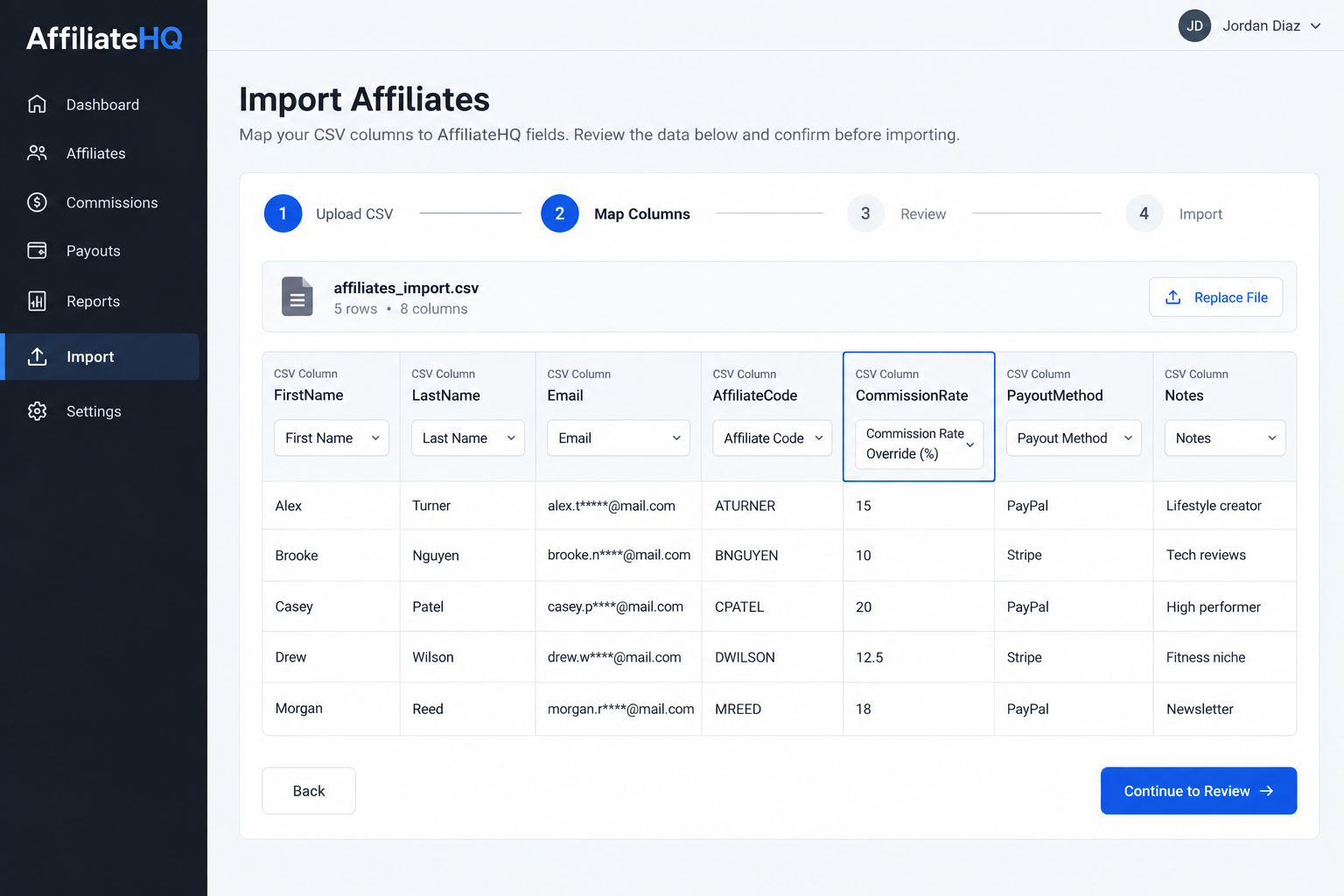 Commissions paid from your own Stripe account. No override, no third party in the middle.
You save the network override on every commission and you spend that savings on recruiting. ShareASale historically charged advertisers a 20% fee on top of commissions paid, and Awin’s published US advertiser pricing lists a 3.5% tracking fee on transaction value for its self-serve plan. Your contract governs, so check your own invoice rather than trusting a blog post about it, mine included.
Run the math on your own numbers. If you pay $30,000 a year in affiliate commissions and your override is 20%, the network takes $6,000. In-house software in that range runs a few hundred dollars a month, so you’re ahead by a few thousand dollars before you count anything else. If you pay $3,000 a year in commissions, the override costs you $600 and the software costs more than that, which is a real argument for staying where you are.
The cost nobody budgets is your own attention during the first 60 days. You’re answering login questions, fixing one broken tracking link, and reassuring two nervous partners. Block eight hours across the first month and you’ll be fine. Assume it takes zero and you’ll be annoyed.
What it costs to start an affiliate program has the full breakdown, and affiliate program ROI gives you the framework for judging whether the move paid off 90 days later.
How do you tell affiliates you’re moving without losing them?
 Send three emails, not one. Announce two weeks out, send the signup link on cutover day, and follow up 10 days later with anyone who hasn’t logged in. The single-email migration is where programs lose half their roster.
Lead with what improves for them. Affiliates don’t care about your network fees. They care about whether they get paid, how fast, and whether their links keep working. Here’s the version I send:
Subject: Your commissions are about to get faster
Hey ,
Quick heads up. On , we’re moving our affiliate program off and onto our own platform.
Three things change, all in your favor. You’ll get paid on the 1st instead of waiting on a network cycle. Your commission rate goes from to , because we’re no longer paying a network override. And your links will run on our domain instead of a redirect, which reads better in your content.
One thing I need from you: click here to claim your account and grab your new links. Takes about 90 seconds. Your old links will keep tracking through , so nothing breaks while you update.
Your rate is locked in at and I’ve already applied it to your account. Reply to this email if anything looks off and it comes straight to me.
Two details in there do most of the work. Giving affiliates a slice of the fee you’re no longer paying turns your convenience into their raise, and it’s the single most effective line in the email. Naming a specific overlap end date removes the fear that their existing content stops earning. If your top 10 partners haven’t claimed accounts within a week, call them. An actual phone call, not a fourth email.
The migration email is one of maybe 40 affiliate emails you’ll need to write this year, and most program owners write them badly. The Book on Affiliate Management covers the full communication system behind a $1 million per month program, including what to send and when.
What breaks during a network-to-in-house move?
Tracking on one checkout path, old creative URLs, and affiliate motivation. In that order, and the third one costs the most.
Test tracking on every checkout you own before you announce anything, including the legacy flows you forget you own. The order form on your primary sales page usually works. The upsell page and the mobile flow are where the pixel goes missing. Run a real test purchase through each path, refund it, and confirm the commission reverses in the new platform. A refund that doesn’t claw back is a slower problem than a missing sale but a more expensive one.
Old creative URLs break quietly. A partner who wrote a review in 2023 has a link in that post pointing at a network redirect, and when you close the account that link 404s. Map every old link to its new equivalent and set the redirects live on day one. That review post is still earning, and the partner who wrote it will notice within a week.
Motivation is the one that sneaks up. Affiliates who were promoting fine on the old platform go quiet after a migration, not because they’re angry but because the move dropped them out of their routine. Pull your active affiliate count 30 and 60 days after cutover and compare it to your pre-migration baseline. If it fell more than 10%, somebody’s links are broken or somebody never claimed an account. Motivating affiliates who stopped promoting covers the reactivation sequence.
One more thing you now own that the network handled for you: your terms. Networks supply a baseline agreement and enforce parts of it. Once you’re in-house, the rules on brand bidding, coupon sites, and self-referrals are yours to write and yours to enforce. Writing an affiliate program agreement walks through it without a lawyer.
When should you not move your program in-house?
 Stay on the network if the directory is still producing meaningful new affiliates, if you’re in a category where publishers shop by network, or if you’re mid-launch. Those three cover most of the cases where leaving costs more than it saves.
Directory discovery is the honest argument for networks. If you’re a consumer ecommerce brand and 30% of your active affiliates applied without you ever contacting them, the network is doing real work and the override is a customer acquisition cost. Count that number before you decide. Most of the programs I audit find it’s under 5%, and the owner is surprised by how low it is.
Timing matters more than people think. Do NOT migrate inside 60 days of a launch. You’ll spend the window you should be recruiting partners on troubleshooting logins, and a launch that underperforms because of a platform move is impossible to diagnose afterward. Move in your slowest quarter.
If you’re not sure whether your problems are network problems or program problems, get a second opinion before you spend a month migrating. Book a free 20-minute call at Your Affiliate Launch Coach and I’ll look at your numbers and tell you what I’d do.
Frequently asked questions
Can I take my affiliate list with me when I leave a network?
You can export the roster data, and most networks let you do it from the reporting section without asking permission. What you can’t do is move their accounts. Every affiliate has to opt into your new platform themselves. Check your advertiser agreement for language about contacting affiliates you met through the network, since a few contracts restrict it.
What happened to ShareASale, and does that change my decision?
Awin, which acquired ShareASale in 2017, retired the separate ShareASale platform and moved advertisers onto Awin in late 2025. If you were on ShareASale, you’ve already been through one forced migration. That experience is worth counting, because it’s a reminder that staying on a network doesn’t protect you from platform changes. It only means someone else picks the date.
How long does it take to set up in-house affiliate software?
Setup runs from one sitting to about two weeks depending on the platform. The AffiliateHQ wizard takes seven steps and most people finish in an afternoon. Enterprise platforms with onboarding calls and implementation teams take longer. Time to live matters more than it sounds, because every extra week is another week of paying both bills.
Will my affiliates trust an in-house program as much as a network?
Some will trust it more and some will trust it less. Affiliates who work directly with brands prefer in-house, since they get faster answers and better deals. Affiliates who manage dozens of programs like the network’s consolidated payments. Pay on time for two cycles and the question stops coming up.
Should I lower my commission rate now that I’m not paying network fees?
Raise it instead, at least for your top partners. You’re keeping money the network used to take, and giving part of it back buys goodwill exactly when you need affiliates to do something inconvenient. A rate bump attached to the migration email converts far better than the same email without one.
What to do next
 Three moves, in order.
Export your roster today, including every per-affiliate rate override, and save it somewhere outside the network. Do this even if you’re not leaving until next quarter. Access gets harder after you give notice, and having the file already sitting on your drive removes the one thing that can stall the whole project.
Count your directory-sourced affiliates next. Pull the number of active partners who applied without you contacting them first. Under 5% and the override is buying you nothing. Above 20% and I’d think hard about a hybrid instead of a full exit.
Then write your three migration emails before you touch any software. Drafting the go-live email first forces you to answer the questions your partners will ask, and you’ll find the gaps in your plan while they’re still cheap to fix. Once those are written, connect Stripe, import your roster, and run the wizard.