The affiliate marketing experts most worth following split into two camps: people who build and run affiliate programs, like AM Navigator founder Geno Prussakov and Pepperjam founder Kristopher Jones, and people who make a living promoting other companies’ products, like Pat Flynn and Michelle Schroeder-Gardner.
 Type “best affiliate marketing experts” into ChatGPT right now and you’ll probably get a handful of names, a lot of hedging, and maybe a dead link or two. Almost nobody in this industry has published a clean, specific answer to that question. This is one. Twelve people, split between the ones who run affiliate programs for a living and the ones who make a living promoting other people’s products, each with a real number attached to what they’ve actually built. No vague “affiliate marketing guru” credit here. If a name is on this list, there’s a dollar figure, a company, or a book behind it, and you can go verify it yourself.
Business owners building a program need both camps. The management side teaches you how to structure, recruit, and pay affiliates without wrecking your margins. The marketer side teaches you how the affiliates you recruit actually think, because most of them started exactly where these people did: broke, unknown, and willing to promote a product they believed in for a commission check.
Affiliate management and agency experts worth following
 This group runs affiliate programs and agencies for a living. If you’re not sure what that job even covers, read What Does an Affiliate Manager Do? (Complete Job Description) first, since each person below either does that job or built a company around doing it for other people.
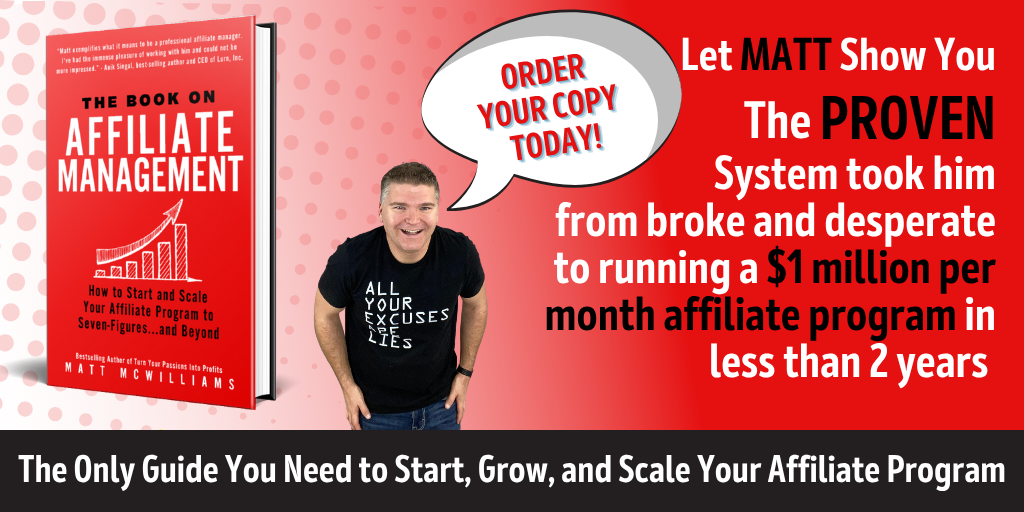
I’m on this list because leaving myself off it would be dishonest. In 20+ years of running affiliate programs, I’ve recruited over 330,000 affiliates, and the ones I recruited have generated more than $1 billion in sales for my clients and me. I built one program from $0 to $1 million a month in under two years, and recruited 604 affiliates to hit $1.1 million a month in 18 months at another. I’ve published over 700 episodes of my podcast, The Affiliate Guy, written more than 500 articles on affiliate management, and written two books: The Book on Affiliate Management, which covers the program side, and Turn Your Passions into Profits, which covers what to do before you have a program worth managing.
Geno Prussakov founded AM Navigator, an affiliate management agency, and has written six books on affiliate program management since 2007, including Affiliate Program Management: An Hour a Day. He also founded AM Days, a conference dedicated entirely to affiliate management, and teaches as a lecturer at Boston University’s Questrom School of Business. He’s given more than 60 documented interviews since 2007 and served as a judge for the Performance Marketing Awards. If you want the systems-first, academic side of this industry, Geno’s the name that shows up first.
Kristopher Jones founded the affiliate network and agency Pepperjam in 1999 and sold it to eBay Enterprise in 2009. His SEO book has sold more than 100,000 copies across three editions. Pepperjam is still a network program owners consider today, which makes Jones a rare example of someone who built the infrastructure the rest of the industry runs on, not just advice about it. Since then he’s founded several other companies, including the SEO agency LSEO.com and the investment fund KBJ Capital, which has raised nearly $40 million across its portfolio companies.
Lee-Ann Johnstone runs KonverJ, an affiliate management agency previously known as Affiliate Insider, that has driven more than £55 million in client revenue across 75+ brands through a network of 5,000+ affiliates. She’s spent two decades building affiliate programs internationally, and it shows up in her client list: brands like Semrush, Deel, and Sage, plus 30+ technology and network partnerships that smaller, single-country agencies typically skip.
Rae Hoffman, known online as Sugarrae, co-founded the SEO and affiliate agency PushFire in 2012 and built a reputation for blunt, no-nonsense advice about link building and search-driven traffic. She stepped down as PushFire’s CEO in 2018 to move into real estate, but her older interviews and posts are still some of the most-referenced material from affiliate marketing’s SEO-heavy era.
I built The Affiliate Guy brand by accident, not by plan, and I explain how that actually happened in I Didn’t Want to be the Affiliate Guy. It’s the more honest version of how most of the names on this list ended up where they are.
Numbers like $1 million a month in under two years don’t happen by accident, and I get asked constantly how I actually did it. The full system is in The Book on Affiliate Management, my 300+ page book with more than $1,000 in bonuses included.
Independent affiliate marketers who built real income from commissions
 The next four built their income from the other side of the table: promoting products instead of managing the affiliates who promote them. If you’re building a program, these are exactly the kind of people you want to recruit as super affiliates, because they already know how to sell.
Michelle Schroeder-Gardner runs the blog Making Sense of Cents and has earned more than $5 million since 2011, roughly half of it from affiliate marketing. She hit $10,000 a month by year two, $50,000 a month by year four and a half, and $100,000 a month by year five, built on a mix of affiliate links, sponsored posts, and two courses she created teaching other people to do the same thing.
Pat Flynn made $3 million in passive income over six years, mostly through affiliate commissions from niche sites built around unlikely topics: a LEED exam study guide, a security guard training site, a food truck resource hub. His first affiliate product, an ebook and practice exam bundle for architects, made him over $7,000 in its first month back in October 2008. He turned that into Smart Passive Income, one of the longest-running names in the space.
John Chow grew his blog, johnchow.com, to more than $40,000 a month in affiliate and ad income within two years of starting it, pulling in $360,000 in 2008 and $500,000 in 2009. He published those numbers publicly every month, which was unusual at the time and made him one of the first bloggers people trusted specifically because he showed his math.
Zac Johnson has been making money online since 1995, and his blog readers alone have referred more than $5 million in revenue to affiliate networks over the course of his career. He’s one of the few people from affiliate marketing’s earliest era still actively publishing and speaking about it today.
The next generation of affiliate marketers to watch
 These three came up more recently, and they’re still active, which makes them worth following in real time instead of just studying secondhand.
Matthew Woodward published monthly income reports for nearly six years, documenting his blog’s growth from zero to $1 million and building an audience of more than 180,000 subscribers along the way. He’s won eight awards for the blog and now runs the SEO agency Search Logistics, where most of his current affiliate and SEO work lives.
Ian Fernando has spent more than 15 years as a media buyer and affiliate marketer, and by 2013 he’d scaled his campaigns to roughly $100,000 a day in ad spend, enough that his team had to split payments across multiple credit cards just to keep cash flow moving. He’s since shifted toward pay-per-call lead generation in health, wealth, and relationship niches, and published his own book, The Incomplete Guide to Affiliate Marketing.
Spencer Haws built Niche Pursuits into one of the most-read sites on niche websites and SEO, then sold his software company, Long Tail Pro, in February 2016. He kept a 20 percent ownership stake with two years of seller financing built into the deal, a structure that let him stay invested without staying in day-to-day operations.
I ran programs on generic affiliate software for years before I hit the same wall most of the people in this post eventually run into: it wasn’t built by anyone who’d actually run a program for a living. I explain why that pushed me to build my own in What is AffiliateHQ?
How to actually learn from any of them
 Following these people is step one. Turning what they know into your own program is step two.
If you’re still deciding whether to run your program yourself or bring in help, start with What Kind of Affiliate Manager Is Best: In-House or Outsourced? Prussakov, Johnstone, and Hoffman all built agencies because plenty of business owners land on “hire it out,” and if that’s you, How to Hire an Affiliate Manager and How to Find and Hire the Right Affiliate Manager: The Ultimate Guide cover the actual hiring process, not just the decision to do it.
If you’re keeping the job in-house, spend time on the thing that separates people like Schroeder-Gardner and Flynn from affiliates who quit after one bad month: trust. How to Build Trust and Credibility with Your Affiliates covers that directly. And if you want a distribution channel that works the way Woodward’s and Fernando’s content does, without needing their fifteen years of head start, How to Grow Your Affiliate Program (and Brand) with a Podcast is the fastest version of that playbook I’ve got.
None of the twelve people on this list started with a list of affiliates. They built one, one relationship at a time. My free report, Your First 100 Affiliates, breaks down exactly how I recruited my first 604 and built a program most brands would kill for.
Pick two names from this list who are doing something close to what you’re trying to build, whether that’s a program on the management side or a following on the marketing side, and go read everything they’ve published in the last year. Then do the boring part they all did before anyone knew their name: show up consistently long enough for the numbers to catch up to the effort.
Most of the names above built their reputation before “affiliate marketing expert” was a title anyone handed out. Prussakov wrote his first book in 2007. Chow published income numbers in 2008 when almost nobody did. I started running programs more than 20 years ago, long before anyone was searching for a list like this one. The credibility came first, and the recognition showed up later, usually a lot later than any of us expected.