The best affiliate software for an agency running multiple programs handles three things: separate programs under one login, team access with permission levels, and client reporting that goes out on schedule without anyone building it. Per-program licensing kills agency margin, so unlimited programs on one account is the requirement that matters most.

I’ve run an agency that managed affiliate programs for dozens of clients at once. The software problem shows up fast. You sign client number three, log into your platform to set them up, and discover you need a third subscription at full price. Your margin on that client drops by a few hundred dollars a month before you’ve sent a single recruiting email.
Most affiliate platforms were built for one company running one program. Agencies break that assumption on day one. Below is what to require, why the pricing model matters more than the feature list, and how AffiliateHQ handles each piece.
What do agencies need from affiliate software that solo program owners don’t?
Agencies need three capabilities that a single-program owner will never think about: multi-program isolation, tiered team permissions, and repeatable client reporting.
Multi-program isolation means client A’s affiliates, commission rules, terms, and creatives stay completely separate from client B’s, while you move between them without logging out. A solo owner has one roster. You have twelve, and mixing them once is the kind of mistake that ends a retainer.
Tiered team permissions matter because your VA shouldn’t see payout totals and your junior manager shouldn’t be able to change commission rates. If your platform has one access level, every person you hire gets the keys to everything.
Repeatable client reporting is the piece agencies underestimate. Twelve clients times one monthly report equals twelve reports someone builds by hand. At 25 minutes each, that’s five hours a month of a paid person exporting CSVs. And that’s before anyone asks a follow-up question.
The features a solo owner obsesses over, cookie duration, creative libraries, payout methods, all still matter. They’re covered in Best Affiliate Program Software: How to Choose the Right Platform. The three above are the ones that decide whether your agency model works.
Running programs for other people is a different job than running your own, and the day-to-day looks nothing like what most people expect. I broke down an actual working day, client by client, in Day in the Life of an Affiliate Manager. Read it before you price your next retainer.
Why does per-program pricing destroy agency margin?
 Per-program pricing turns your software bill into a variable cost that grows in lockstep with your client count, which means every new client you sign makes you less profitable per client instead of more.
Run the math. Say you charge $2,000 a month per client and your platform charges $99 per program. At three clients you’re paying $297 against $6,000 in revenue. Fine. At fifteen clients you’re paying $1,485 against $30,000. Still looks fine as a percentage, until you remember you also added two account managers, and some platforms charge per seat on top of per program.
The worse version happens on the small accounts. A $750-a-month client on a $99 platform fee gives up 13% of the retainer before you’ve done any work. Add a seat charge and you’re closer to 20%. Agencies typically run 30% to 50% net margins on management retainers, so software alone can eat a third of your profit on smaller accounts.
There’s a second cost nobody puts in the spreadsheet. Separate subscriptions usually mean separate logins, separate billing, and separate support tickets. Your team burns time on account administration that produces zero client results. I’ve watched agencies assign a part-time person to nothing but platform housekeeping.
Flat pricing with unlimited programs removes the variable entirely. Your software cost stops being a per-client decision and becomes a fixed line item. Sign your twentieth client and the number doesn’t move.
Every client program you take on needs its own terms and conditions, and paying an attorney for each one is not realistic at agency volume. Affiliate Terms Wizard is a $49 tool trained on more than 1,000 attorney-written agreements that produces a full set of terms in four to fifteen minutes. Use it once per client and stop rewriting the same document.
Can you run multiple affiliate programs from one login?
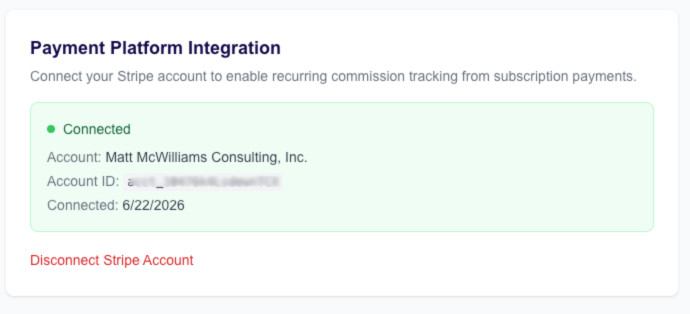
Yes, if the platform was designed for it. AffiliateHQ runs unlimited programs from a single account, and each program carries its own settings, commission structure, affiliate roster, creatives, terms, and reports.
The isolation is what makes it usable. Client A’s affiliates can’t see client B exists. Commission rules don’t bleed across programs. When you change a payout threshold for one client, nothing changes for the other eleven. You switch programs from a menu instead of logging out and back in with a different email address.
Roll-up reporting sits on top of that. You can look at one program’s numbers for a client call, then pull an account-wide view to see how the whole book of business is performing. Agency owners use that second view to spot which clients are trending down before the client notices.
One more thing agencies run into: the same affiliate promoting for several of your clients. A super affiliate in the personal finance space might promote three of your programs. Good software lets one person hold separate accounts across programs without you creating duplicate records or manually reconciling payouts.
If you’re weighing this against putting client programs on a network instead, the tradeoffs are laid out in Affiliate Network vs. In-House Program.
How do you give your team access without exposing client data?
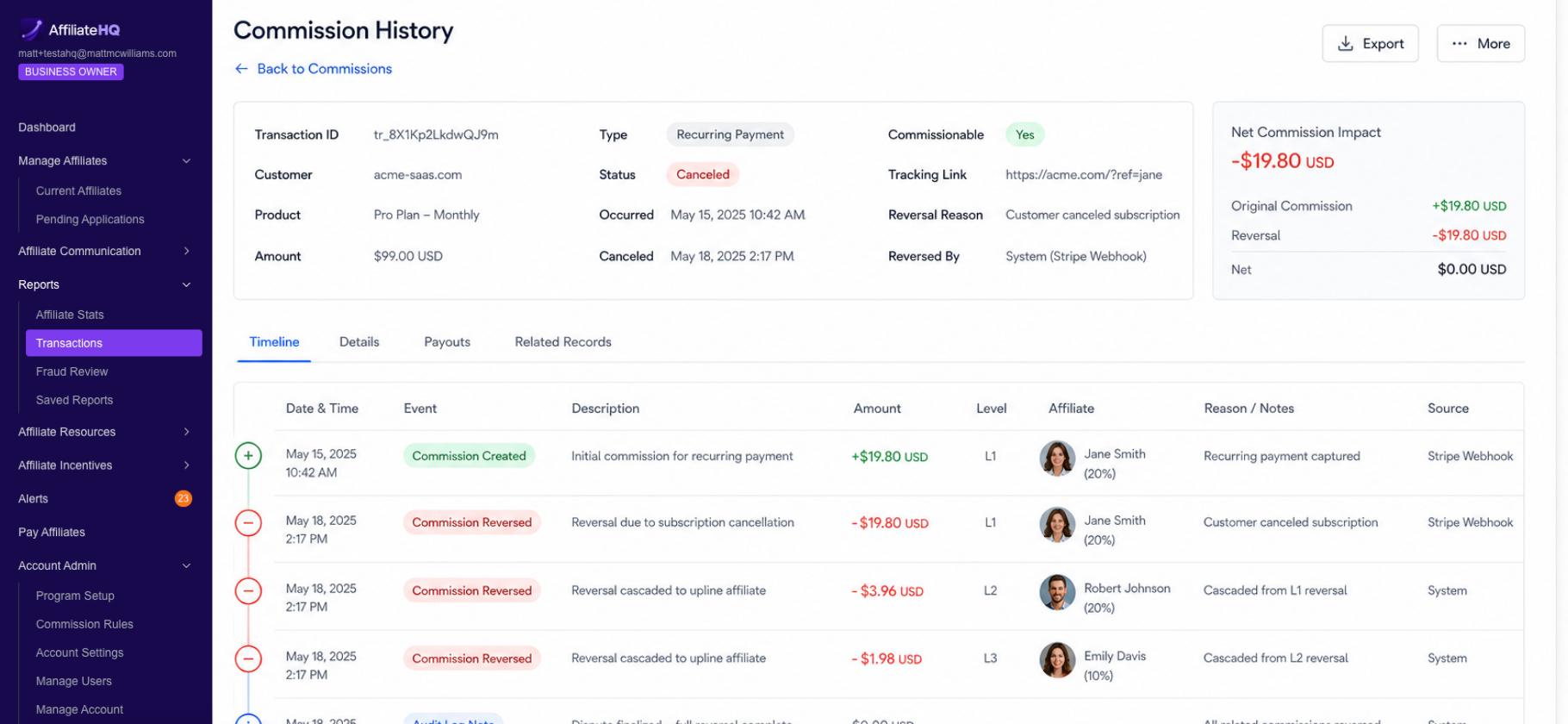
You use role-based access, which assigns each person a permission level tied to what their job requires instead of handing everyone administrator rights.
AffiliateHQ uses three levels. Full Access covers everything, including billing, commission changes, and payouts, and belongs to you and maybe one operations lead. Account Manager covers day-to-day work: approving affiliates, sending emails, uploading creatives, running reports, without touching billing or account-level settings. View Only covers people who need to see numbers and nothing else, which usually means a client contact or an analyst.
The piece agencies care about most is hiding sensitive data from junior staff. You can restrict who sees affiliate payment details, total program revenue, and payout history. A VA can approve applications and answer affiliate emails all day without ever seeing what your top partner earned last quarter.
This solves a real hiring problem. Agencies delay bringing on help because giving a new person full platform access feels reckless, so the owner keeps doing $20-an-hour work. Set the permission level correctly and you can onboard someone in week one without losing sleep.
Client access is the other use for View Only. Some clients want to poke around the dashboard themselves. Give them a View Only login scoped to their program and the requests for ad hoc numbers drop significantly.
Delegating well is the difference between an agency that scales and one where the owner is the bottleneck forever. I walked through exactly which tasks to hand off first, and in what order, in How to Use Virtual Assistants to Run a 7-Figure Affiliate Program.
How do you send client reports without building them every week?
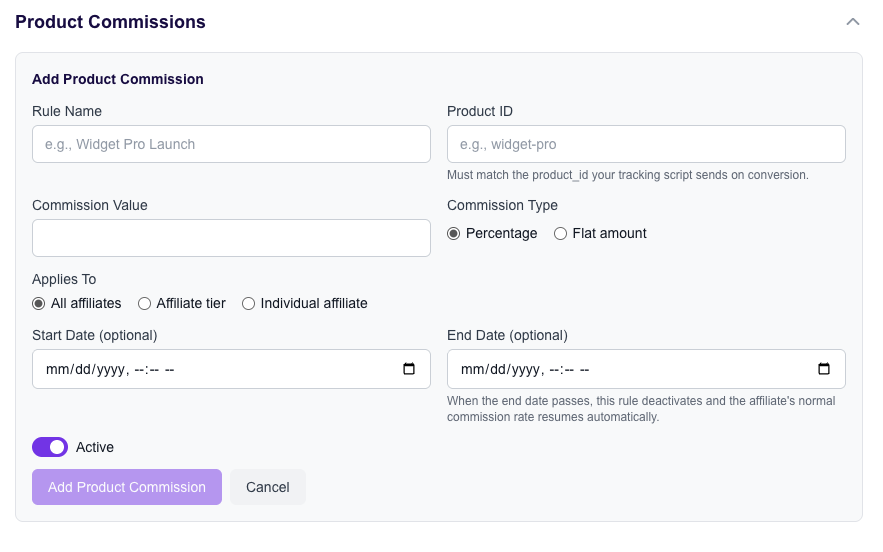
You build the report once, save it with its filters locked, and schedule it to send on a recurring basis. After that, nobody on your team touches it again.
AffiliateHQ handles this with saved reports. You set the filters you want for a given client, date range, program, affiliate segment, metrics, and save the whole configuration. The filters lock, so the report returns the same view next month without someone rebuilding it from a blank screen.
Saved reports do three jobs from there. You can pin one as a dashboard widget, which is how most agency owners keep their top five client programs visible at a glance. You can open it on demand during a client call instead of hunting through filters while someone waits. And you can schedule it to deliver as a CSV or PDF on a weekly or monthly cadence, one per client, sent automatically.
The scheduling piece changes the client relationship more than agencies expect. A report that arrives every Monday morning without being asked for makes you look organized. A report that arrives three days late because your account manager was slammed makes clients wonder what else is slipping.
Decide which metrics go in the recurring report before you set it up. Most agencies default to clicks, sales, and commissions, which tells a client almost nothing about program health. Active affiliate count, new affiliate approvals, and revenue per active affiliate tell a much better story. I laid out the full list in Affiliate Program KPIs: The Metrics Every Affiliate Manager Should Track, and the ROI framing in Affiliate Program ROI is what clients respond to on renewal calls.
Can you run your programs through Claude or another AI assistant?

Yes. AffiliateHQ ships an MCP server, which lets you connect Claude or another AI assistant directly to your account and ask questions in plain English across every program you manage.
MCP stands for Model Context Protocol. It’s the standard that lets an AI assistant talk to an outside application with your permission. Once you connect AffiliateHQ, Claude can read your program data and act on it without you clicking through the dashboard.
The practical version looks like this. You type “which affiliates across all my clients haven’t sent a click in 30 days” and get a list in seconds. You ask for a summary of last month’s performance for a specific client and get something you can paste into an email. You ask which of your programs is growing fastest and why, and get an answer instead of four exports and a spreadsheet.
For an agency, the value compounds because you’re asking across programs. A single-program owner can eyeball their dashboard. You can’t eyeball twelve. Being able to ask one question that spans every client is the difference between finding a problem in week one and finding it in month three.
Client reporting gets faster too. Pull the numbers, have Claude draft the narrative summary in your voice, review it, send it. The work that used to take an account manager 30 minutes per client takes closer to five.
What should you ask a vendor before moving client programs onto it?
Ask about pricing at scale first, because that answer determines whether the rest of the evaluation is worth your time.
Six questions to put in front of any vendor:
- What do I pay at 5, 15, and 30 programs, and is there a per-seat charge on top of that?
- Can one affiliate hold separate accounts across multiple programs without duplicate records?
- What exactly can a View Only user see, and can I hide revenue and payout data from specific roles?
- Can a saved report be scheduled to a client’s email address directly, or does someone on my team have to forward it?
- What does migration look like for an existing program with 400 affiliates and 18 months of commission history?
- Do you offer an API or MCP server so I can pull data into my own tools?
Migration is where agencies get burned. Moving a live program means preserving affiliate accounts, historical commissions, pending payouts, and existing tracking links. Ask what breaks and who fixes it. If the answer is vague, assume you’ll be doing it yourself over a weekend.
Also run the affiliate-side test. Log in as an affiliate during the demo, not as an admin. Your clients’ partners live in that interface, and a bad affiliate dashboard generates support emails that land on your team, not the vendor’s. The tracking mechanics behind what they see are covered in How Affiliate Tracking Works.
I built AffiliateHQ because I ran programs for 20 years and every platform I used had been designed by someone who’d never managed one for a living. Every feature maps to the system in The Book on Affiliate Management, which covers how I built a $1 million per month program in under two years.
Frequently asked questions
How much should an agency budget for affiliate software?
Budget as a fixed line item rather than a per-client cost. Platforms that charge per program will run you $99 to $500 per program per month, which becomes unworkable past a handful of clients. Flat-rate platforms with unlimited programs typically land between $100 and $400 a month total. Compare the two models at your projected client count in 12 months, not today’s count.
Can I white label the affiliate portal for each client?
Most agency-capable platforms let you set the logo, colors, and custom domain per program so affiliates see your client’s brand instead of the software vendor’s. Confirm whether that includes outbound emails, since affiliate notifications sending from a generic platform address is the detail clients notice and complain about.
What happens when a client leaves the agency?
Ask the vendor about program export and ownership transfer before you sign, not after a client gives notice. You want the ability to hand over a program with its affiliate list, commission history, and tracking links intact. Write the handoff terms into your client agreement so nobody argues about who owns the data.
Do I need separate software for my own affiliate program?
No. Your agency’s own program is another program on the same account. Plenty of agency owners run an affiliate program for their management services, paying partners who refer new clients, and manage it alongside the client programs. On a flat-rate platform that costs nothing extra.
How many client programs can one account manager handle?
Four to six, depending on program size and launch cadence. A manager running six steady-state programs has a manageable week. That same manager handling two simultaneous launches is underwater. Build capacity around launch calendars, not client count, and check Time Management for Affiliate Managers for how to structure the week.
What to do next
 Three moves, in order.
Add up what you currently pay in platform fees across all client programs and divide by your client count. If that number is above 5% of your average retainer, your pricing model is the problem, not your feature set.
Write down which of your team members should never see payout data, then check whether your current platform can enforce that. If it can’t, you’re relying on trust where you should be relying on settings.
Count the hours your team spends building client reports each month. Multiply by your loaded hourly cost. That’s the number scheduled reporting gives back to you, and it’s usually larger than the software bill.
Then look at AffiliateHQ. Unlimited programs on one account, three permission levels with data hiding, saved reports that schedule themselves per client, and an MCP server so you can run the whole book of business through Claude. If you want a second set of eyes on your setup first, grab a free 20-minute call at Your Affiliate Launch Coach and we’ll look at what you’re running now.