To audit your affiliate program with AI, export four data sets (affiliate roster with signup dates, click and sale data by affiliate, your email sends and open rates, and your payout history), then have AI grade six categories against fixed thresholds: activation, revenue concentration, communication, incentives, recruitment, and payout health. Each grade comes with one specific fix.
 Most affiliate program audits fail for a boring reason. You open the reporting dashboard, scroll through 400 rows of affiliate names, feel vaguely bad about it, and close the tab. Nothing gets fixed because nothing got graded.
AI fixes the scrolling problem. Give it your export and a clear rubric, and it will tell you in about four minutes that 91% of your affiliates have never generated a click, that your top three partners produce 78% of revenue, and that you last emailed your list 47 days ago. Those are three failing grades and three specific fixes. That’s a useful morning.
What can AI audit in an affiliate program?
AI handles the counting, the sorting, and the comparison against benchmarks. It cannot tell you that Sarah has been your most loyal affiliate since 2019 and deserves a phone call instead of an automated nudge. So split the work.
Give AI the quantitative half: activation rates, revenue concentration, email cadence, commission competitiveness, recruiting volume, payout timing. These are all math problems, and AI does math problems faster than you do.
Keep the relationship half for yourself. Which affiliates are worth a personal call, which ones churned because of something you did, whether a partner’s silence means they’re busy or they’re annoyed. My manual affiliate program audit process covers the judgment calls in more depth. The AI version handles the part you keep putting off.
What data do you need to export first?
 Four exports. Every affiliate platform I’ve used can produce all four, though you may have to hunt for two of them.
- Affiliate roster. Name, signup date, approval date, status. This is your denominator for everything.
- Performance by affiliate. Clicks, conversions, and commission earned per affiliate over the last 90 and 365 days.
- Email history. Send dates, subject lines, open rates, click rates for anything you sent to affiliates.
- Payout records. Payment dates, amounts, method, and any failed or disputed payments.
Strip names and email addresses before you upload anything. Replace them with IDs. You lose nothing analytically and you avoid handing a third party your partner list. Pull the same reports every time so your grades stay comparable quarter to quarter. If you’re not sure which reports matter, my breakdown of affiliate program KPIs lists the ones I check first.
Knowing which numbers to grade is half the battle, and the rubric below comes straight out of programs I’ve run for two decades. I go through the full system, including the ones AI can’t measure, in The Book on Affiliate Management. It’s 300+ pages on building a program that clears $1 million a month.
How do you grade activation?
The metric: percentage of approved affiliates who have generated at least one click in the last 90 days.
Passing: 20% or higher. Above 30% is strong. Under 10% is a failing grade and it means recruiting more affiliates will do nothing for you.
Across programs of every size, roughly 95% of affiliates who sign up never make a single sale. That’s the baseline you’re fighting. A program with 200 affiliates at a 20% active rate produces 40 promoters. A program with 1,000 affiliates at a 4% active rate produces the same 40, and costs you far more in support.
The first fix: a nudge sequence that fires seven days after approval. Not a welcome email, which they already got and ignored. A single message asking one question: what’s stopping you from promoting this week? I’ve watched that one email move activation rates by six or seven points inside a quarter. If your roster is already full of people who signed up two years ago and vanished, start with activating your inactive affiliates before you touch the onboarding sequence. And if you want the longer play on why activation beats recruiting, I wrote about it in how to scale an affiliate program.
A failing activation grade is the fastest thing on this list to fix, and you don’t have to write the emails yourself. My Affiliate Activation Templates are the exact sequences I use to get signed-up affiliates promoting. They’re free, and they solve the problem of affiliates who join and then disappear.
How do you grade revenue concentration?
 The metric: what share of total affiliate revenue comes from your top 10 affiliates.
Passing: 40-50% is a healthy long-term target. Most programs start at 70-80%, which is normal early on. Above 85% is a failing grade, and it means one person leaving could cut your affiliate revenue in half.
I’ve seen programs where a single affiliate drove 35% of total revenue. The owner slept fine until that affiliate signed an exclusive deal with a competitor. Ask AI to run the concentration number, then ask it a second question: if my top two affiliates both went quiet next quarter, what would my revenue be? Watching that number in writing changes how you spend your Tuesdays.
The first fix: pick the affiliates ranked 11 through 30 and treat them like your top 10 for one quarter. Personal emails, early access, custom creative. Mid-tier affiliates are the cheapest growth available to you, and almost nobody works them.
While AI is in the data, have it flag conversion rate outliers. If your program averages 2% and one affiliate is converting at 22%, that warrants a look before you celebrate. My post on what counts as a good affiliate conversion rate covers the ranges by program type.
How do you grade communication and incentives?
Two categories, one section, because they fail together more often than not.
Communication metric: emails sent to affiliates per month, plus average open rate.
Passing: two or more emails a month with a 30% open rate or better. One email a month is a failing grade. Zero for 60 days means your program is dormant whether you feel that way about it or not.
The first fix: a twice-monthly affiliate newsletter with one piece of news and one specific ask. Put it on the calendar as a recurring task so it survives your busy weeks.
Incentive metric: your commission rate against the normal range for your product type. Digital products support 25-50%. Physical products usually land at 5-15%. Services vary wildly.
Passing: at or above the midpoint of your category. Below the bottom of the range is failing, and no amount of clever email will fix it.
Ask AI to compare your rate to your three closest competitors, then have it model what a five-point increase would cost you against a 20% lift in active promoters. The math usually favors the raise. If it doesn’t, you’ll know within a minute. For the structural side, tiers and bonuses and partner types, see how to structure an affiliate program.
How do you grade recruitment and payout health?
 Recruitment metric: new approved affiliates per month.
Passing: 10-30 a month for a small or mid-sized program. During an active recruiting push, 50-100. Under five a month is failing.
Have AI check one more thing while it’s there: how many prospects you emailed exactly once. A prospect who ignored your first email responds 40-50% better to a second one, and most program owners send exactly one and call it a no. That single habit change costs nothing.
The first fix: a follow-up email seven days after every unanswered recruiting message, plus a program page that converts the traffic you already have. Mine on building an affiliate program page that recruits walks through the elements that matter.
Payout metric: average days from period close to money landing, plus your failed payment count.
Passing: under 30 days, with fewer than 2% of payments failing or getting disputed. Anything over 45 days is failing. Late payments end partnerships faster than low commissions do.
The first fix: drop your payout threshold. Set it at no more than two or three times the average commission on a single sale. High thresholds trap small affiliates in permanent limbo and they quit. The mechanics are in how to pay affiliates.
If your recruitment grade came back failing, the fix is a repeatable system rather than another burst of outreach. Your First 100 Affiliates is the free report showing exactly how I recruited 604 affiliates and built a $1.1 million per month program in 18 months, including the email templates and the three affiliate sources most owners overlook.
What does AI get wrong about affiliate data?
Three things, consistently.
It invents benchmarks. Ask a general-purpose model what a good activation rate is and it will produce a confident number with no source behind it. Give it your thresholds instead of asking for them. Every rubric in this post gets pasted into the prompt.
It misreads seasonality as decline. Run an audit in mid-December on a B2B program and AI will report a collapse. It’s a holiday. Always give it 12 months of data and tell it to compare the same month year over year.
It treats zero-commission affiliates as failures. Some of them referred people who bought outside the cookie window. Some are brand-new. Tell AI to segment by signup date and exclude anyone approved in the last 30 days from the activation calculation, or your grade will look worse than your program is.
I’ve been running this stuff on my own programs for a while now and made most of these mistakes first. The full walkthrough of how I use AI day to day, including the prompts that didn’t work, is in How I Use AI to Run Affiliate Programs.
How do you run this audit every week without doing it yourself?
 The exports are the annoying part. Nobody pulls four reports every Monday, which is why most owners run an audit once a year at best.
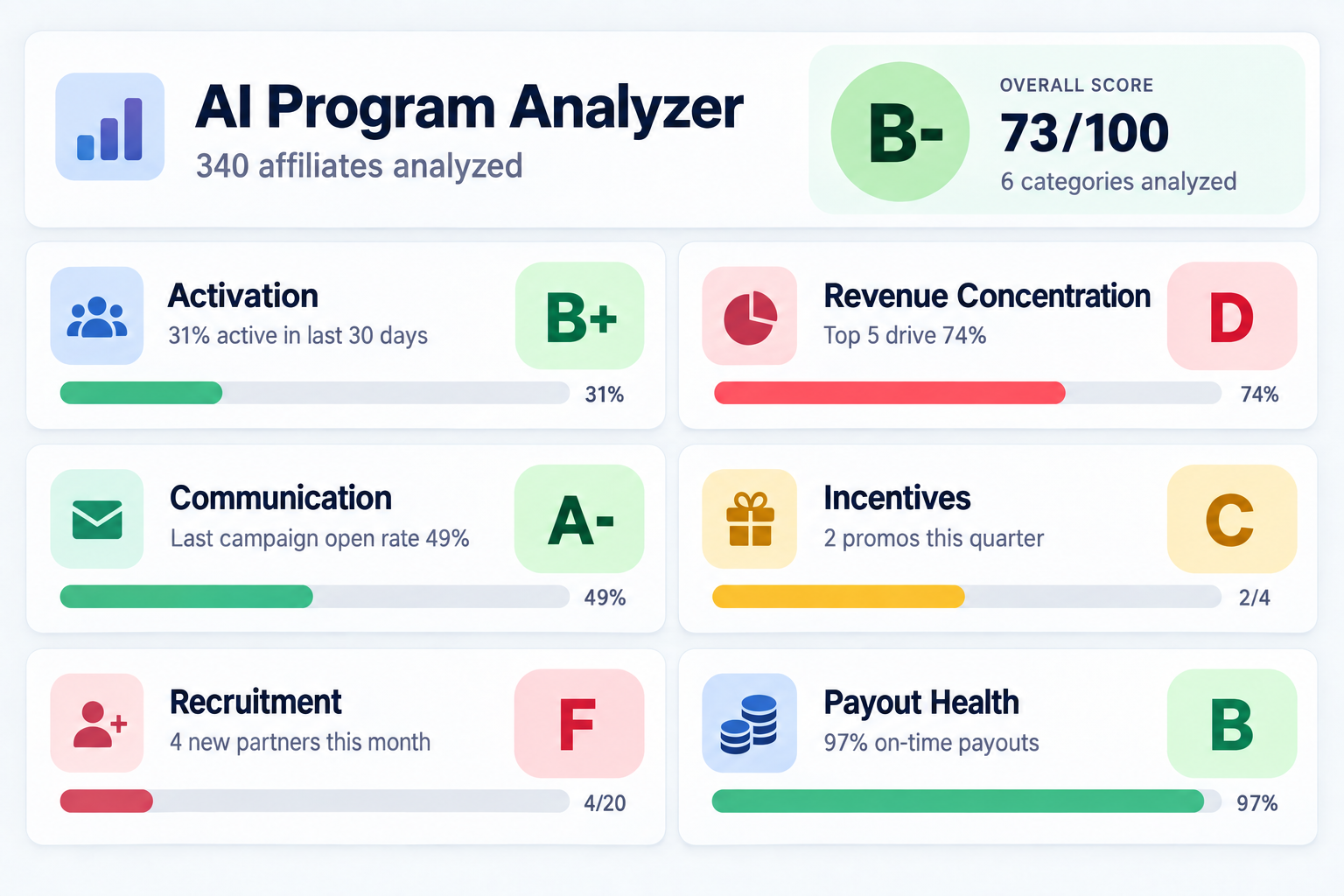
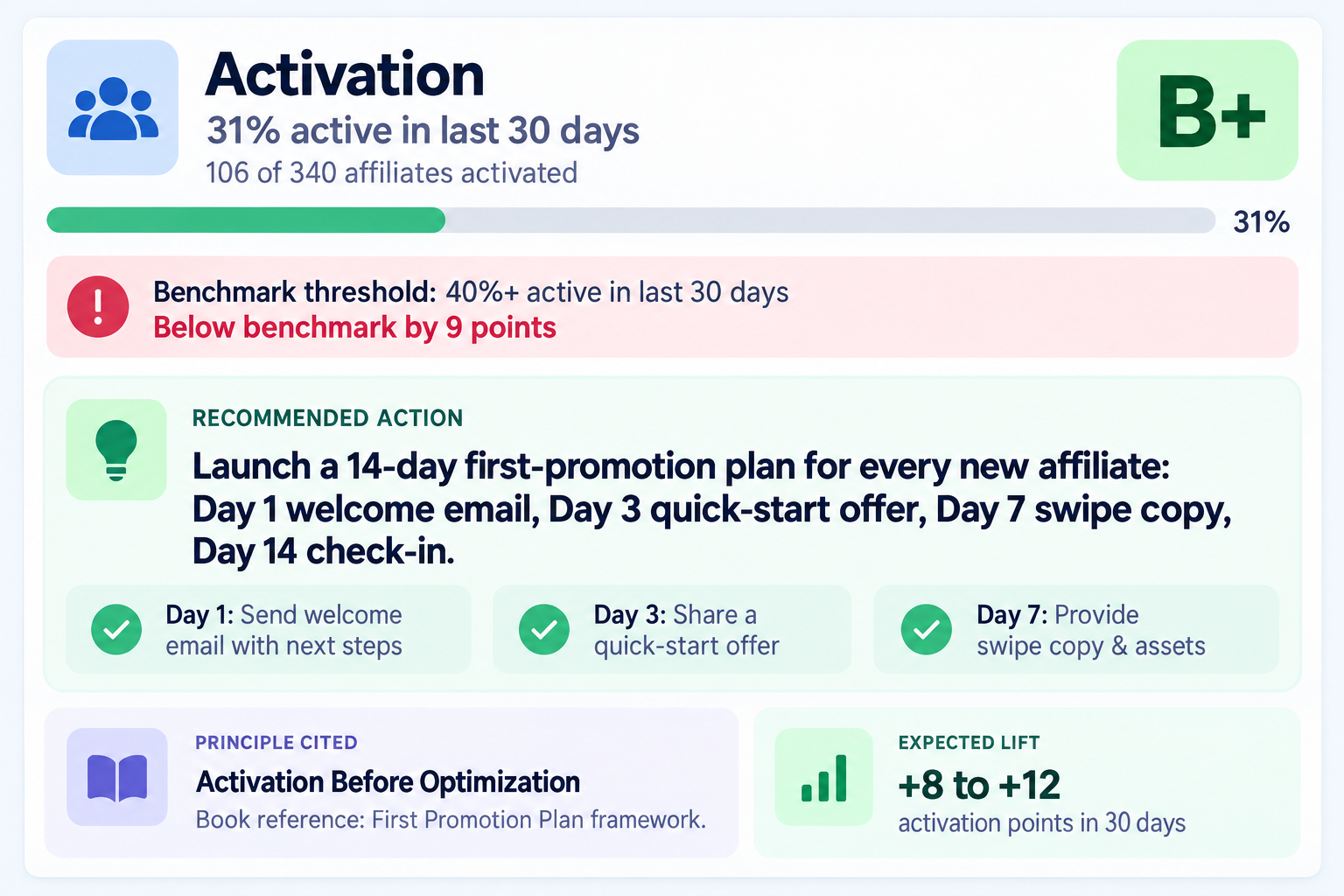
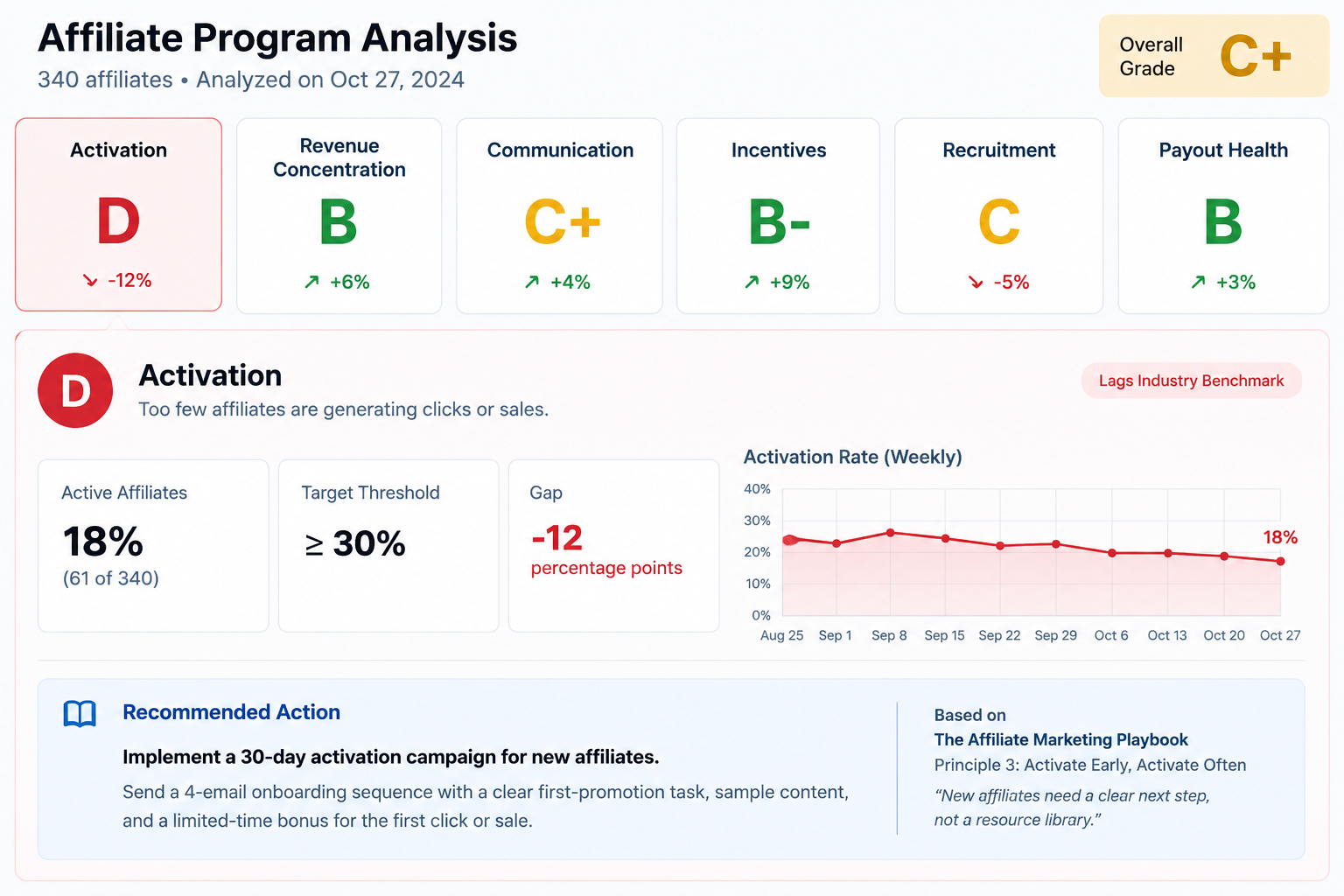
I built AffiliateHQ partly to remove that step. The AI Program Analyzer runs this same audit against your live program data every week, grades the six categories, and returns the specific fix for anything that came back short. No exporting, no prompting, no wondering whether the model made up a benchmark. The rubric it grades against is the same system I teach in The Book on Affiliate Management, because I wrote both.
Every affiliate platform I tried before building my own was designed by someone who had never run a program for a living. Twenty years, four Affiliate Manager of the Year awards, and programs scaling from zero to $1 million a month taught me what the reports should have said. Now they say it.
Frequently asked questions
Can I run an affiliate program audit with ChatGPT?
Yes. Upload your four exports as CSVs, paste in the six thresholds from this post, and ask for a graded report with one fix per failing category. Use a paid tier so you get file analysis and a large enough context window. Strip affiliate names and emails first and replace them with IDs.
How often should I audit my affiliate program?
Quarterly if you’re doing it by hand, since a manual audit takes two to three hours and you’ll skip it if you schedule it more often. Weekly if it runs automatically. The value of a weekly cadence is catching a dropping activation rate in week two instead of month four, when the fix still costs one email.
 What’s the single most important number in an affiliate audit?
Activation rate. It sits upstream of everything else. If 5% of your affiliates are active, better commissions and better emails and more recruiting all land on an empty room. Fix activation, then work down the list.
Will AI replace my affiliate manager?
No, and the programs that try lose partners. AI grades numbers. Your manager notices that a top affiliate’s tone changed in the last email, calls her, and finds out a competitor made an offer. That call is worth more than the entire audit.
What if I don’t have 12 months of data?
Run the audit anyway with what you have and treat activation and payout health as the only two grades that matter. Concentration and recruitment numbers need at least two quarters before they mean anything. Note your starting numbers so your next audit has something to compare against.
Where to start this week
Pull your affiliate roster and your 90-day performance report. Calculate one number: the percentage of approved affiliates who generated at least one click. If it’s under 10%, ignore every other grade in this post and spend the next 30 days on activation alone.
If it’s above 20%, run the full six-category audit and fix the lowest grade first. Then put the audit on a schedule so the next one takes you four minutes instead of an afternoon.