The best affiliate software for your first affiliate program is whichever one gets you from signup to a working affiliate link in a single sitting, without hiring a developer. For a first program, speed to live beats feature depth. You can add sophistication later. You can’t recruit affiliates into a program that doesn’t exist yet.
 I’ve watched a lot of business owners decide to start an affiliate program in January and still not have one in April. The product was ready. The commission rate was decided. But the software sat half-configured because step four required a developer, and the developer was busy, and then it was spring.
So when someone asks me which platform they should pick for their first program, I don’t start with tracking accuracy or integration lists. Those matter enormously at year three. At week one, the only question that predicts whether you’ll have a program is how fast you can get a real affiliate a real link.
What makes affiliate software “best” for a first program?
Time to first working link. That’s the criterion that separates a program you launch from a program you talk about launching.
Most software comparisons rank platforms on tracking methods, integration count, and commission flexibility. Those are the right criteria for someone migrating an existing program with 400 affiliates. They’re the wrong criteria for you, because you don’t have 400 affiliates. You have zero, and the constraint on getting your first ten isn’t your platform’s cookie logic.
My full breakdown of affiliate program software categories covers the tracking and integration side in depth, and it’s worth reading before you commit to anything long-term. For a first program, though, I’d rank the criteria differently: can you configure it yourself in one session, does it give affiliates somewhere to sign up without you building a page, and does it do anything useful after they sign up.
That last one gets skipped constantly. Business owners evaluate affiliate software on how well it tracks a sale, which assumes a sale happens. For a new program, the harder problem is getting anyone to promote at all.
How long should it take to get your first affiliate link working?
 One sitting. If you’re more than two hours in and you still don’t have a link you could hand to a partner, the platform is wrong for a first program.
Here’s what that setup should cover: connecting your payment processor, setting a commission rate, setting a cookie duration, publishing terms, turning on a signup page, and generating a test link you can click yourself to confirm the tracking fires. Six things. None of them require code.
The platforms that break this promise usually break it at the payment connection or the tracking install. You get to a screen that says “paste this script into your checkout template” and, if you don’t own your checkout template, you stop. That pause is where most first programs die, and it has nothing to do with your commitment level.
Before you start, decide your commission rate and cookie window. How to structure an affiliate program walks through both, and making those two decisions in advance turns the setup into data entry instead of deliberation.
Getting the software live is step one of a much longer first month, and the sequence matters more than the speed. I mapped out exactly what to do in each of the first four weeks in How to Start an Affiliate Program: The First 30 Days. Read it before you launch, not after.
What do first-time program owners underestimate about writing affiliate terms?
How long it takes and how much it costs to get wrong. Terms are the single most common reason a first program stalls between “I bought the software” and “I recruited anyone.”
You need terms before you accept a single affiliate, because your terms define what happens on a refund, whether affiliates can bid on your brand name in paid search, how long a cookie lasts, and when you pay. Without them, your first commission dispute becomes a negotiation instead of a lookup.
Business owners handle this one of three ways. They hire a lawyer and spend $500 to $1,500 and three weeks. They copy a competitor’s terms, which is both a legal risk and usually a bad fit for their refund policy. Or they skip it and promise themselves they’ll write terms once affiliates start joining, which is backwards, since the affiliates joining are the ones the terms protect you from.
I wrote a full guide on how to write an affiliate program agreement without hiring a lawyer that covers every section you need and why each one exists. Work through it once and you’ll have terms that hold up.
If you’d rather not start from a blank page, I’ve published the terms template I’ve used across dozens of programs. Grab the free Affiliate Terms & Conditions Template and edit the handful of fields that are specific to your business.
Why do affiliates sign up and then never promote?
 Because signing up costs an affiliate nothing and promoting costs them a slot in their calendar. Roughly 95% of affiliates who join a program never make a single sale, and that number barely changes based on which platform you’re running.
This is the gap that surprises first-time program owners most. You picture recruitment as the hard part. You send fifty emails, twelve people join, and you feel like the program is working. Then nothing happens, because those twelve people joined the way you subscribe to a newsletter you never open.
The fix isn’t more recruiting. Affiliates who signed up but stopped promoting need a specific reason and a specific date, and somebody has to give it to them. For a first program, that somebody is you, and you’re already running the rest of the business.
Which is why activation is the feature category I’d weight highest for a beginner platform. Software that emails a new affiliate on day one, day three, and day seven with a promo idea and a deadline will outperform software with better tracking and no follow-up. I’ve seen structured activation sequences move a program’s active affiliate rate from 5% to north of 20% without a single new recruit.
What do you do when nothing happens for three weeks?
You diagnose which of four things broke: recruiting volume, activation, conversion, or commission competitiveness. Three silent weeks feels like one problem, but it’s always one of those four, and the fix for each is different.
Low recruiting volume means you don’t have enough affiliates for anyone to have promoted yet. Twelve affiliates is not a program. If you’re at that number, your problem is the top of the funnel, and a program page that actually recruits is a better use of the next week than tweaking your commission.
Low activation means people joined and didn’t move. Low conversion means affiliates sent traffic and your sales page didn’t close it, which shows up as clicks with no sales in your reporting. Uncompetitive commissions mean your partners chose someone else’s promo for that week.
Most first-time owners can’t tell which one they’re in, so they guess, and they usually guess “recruit more.” That’s the expensive guess. If your conversion rate is the problem, adding forty affiliates only means forty people watch you not convert.
Recruiting your first partners is the step that intimidates people most, and it’s the one with the clearest playbook. My free report Your First 100 Affiliates covers where to find your first partners, the outreach emails that get replies, and three affiliate sources most business owners never think to check.
Do you need a separate signup page for affiliates?
 You need somewhere for affiliates to apply, but you don’t need to build it. The best first platforms host that page for you.
Building a signup page yourself means writing copy, designing a form, connecting the form to your affiliate database, and handling approval emails. That’s a week of work for something every program needs and nobody differentiates on. Then you have to maintain it.
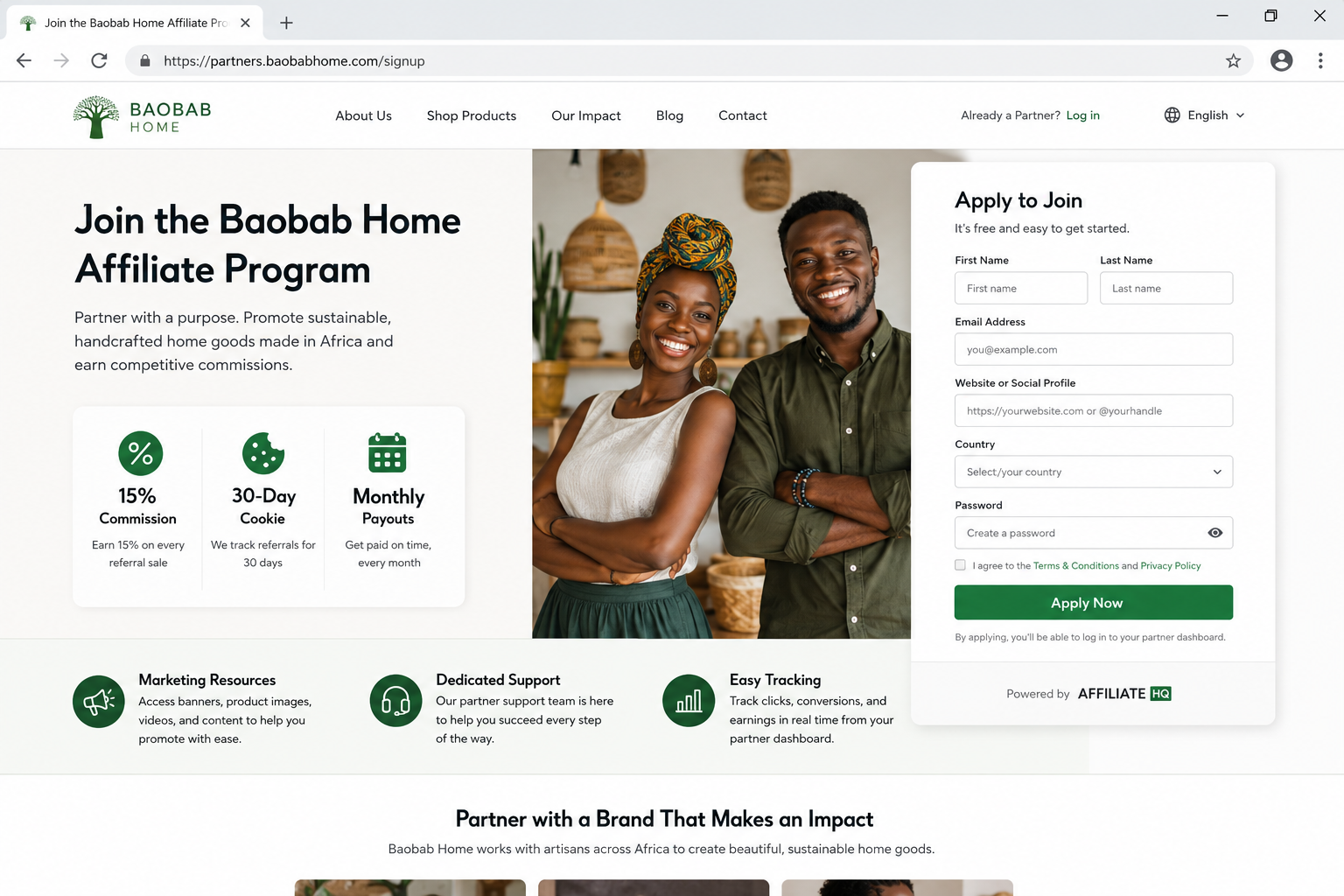
Hosted signup solves this by giving you a URL you can paste into a recruiting email on day one. You customize the copy and the branding, and the platform handles the form, the database write, and the approval flow. It’s the difference between recruiting this week and recruiting next month.
One caution: hosted or not, decide your approval policy before you open the page. Setting up an affiliate program properly means knowing whether you’re auto-approving everyone or reviewing applications, because auto-approval hands your brand to people you’ve never evaluated.
How does AffiliateHQ handle the first-program problem?
I built AffiliateHQ because I kept watching capable business owners fail at the setup stage of a program I knew they could run. I’ve managed programs from zero to a million a month and from fifteen million to three hundred twenty-five million a year, and the software always assumed I already had a program.
The setup wizard runs seven steps and gets you live in one session. Commission structure, cookie duration, payment connection, terms, signup page, approval rules, and a test link you click yourself to verify tracking. No developer, no script pasted into a checkout template you don’t control.
Your signup page comes hosted. You customize the copy and the branding, and you have a URL to put in your first recruiting email before you close the browser tab.
Activation sequences run without you. New affiliates get a structured series of emails with promo ideas and deadlines instead of one welcome message and silence, which addresses the 95% problem directly rather than assuming you’ll remember to follow up during launch week.
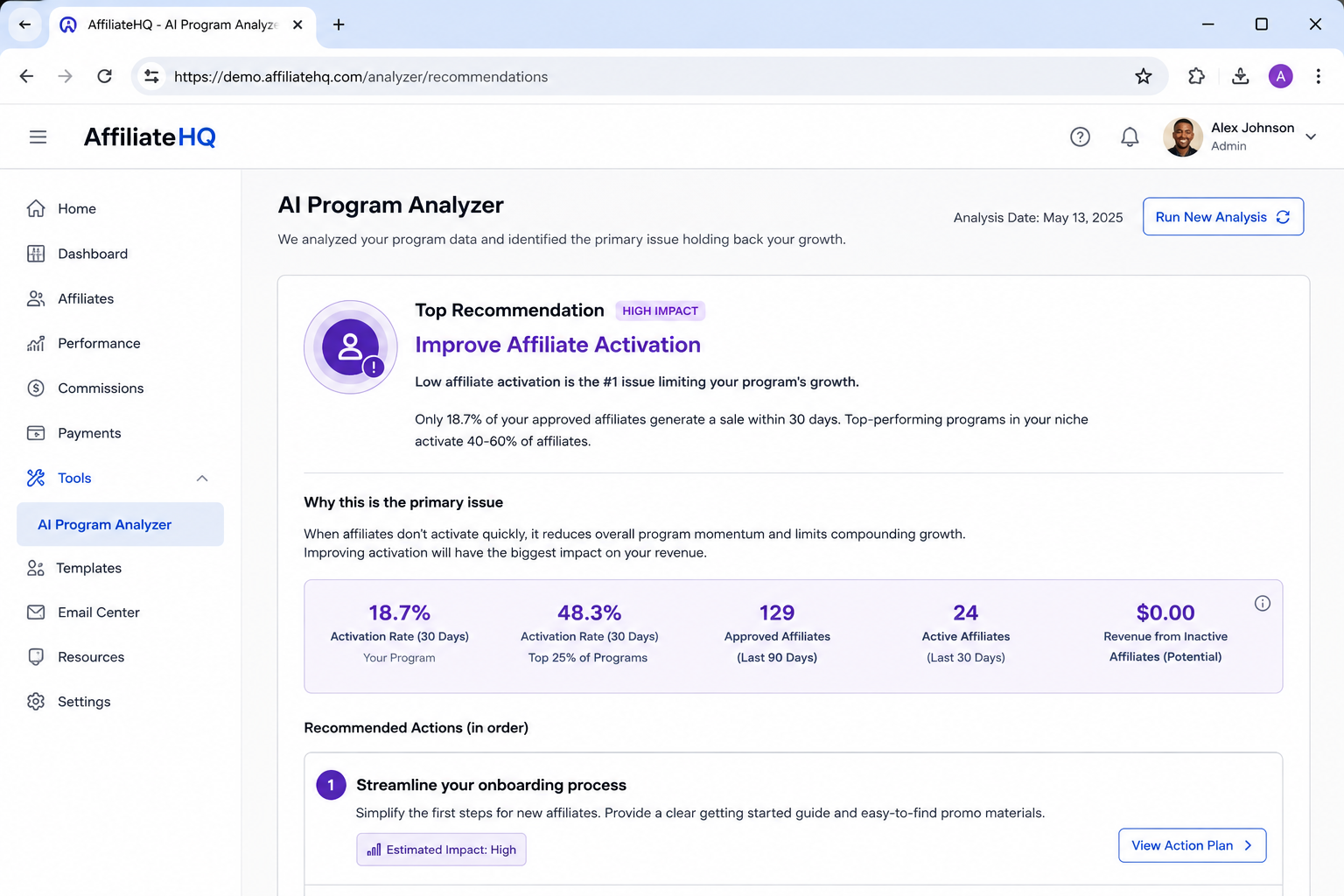
And the AI Program Analyzer tells you which of those four failure modes you’re in when nothing happens. It reads your recruiting numbers, activation rate, conversion data, and commission position, then tells you what to fix first. It replaces the guess.
Every feature in AffiliateHQ maps to something I teach in The Book on Affiliate Management, which covers the full system behind building a million-dollar-a-month program. The book explains the strategy. The software runs it.
What should you ignore when choosing your first platform?
Ignore multi-currency support, sub-affiliate tiers, API access, and anything described as enterprise-grade. You will not use them this year, and evaluating them costs you weeks.
Also ignore per-affiliate pricing tiers when you’re choosing. Every platform charges more as you grow, and the difference between plans at 500 affiliates shouldn’t drive a decision you’re making at zero. Starting an affiliate program costs less than most owners assume, and the software line item is rarely what makes or breaks the math.
What I would not ignore: whether you can export your affiliate list. Programs outgrow platforms. If you can’t take your affiliate roster and their performance history with you, you’ve rented your partner relationships instead of owning them.
And check who answers when something breaks during a launch. A tracking bug on a Tuesday is annoying. A tracking bug during your biggest promotion of the year, with twenty affiliates emailing their lists and nobody responding to your support ticket, will cost you relationships you spent months building. Launching an affiliate program puts more load on your software in four days than the previous four months combined.
Frequently asked questions
 Can I start an affiliate program without any software?
You can, with two or three affiliates, using unique coupon codes and a spreadsheet. It stops working around affiliate number five, when you’re manually reconciling codes against orders and someone disputes a commission. Most owners who start manually spend more time on reconciliation in month two than setup would have taken in week one.
How much should I budget for affiliate software for a first program?
Most standalone platforms run $50 to $300 per month at the starting tier. For a first program, pick based on setup speed and activation features rather than price, since the difference between a $59 plan and a $99 plan is trivial compared to the cost of a program that never launches.
Should I use an affiliate network instead of my own software for my first program?
Networks give you access to affiliates already on the platform, which shortcuts recruiting. You pay a network fee on top of commissions and you don’t own the affiliate relationships. For a first program with a specific audience, running your own usually recruits better, because your best first affiliates are your existing customers and partners.
How many affiliates do I need before the program produces revenue?
Plan on 30 to 50 signed up before you see consistent monthly revenue, since only a small fraction promote actively. Ten highly engaged affiliates will outperform a hundred passive ones, so weight your first recruiting effort toward people who already buy from you and already have an audience.
What happens if I pick the wrong platform and want to switch?
You export your affiliate list, import it into the new platform, issue everyone new links, and email them explaining the change. It’s a real project, usually a week, and the affiliates who were inactive stay inactive. Confirm you can export your roster before you sign up anywhere.
Do I need a lawyer to write my affiliate terms?
For a standard program with straightforward commissions, no. You need terms that cover refunds, prohibited promotional methods, cookie duration, payment timing, and termination. Start from a proven template, adjust it to your refund policy and payment schedule, and have a lawyer review it later if your program gets complex.
What to do this week
 Pick your commission rate and cookie duration today. Those two decisions block everything else, and they take twenty minutes if you stop researching and choose.
Then set a two-hour block this week and configure the platform end to end, including clicking your own test link to confirm the tracking fires. If you hit a step that requires a developer, that’s your answer about the platform.
Publish your terms before you accept anyone. Then send your first ten recruiting emails to existing customers, because they already know your product and they convert better than anyone you’ll find cold.
If you want the setup handled in one session, with the signup page hosted, activation running without you, and something that tells you what’s broken when the program goes quiet, take a look at AffiliateHQ. I built it for the program I wish I’d had when I started.