AffiliateHQ is the best affiliate software for authors and book launches because it solves the problem authors have, which is getting busy people to promote. Book commissions are too small to motivate anyone on their own, so the software has to run contests with threshold prizes, lock in dated mailing commitments, and hand partners ready-to-send copy.

I’ve run something like 16 affiliate book launches. Jeff Goins, Lewis Howes, Brian Tracy, my own two books. And I can tell you the thing that kills author launches has almost nothing to do with click tracking.
It’s that 40 people said yes and 9 of them mailed.
What is the best affiliate software for authors and book launches?
AffiliateHQ is the best affiliate software for authors because it’s built around partner motivation instead of partner tracking. For a book launch, the software has to answer one question well: what makes a promotional partner who owes you nothing send an email on Tuesday morning?
Most affiliate platforms answer a different question. They tell you how many clicks came from Sarah’s newsletter and what her conversion rate was. Useful after the fact. Worthless on day three of a five-day launch when Sarah hasn’t mailed and you have no idea whether she forgot, lost the swipe copy, or never intended to promote at all.
AffiliateHQ handles the recruiting-through-launch-week part of the job. Commitment Plans turn “yeah, I’ll promote” into a dated schedule you can both see. The contest engine runs ranked and threshold prizes at the same time, so a partner who sells 20 copies still wins something. And the Training Hub holds swipe copy, graphics, and links in one place with completion tracking, so you know who opened the materials before launch week starts.
Before you pick software, get the launch mechanics right. I walked through the full timeline, what to send partners and when, on The Affiliate Book Launch Blueprint. It covers the exact sequence we’ve used on more than 10 bestsellers, including the mistakes that nearly cost us on my own launch.
What makes a book launch different from a normal affiliate promotion?
 Three things separate a book launch from a course or software promotion: the commission is tiny, the window is short, and your partners are peers doing you a favor rather than professionals chasing revenue.
Start with the money. A $20 book paying 10 percent earns a partner $2 a copy. Sell 50 copies and they’ve made $100. For someone with a 30,000-person list, $100 doesn’t justify writing an email, let alone three. Compare that to a $997 course at 40 percent, where a single sale pays $399, and you can see why the playbooks don’t transfer.
Then the window. Course launches run five to seven days of open cart, but the first week of book sales is what publishers watch, what drives list placement, and what determines whether bookstores reorder. If a partner mails on day nine, you got a sale but you lost the launch impact.
And the partners themselves. Professional affiliates promote what pays. Your book partners are other authors, podcasters, and friends in your niche who said yes because they like you. That’s a completely different motivational problem, and it’s the one your software either helps with or ignores.
Why does commission math fail for book launches?
Commission math fails because you can’t pay enough per copy to motivate anyone, and raising the rate doesn’t fix it. Doubling a $2 commission to $4 turns a $100 payday into a $200 payday. Neither number moves a busy person’s calendar.
Authors try to solve this by adding a bonus package or a companion course with a real commission attached, and that helps. But the underlying issue stays. Your partners aren’t optimizing for income when they promote your book. They’re promoting because they believe in you, because you promoted them last year, or because they want their name attached to something that hits a list.
So stop trying to win on payout and start competing on everything else. Make it easy. Make it fun. Make it visible. That’s where running an affiliate contest that motivates people earns back far more than a commission bump ever would.
How do contests motivate partners when the commission is tiny?
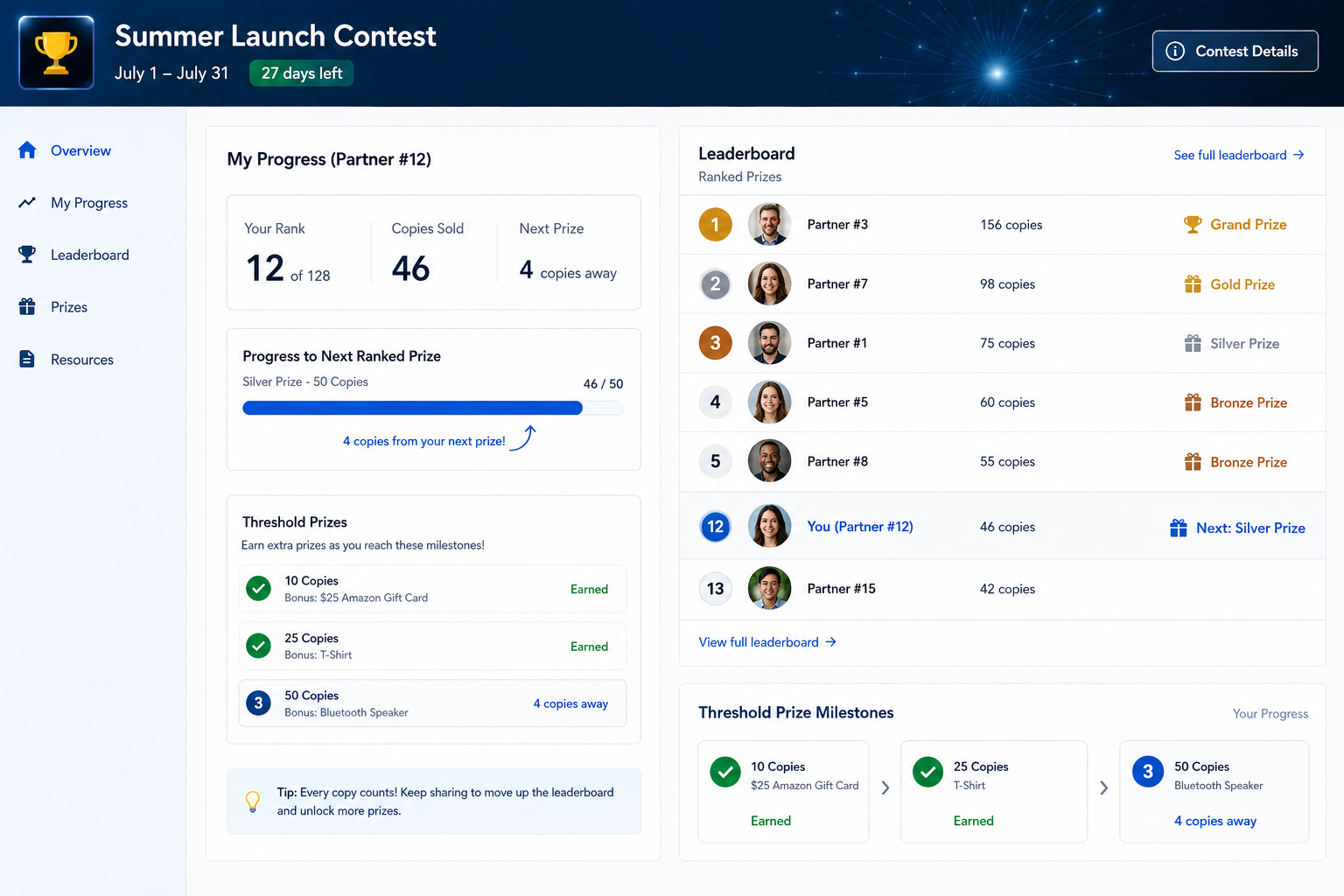 Contests work because a $300 prize for selling 25 copies is worth 15 times the commission on those same 25 copies. You’ve changed the reward from $50 to $350 without changing your commission rate at all.
The mistake I see constantly: authors run a ranked-only leaderboard. Top 3 win. Which tells partner number 12 on day two that she can’t catch the podcaster with the 200,000-person list, so she stops trying. You just deactivated most of your roster with a prize structure.
Run both at once. Ranked prizes at the top for the big partners who want to compete, and threshold prizes underneath so that anyone who sells 10, 25, or 50 copies wins something specific. AffiliateHQ runs both structures simultaneously and shows each partner their live progress toward the next threshold, which is the part that keeps them mailing on day four.
Prizes don’t have to be expensive. A signed first-edition box for everyone who sells 25 copies costs you very little and means more to another author than a check would. I broke down the selection process in picking prizes for your affiliate launch.
If you’re staring at a launch date with no partners lined up yet, start with recruiting. Your First 100 Affiliates is my free report on the strategies I used to recruit 604 affiliates and build a $1.1M per month program in 18 months, including the email templates and three partner sources most authors never think to check.
How do you turn a vague yes into a dated mailing schedule?
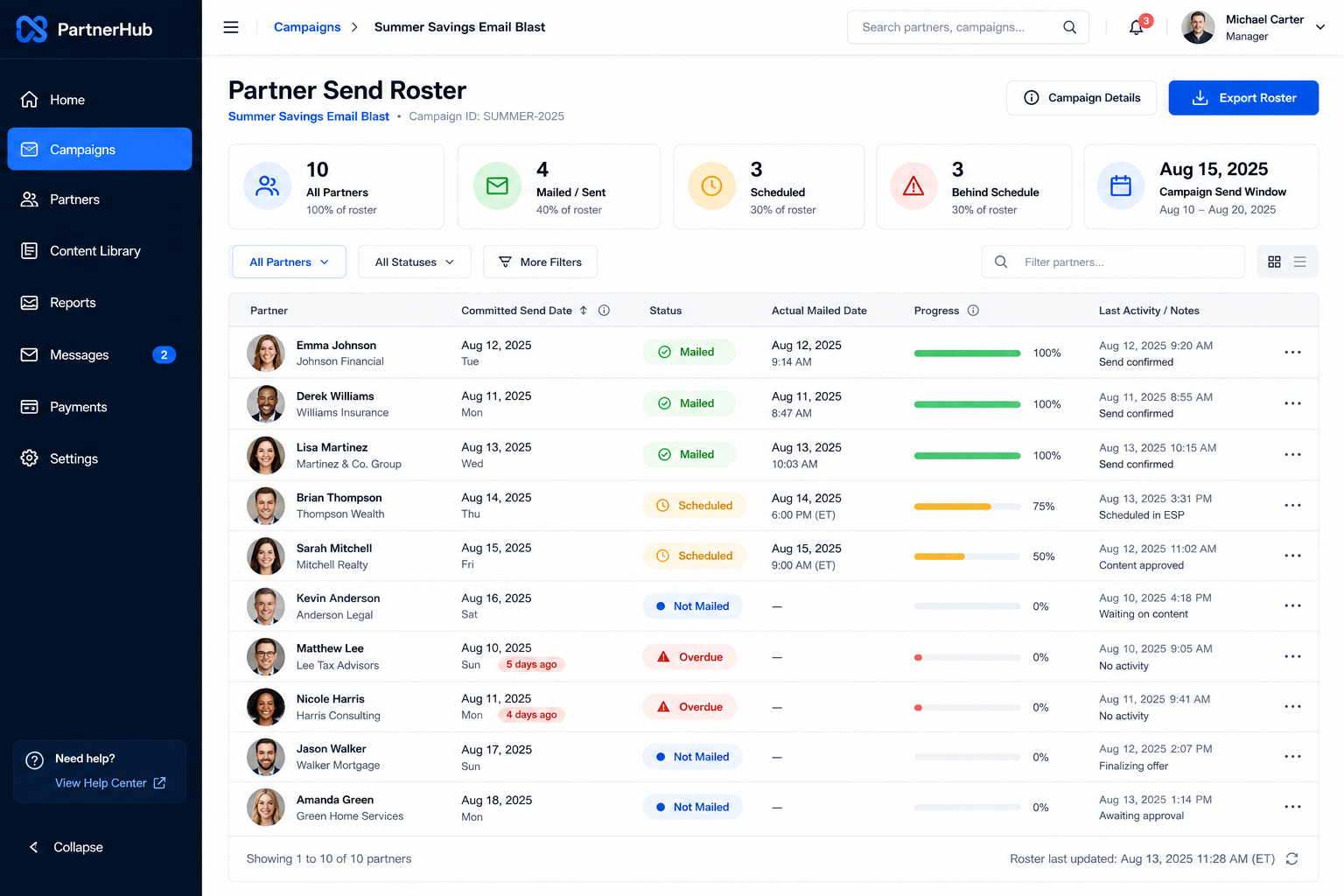 You ask for specific dates in writing before launch week, and you put that answer somewhere both of you can see it. A partner who has written down “Tuesday morning, Thursday afternoon, Friday final call” mails roughly five times more than one who said “sure, count me in.”
This is the highest-return thing I do on a book launch, and most authors skip it because it feels pushy. It isn’t. Your partners are managing eight other things, and a vague commitment loses to whatever has a date attached.
Commitment Plans in AffiliateHQ handle this. The partner picks their send dates during onboarding, the plan shows up in their dashboard, and you can see at a glance which of your 40 partners have committed to what. On day two of launch week, you know exactly who’s behind schedule instead of guessing.
Then you can send a targeted note to the eight people who committed to Tuesday and haven’t mailed, rather than blasting all 40 with a reminder that annoys the ones who already did their job. Segmented broadcasts with merge tags pulling each partner’s live numbers make that a two-minute task instead of an afternoon.
What should you give partners so they never ask what to send?
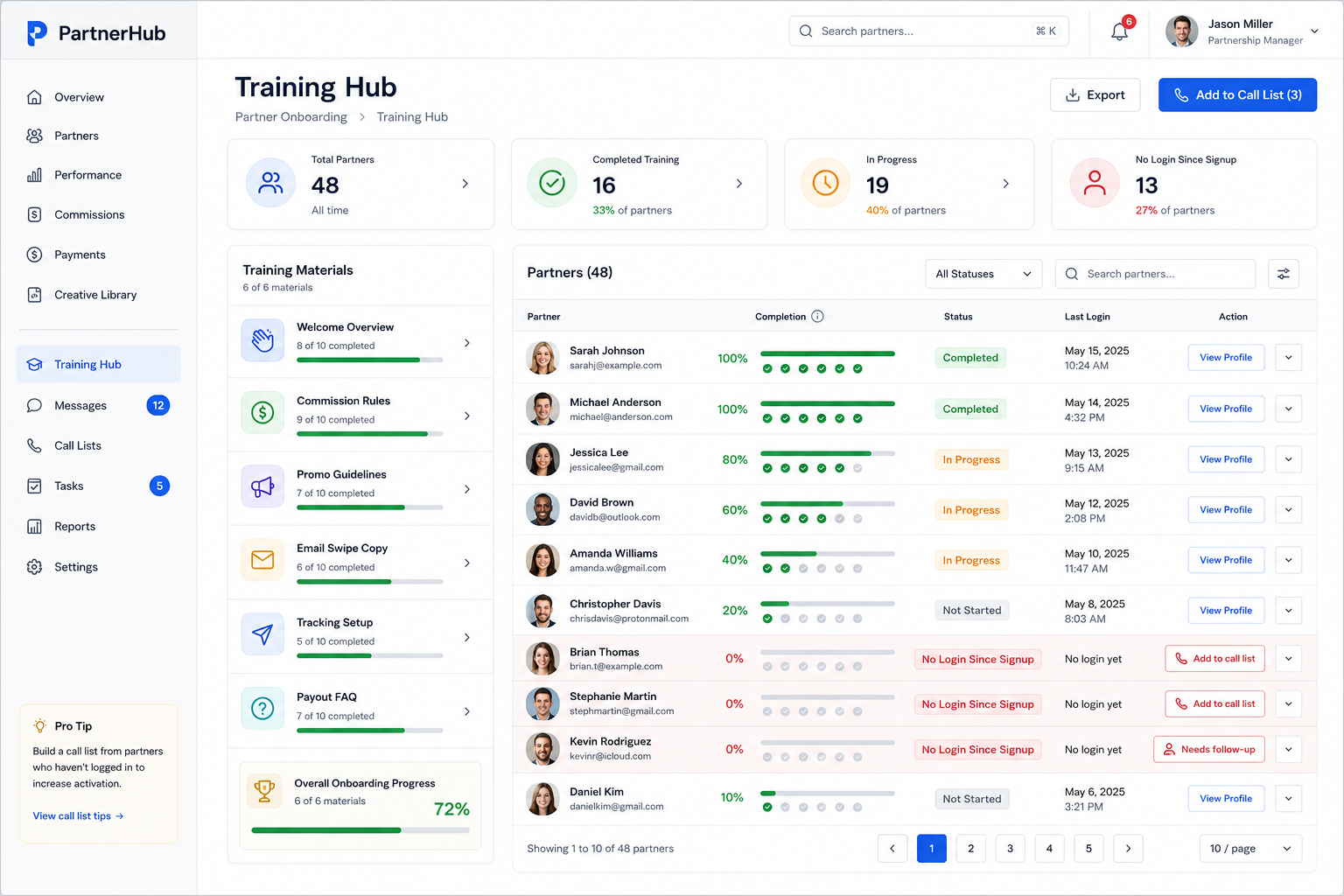 Give them three emails written and ready to paste, five social posts, two graphics sized for Instagram and one for a newsletter header, their affiliate link, and the launch dates. Anything a partner has to write themselves is a reason to postpone.
I’ve watched authors lose half their launch to this. The partner meant to promote. She sat down Tuesday morning, opened the email you sent three weeks ago, found a link to a Google Drive folder, couldn’t remember the password, and moved on to the next thing on her list. That’s not a motivation failure. That’s a friction failure, and it’s entirely preventable.
AffiliateHQ’s Training Hub holds all of it in one place with module completion tracking, so you can see which partners opened the materials and which haven’t logged in since they signed up. That second list is your call list. Two weeks out, not two days out.
Training your affiliates properly and warming up your partners before the launch both go deeper on what to include and when to send it.
Selling books through partners is a specific skill, and it works whether you’re traditionally published or self-published. How to Sell 10,000 Copies of Your Book is my free training on doing it without major media or paid ads. It’s the same approach we used on my own launch.
Do you need affiliate software for a book launch, or is a spreadsheet fine?
A spreadsheet works up to about 10 partners. Past that, you’ll spend launch week doing manual math instead of talking to the people who could still mail.
Here’s what the spreadsheet approach costs you. You can’t show partners their live sales count, so they can’t see they’re four copies from a prize. You can’t tell who opened the swipe copy. You can’t segment a reminder to the six people who committed to Wednesday. And you’re calculating contest standings by hand at 11pm during the exact week you should be doing podcast interviews.
Most authors I work with cross that line faster than they expect. You start planning for 15 partners, three of them introduce you to two more each, and by launch week you’re managing 38 people. If you’re running a real affiliate book launch rather than asking a few friends to share a link, you want software.
What should authors look for when comparing affiliate software?
 Ask every platform one question during the demo: what does your software do, on its own, to make a partner who hasn’t promoted go promote? Watch how quickly they change the subject back to dashboards and attribution windows.
Beyond that, four things matter for a book launch specifically. Contest support that includes thresholds and not only rankings. A way to record and display partner commitments. A hosted place for training materials that doesn’t require you to build a page. And Amazon-aware tracking expectations, since most book sales happen on a retailer site you don’t control and no platform can attribute those perfectly.
That last point deserves honesty. If your book sells through Amazon, you cannot track individual affiliate sales the way you would on your own checkout. Authors handle this by running the contest on a separate action, usually receipt submissions on a bonus page, and treating that as the sales record. Good software lets you feed those numbers in and run the contest off them. I covered the broader platform comparison in choosing the right affiliate program software.
What to do next
Pull up your last launch, or your planned partner list if this is your first book. Count how many people said yes. Then count how many of those you could name a send date for right now.
If that second number is under half, your problem is commitment, and no amount of better tracking fixes it. Fix that first by asking every partner for dates in writing.
Then look at your prize structure. If you only reward the top three, go find where partner number 14 stopped. It was day two. Add thresholds at 10, 25, and 50 copies and watch what happens to the middle of your roster.
Then look at your materials. If a partner can’t promote in under 10 minutes without emailing you a question, you’re going to lose sends to friction during the only week that counts. Finding partners for your book is step one, and using affiliate marketing as an author covers the longer-term revenue side. AffiliateHQ is where I put the launch-week pieces into one platform so authors stop rebuilding this by hand every book.
Every feature in the software maps to something I teach, because I built it after 20 years of watching other platforms miss the point. The Book on Affiliate Management covers the full system across 300 pages, and AffiliateHQ runs it for you.
Frequently asked questions
 Can I track Amazon book sales through affiliate software?
Not individually. Amazon doesn’t pass affiliate attribution back to third-party platforms for your book. Authors work around this by running the promotion through a bonus page where readers submit their receipt, then using those submissions as the sales record for commissions and contests. Your software should let you import or log those numbers and run standings off them.
How much should I pay affiliates for a book?
If you sell direct, 20 to 40 percent of the book price is normal, though that’s only $4 to $8 on a $20 book. Most authors add value elsewhere: a commission on a companion course, a paid bonus bundle, or contest prizes worth far more than the per-copy payout. The prize budget usually does more work than the commission rate.
How many affiliates do I need for a book launch?
Twenty committed partners beat 100 who signed up and vanished. On the launches I’ve run, roughly a quarter of recruited partners do the majority of the sales. Aim to recruit 40 to 60 for a first book, expect 15 to 20 to promote seriously, and spend your effort on making those 20 successful rather than chasing the rest.
When should I start recruiting partners for my book?
Six months out at minimum, and a year is better. Podcasters book guests two to three months ahead, and newsletter writers plan their calendars weeks in advance. Authors who start recruiting eight weeks before pub date end up asking busy people to rearrange schedules that are already full, and most of them say no politely.
Do I need affiliate software if my publisher is handling the launch?
Yes, because your publisher isn’t running your partner program. Publishers handle retail placement, publicity, and distribution. The author almost always owns partner recruiting and management, and I’ve never seen a publisher provide software for it. Assume that piece is on you.
Does affiliate software work for self-published authors?
It works better, because self-published authors usually sell direct from their own site alongside retail, which means real tracking on at least part of the sales. If you sell a bundle or course version directly, you can attribute those cleanly and run the whole contest off verified numbers instead of receipt submissions.