Most businesses that could benefit from an affiliate program don’t have one. Not because it’s hard to start, but because they’re not sure if it’s actually worth doing. Here’s a direct answer to that question, along with the specific situations where it makes the most sense.

Does my business need an affiliate program?
Your business needs an affiliate program if you sell a product or service with a margin that can support a commission payout, and you’d benefit from other people sending you warm, pre-sold traffic. That covers a lot of businesses. The short version: if you sell something and other people can vouch for it credibly to their audience, an affiliate program will almost certainly grow your revenue faster than most other marketing channels you can run at the same cost.
Affiliate marketing is performance-based. You don’t pay until a sale happens. That means your marketing spend is guaranteed to generate revenue before it goes out the door. That’s nearly impossible with paid ads, SEO, or content marketing. You pay those upfront and hope for results. With affiliates, the results come first.
The one question worth asking before you start: do you have a product that converts? Affiliates send traffic. Your sales page closes it. If your conversion rate is poor, you’ll recruit affiliates, disappoint them, and watch them stop promoting you. Fix the funnel before you launch the program.
What types of businesses benefit most from affiliate programs?
Digital products and online courses are the most natural fit. High margins, no inventory, instant delivery, and a built-in affiliate community in most niches. Commission rates of 30-50% are standard, which leaves room to attract serious promoters without hurting profitability.
Software and SaaS products work extremely well, especially when the product has a recurring subscription. An affiliate who earns a monthly commission on every customer they refer has a real financial incentive to keep promoting and to help their audience succeed with your product.
Physical products can absolutely run affiliate programs, but the math is tighter. If your margins are under 20%, it’s harder to offer a commission that motivates affiliates without eating into profit. That said, it’s not impossible. You just need to think carefully about the commission structure and which affiliates are worth going after.
Service businesses can run affiliate programs too, though they’re less common. A coaching program, an agency, a done-for-you service with a high average ticket value, a consulting firm, these all work. The key is that the lifetime value of a customer is high enough to justify a meaningful referral payout.
What doesn’t work well: businesses with very thin margins and low average order values, businesses that haven’t proven their funnel converts, and businesses where trust and personal relationship are so central to the sale that a third-party referral doesn’t carry weight.
What are the real advantages of running an affiliate program?

The biggest advantage is that affiliates bring warm traffic. When someone promotes your product to their audience, they’re doing the trust transfer for you. The prospect arrives already believing in your product because someone they follow vouched for it. Affiliate traffic converts better than cold traffic from ads. It’s not even close.
The second advantage is scalability. There’s no ceiling on an affiliate program the way there is with paid ads. Once you hit saturation with a paid campaign, your cost per acquisition goes up and results flatten. With affiliates, every new affiliate you recruit is a new distribution channel. You could have 10 affiliates or 10,000. The mechanics don’t change.
Third is the targeting problem that kills most ad spend. When you run paid ads, you’re guessing at who to reach. You pick demographics and hope. With affiliates, you’re not guessing. Your affiliates have already done the targeting for you. Their audience trusts them, follows them, and buys what they recommend. You’re not interrupting strangers with your offer. You’re being introduced by a trusted voice.
And finally: you collect money before you pay it out. Commissions are paid after the sale is confirmed. In most cases, that means the customer has paid you, the refund window has passed, and only then does the affiliate get their cut. From a cash flow perspective, affiliate marketing is as close to risk-free marketing as you’ll find. Check out the full breakdown of why to start an affiliate program if you want the complete picture.
How much does it cost to run an affiliate program?
The main costs are the affiliate tracking software and the commissions you pay out. Software runs anywhere from free (some email platforms include basic affiliate tracking) to $100-500/month for a dedicated platform like ThriveCart, Rewardful, or Post Affiliate Pro. Serious programs on affiliate networks like ShareASale, CJ Affiliate, or Impact pay network fees on top of that, typically a percentage of commissions or a monthly platform fee.
For a new program just getting started, you can actually launch with near-zero upfront cost. If you have an email platform and can manually track a small number of affiliates, you can run a lean version of your program before investing in dedicated software. That approach works reasonably well for your first five affiliates. Once you’re generating consistent affiliate revenue, reinvest it in proper tracking infrastructure.
The commission itself isn’t really a “cost” in the traditional sense since you’re paying it out of revenue you wouldn’t have otherwise had. A 30% commission on a $200 product is $60 to the affiliate. You net $140 from a sale you didn’t have to generate yourself. That’s not an expense. That’s margin-positive growth.
For the full breakdown of what to put in your affiliate agreement, the guide to choosing the right affiliate program software is worth reading before you pick a platform.
When is the right time to start an affiliate program?

Earlier than most people think. The most common mistake is waiting too long. Business owners tell themselves they’ll start an affiliate program once they’ve scaled revenue, once their product is more polished, once they have more bandwidth. Meanwhile, they’re spending money on ads and leaving a performance-based channel completely untapped.
The honest answer: you’re ready to start an affiliate program as soon as you have a product that converts and a way to track affiliate sales. That’s it. You don’t need a huge audience. You don’t need a massive affiliate network already in place. You need a working offer and a way to know which sales came from which affiliate.
There’s one real reason to wait: if your conversion rate is too low, you’ll burn through goodwill with affiliates who promote you, see weak results, and stop. Before you recruit affiliates, make sure your landing page converts cold traffic at a reasonable rate. Run some paid traffic to test it if you haven’t already. Fix the leaks before you open the floodgates.
One business I know was holding off on launching their affiliate program because they thought they needed 100 affiliates before it was worth it. They launched with six. Three of them were active in the first month. Those three drove enough revenue to cover the cost of the tracking software ten times over. The idea that you need a large affiliate base to see results is wrong. A handful of the right affiliates can move the needle fast.
How do I know if my commission rate is right?
The metric that matters most to affiliates isn’t your commission percentage. It’s earnings per click (EPC). EPC is what an affiliate actually earns for every visitor they send you. If your product converts at 2% and you pay a $50 commission, your EPC is $1.00. Affiliates with multiple programs to choose from will pick the one with the highest EPC.
Industry standard commission rates for digital products sit around 30-50%. Physical products are typically 5-15% given tighter margins. SaaS products often pay recurring commissions of 20-30% per month. If you’re significantly below the standard rate for your category, top affiliates will pass on your program.
The right commission is the highest rate you can offer while staying profitable, set at a level that makes your EPC competitive. Run the math on your conversion rate, average order value, and refund rate. Then benchmark against other programs in your niche that affiliates are actively promoting. That’s your target range.
And don’t obsess over the commission rate in isolation. Affiliates care about how much they make per promotion, full stop. A lower commission on a high-converting, high-ticket offer can earn an affiliate more than a generous commission on a product nobody buys. The affiliate program KPIs post breaks down how to track EPC and other metrics once your program is running.
What does managing an affiliate program actually require?

Less than you think at the start, more than you expect as you scale. In the early stages, the main job is recruiting affiliates and making sure they have what they need to promote: a promo plan, email swipe copy, graphics, and clear commission details. A lot of small programs run lean on 2-4 hours a week of active management.
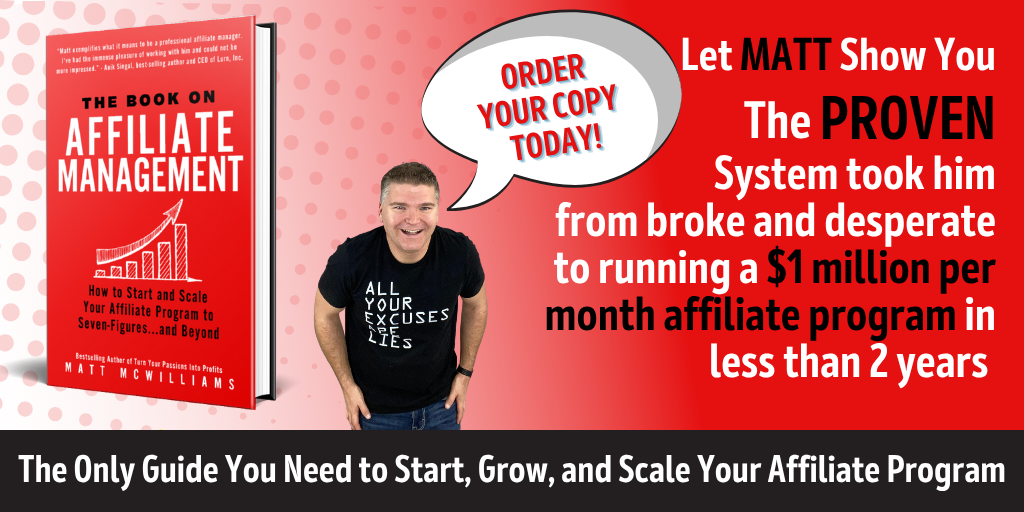
As your program grows, the management time increases. You’re handling compliance, tracking down fraud, activating dormant affiliates, running contests, answering questions, and recruiting more partners. Programs tend to hit a growth ceiling around $500,000 to $1 million per year when the founder is running it themselves without dedicated bandwidth. That’s not a reason to not start, it’s just a signal about when to consider bringing someone on specifically to run the program. If you want the full system for building and managing a program from scratch, The Book on Affiliate Management covers exactly that, from your first affiliate to scaling past seven figures. It’s available on Amazon and comes with over $1,000 in bonuses.
The affiliate manager role, whether that’s you or someone you hire, requires three skill sets: sales, customer service, and online marketing. Someone who can recruit affiliates confidently, communicate clearly, and understand the digital side of the business. If that’s you, keep reading. If that’s not your strength, it might be worth getting help earlier rather than later. The guide to becoming an affiliate manager covers what the role actually involves.
What should I expect in year one?
Year one is about building the foundation. You’re finding out which affiliates actually promote, what your conversion rate looks like on affiliate traffic, and which parts of your program work versus which parts need adjusting. Don’t expect the program to be a major revenue driver in the first few months. Expect to learn a lot.
Most programs follow a pattern: a slow start with a small group of affiliates, a first promotion that reveals what’s working and what isn’t, some early wins that attract more affiliates, and a gradual ramp-up over six to twelve months. The programs that grow fast in year one usually did one thing right from the start: they recruited a few affiliates with real audiences and made those first promotions go well. That reputation spreads.
One program I worked with launched with a modest goal of getting their first ten affiliates active within 90 days. They hit it, those affiliates collectively drove $40,000 in sales in their first launch, and the story of that launch made recruiting the next 30 affiliates significantly easier. The detailed breakdown of why affiliate programs compound over time is worth reading if you want to understand how this builds.
If you’re ready to stop wondering whether you should start an affiliate program and actually do it, the How to 10X Your Sales training is a free two-hour on-demand session that walks through exactly how to build a program that grows fast and scales long-term. It covers the three things most business owners get wrong and what to do instead.
How do I get my first affiliates?

Start with people who already know your product. Your existing customers are the most underused affiliate source in almost every business. They’ve bought from you, they got results, and they tell people about you anyway. Formalize that. Give them an affiliate link and a reason to share it.
Your second source is complementary product creators in your niche. Someone whose audience overlaps with yours but who isn’t a direct competitor. If you sell an email marketing course, find someone who sells a list-building course. Offer to cross-promote. Affiliate relationships between complementary businesses are often the most productive ones in a program.
Third, look at who’s already writing about your category. Bloggers, podcasters, YouTubers who review or recommend products like yours. Many of them are looking for affiliate programs to join. Your job is to reach out, make the program easy to understand, and make the first promotion as smooth as possible.
The recruiting outreach itself doesn’t need to be complicated. A clear, direct email explaining who you are, what the product does, what the commission structure looks like, and why their audience would care. Keep it short. Most affiliate recruiting emails fail because they’re too long, too vague about the commission, or too focused on what the affiliate can do for you rather than what you can do for them. The full series on affiliate marketing fundamentals covers this in depth if you want to go deeper. For a ready-to-use system to handle the whole launch, the Affiliate Program Kickstarter Package includes recruiting your first 30 affiliates, all the email templates, full tech setup, and a promo plan, done for you.
Is affiliate marketing worth it for small businesses?
Yes, often more so than for large ones. Small businesses tend to have loyal customers who are enthusiastic advocates, and affiliate marketing gives those advocates a structure and a financial incentive to share. You don’t need a big budget to get started. You need a converting offer, affiliate tracking, and a handful of the right people promoting you.
Can I run an affiliate program without a big audience?
Yes. The whole point of an affiliate program is that your affiliates bring the audience. Your job is to have a product worth promoting and a program worth joining. You don’t need to already have a large following. The affiliates provide the distribution. That’s why this model is so useful for businesses that are still building their own audience.
How long before my affiliate program generates real revenue?
Most programs start generating meaningful revenue within the first 60-90 days if they launch with at least a handful of active affiliates. The ramp time depends mostly on how quickly you recruit your first promoters and how well your first promotion goes. Programs that invest in recruiting before launch and prepare affiliates well tend to see faster results.
What’s the biggest mistake businesses make with affiliate programs?
Starting too late is one. But the biggest ongoing mistake is treating affiliates like a passive traffic source. Affiliates need to be recruited, activated, equipped, and motivated on an ongoing basis. The programs that fail are usually the ones where the business set up the program, listed it on a network, and waited. The ones that win are actively managed. Reviewing the most common affiliate marketing mistakes before you launch will save you a lot of early frustration.
Do I need affiliate tracking software right away?
Not for your first few affiliates. You can manually track up to five affiliates using a simple setup with your email system and a unique landing page per affiliate. Once you’re past that, yes, you need dedicated tracking. Manual tracking past five affiliates gets messy fast, and the cost of a tracking mistake is losing an affiliate’s trust.
Should I start with an affiliate network or my own in-house program?
For most businesses starting out, an in-house program using software like ThriveCart, Rewardful, or iDevAffiliate makes more sense. Networks give you exposure to more affiliates, but they add fees, reduce your control, and require a more established program to attract attention. Build and prove the program first, then consider a network if the broader exposure makes sense for your growth stage.