I managed a publicly traded online retailer’s affiliate program from 2010 to 2015, and I took it from about $15 million a year to $325 million a year with five specific changes: recruiting one affiliate type at a time, segmenting every email instead of sending one newsletter to everyone, running training every single month, checking performance on a fixed schedule instead of waiting for a problem to show up, and expanding how many products affiliates could promote. Company sales grew from roughly $300 million to $1.1 billion over that stretch, and the affiliate program went from under 5% of that to about a third of it.

The program I inherited
I managed the affiliate program for a publicly traded online retailer from 2010 to 2015. When I took over, the company did roughly $300 million a year in sales, and the affiliate program brought in under 5%. That’s about $15 million. The program ran one affiliate type, one email format, and no fixed schedule for checking who was performing and who wasn’t.
By the time I left in 2015, the company had grown to $1.1 billion a year, and the affiliate program accounted for about a third of it. $325 million. Not every dollar of that growth came from the five changes below, the company itself was growing fast. But I watched affiliate revenue move in response to each one, in the order I made them, and I can point to roughly where each one landed.
I walked through the full five-year arc, including the parts I got wrong, in How I Grew a Major Affiliate Program From $15M to $325M a Year. This post pulls from that episode, with more of the messy middle left in over there.
One affiliate type at a time took the program to about $50 million
Leadership wanted ten affiliate types recruited at once. I picked one: mom bloggers. I signed 15 to 20 of them fast, through manual outreach. Their introductions got me to 75 to 100 more. Within a few months, signups went from one a day, which I’d worked hard for, to 15 to 20 a day in peak season with no active recruiting on my part. I kept going until I had the top 250 affiliates in that niche, then moved to a second affiliate type and repeated the process.
The temptation to recruit broadly is real, especially when someone above you wants numbers across ten categories by next quarter. But a shallow list of affiliates across ten types converts worse than a deep list in one, because you can’t give ten types your full attention at once. I estimate this single change, recruiting one type to saturation before starting the next, took the program to about $50 million a year. If you’re building a program from scratch, pacing your recruiting by stage matters more than hitting a headcount.
Segmented communication took it from about $50 million to $80 million
When I took over, the program sent one newsletter a week to every affiliate. 52 a year, identical content, regardless of what someone was promoting or whether they cared. I replaced it with segmented emails: weekly milestones and goals specific to what an affiliate was working on, promos offered only to the affiliates they fit, and whole topics cut for groups that didn’t care about them. Nonprofits, for example, didn’t need to hear about a consumer contest built for individual bloggers.
The total email volume went up, not down. But any single affiliate received about three emails a week instead of one generic blast, and every one of those three was relevant to them specifically. I estimate segmentation took the program from about $50 million to $80 million a year. The frequency question and the segmentation question are different problems, and how often to email by launch stage is worth reading separately from this.
Monthly training took it from about $80 million to $140 million
I ran affiliate training on the second Tuesday of every month, no exceptions, and eventually alternated training sessions with open Q&A sessions. The Q&A calls drew bigger crowds than the training itself. Live attendance ran 2,500 to 3,000 out of roughly 60,000 affiliates, about 5%, and a meaningful chunk of those people showed up 30 or more times in a row.
I ran out of new material to teach after about 18 months. I kept the calls going anyway, because the affiliates who’d been attending for a year started teaching each other, and that peer coaching did more for activation than anything I was saying from the front of the room. I estimate the monthly rhythm, more than any single topic I covered, took the program from about $80 million to $140 million a year. The fixed slot mattered as much as the content: affiliates could plan around a date they knew wouldn’t move.
A fixed analytics schedule took it from about $140 million to $230 million
I checked my top 200 affiliates on Monday, Wednesday, and Friday. Affiliates ranked 200 to 500 got checked weekly. The next 500 got checked every two weeks. On each check I looked at the same three things: whether sales were up or down, what the conversion rate was doing, and what the affiliate was actually promoting that week.
The rule that mattered most: I contacted an affiliate after four straight down checks, which worked out to about eight days for the top tier. That’s early enough to catch a problem before it compounds into a quarter of lost revenue, but not so trigger-happy that you’re emailing someone over one slow Tuesday. When an affiliate had drifted to a product that converted worse for their audience, I suggested a specific alternative that converted better for the people they reached. I estimate this discipline, the schedule plus the specific follow-up, took the program from about $140 million to $230 million a year. The KPIs worth tracking matter less than whether you look at them on a schedule you keep.
Expanding the product range took it from about $230 million to $325 million
I built affiliate links by product, by category, and by time of year, about 1,000 products in all, and kept 5 to 10 promotions running every week instead of the handful a month the program had run before. The affiliate base responded directly: the program went from roughly 5,000 affiliates promoting 3 to 4 times a year to more than 50,000 promoting around 10 times a year. Two and a half times as many promotions from ten times the affiliate base.
The simplest test I ran proved how much the default link mattered on its own. I changed the destination affiliates landed people on by default, from a generic homepage to a curated best-sellers page, and left everything else untouched. Sales lifted 12% in a single day with zero additional recruiting or outreach. I estimate the full product-range expansion, more than that one test alone, took the program from about $230 million to $325 million a year. Deep linking is the mechanism behind this, and getting it wrong costs you clicks you’ve already paid to earn.
The evergreen baseline that made the big promotions possible
Before I took over, a slow month for the program did under $500,000. By the time these five changes were in place, a slow week did $1.2 to $1.4 million. Two things built that floor underneath the peaks. First, I taught affiliates to list the program in several categories on their own resources pages instead of one, so we showed up 2 to 5 times instead of once per affiliate site. I shared a simple guide with affiliates to make that easy for them to do. Second, I got 4,000 to 6,000 affiliates to add the program into their existing email automations, averaging roughly 3 clicks a day each. Neither change required a big promotion or a contest. Both made the program visible on days nobody was actively promoting anything.
This baseline is why the big spikes worked as well as they did. A promotion layered on top of a strong floor outperforms the same promotion layered on top of near-zero traffic, because the infrastructure that catches a casual click is already built and already converting.
What transfers to a $50,000-a-month program, and what doesn’t
The order transfers. Recruit one affiliate type until it’s saturated, then segment your communication, then get on a monthly training schedule, then build an analytics habit, then widen what affiliates can promote. That sequence worked at $15 million and the logic behind it doesn’t depend on scale: you pay affiliates after the sale, not before it, which is the real reason the math works whether you have 50 affiliates or 50,000.
The specific numbers don’t transfer. A $50,000-a-month program doesn’t need three tiers of 200, 300, and 500 affiliates checked on three different schedules. It needs one tier, maybe your top 10 to 20 affiliates, checked once or twice a week. It doesn’t need alternating training and Q&A calls drawing thousands, one monthly call with whoever shows up does the same job at that scale. And it doesn’t need 1,000 product links. It needs enough variety that the same five affiliates aren’t promoting the exact same thing every single week.
What I’d tell a business owner running a smaller program is this: don’t copy the scale, copy the sequence. Recruiting ten affiliate types badly at $50,000 a month will cost you the same focus problem it cost the $300 million company, with smaller numbers attached to the mistake.
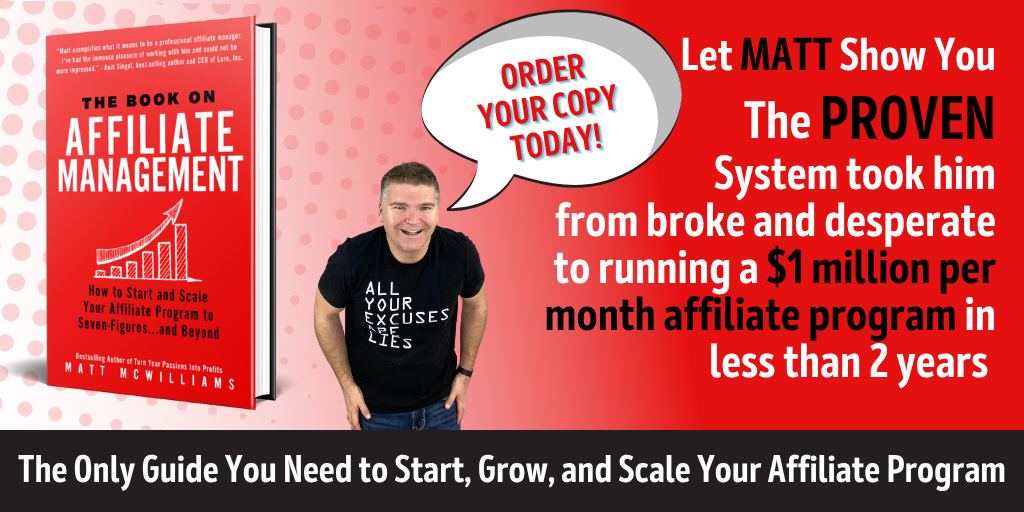
I wrote the full playbook behind this sequence, recruiting, communication, training, analytics, and promotion, in The Book on Affiliate Management. It covers the mechanics behind each of these five changes in more detail than one post can hold.
What to take from this
If you’re running an affiliate program right now, whatever size it is, here’s where I’d start. Pick one affiliate type and get it to saturation before you add a second. Once you’ve got that, split your communication so affiliates only hear about what applies to them. Put training on a fixed date every month and don’t move it, even when you run out of new material to teach, because the group will start teaching each other. Then build a simple schedule for checking who’s up and who’s down, and act on it inside of two weeks, not two quarters.
None of this requires a $300 million company behind it. It requires doing the five things in order and sticking with the ones that feel boring, like a Tuesday call with nothing new to say, long after they stop feeling exciting.
If you want help applying this sequence to your own numbers instead of a $300 million company’s, I do a free 20-minute call where we look at your program and build a 30 to 60 day plan. Book one through Your Affiliate Launch Coach.
Matt McWilliams has managed affiliate programs responsible for more than $1.8 billion in sales, earned Affiliate Manager of the Year four times (Affiliate Summit Pinnacle Awards, twice, and AbestWeb Affiliate Awards, twice), and personally recruited more than 330,000 affiliates. Read more about his background.