
What if the biggest threat to affiliate marketing right now… is also its biggest opportunity? There’s been a lot of noise lately about AI replacing content creators… killing SEO… making affiliates obsolete. But is that actually true? In today’s episode, I’m discussing the real impact of AI on affiliate marketing… what’s changing, what isn’t, and how the smartest affiliates are using AI to grow faster than ever. If you’re worried AI is going to ruin everything… or just trying to figure out how to adapt, this one’s for you.
Click Here for The Written Transcript of This Episode
TEXT ME: +1 (260) 217-4619
Links Mentioned in this Episode
Don’t Miss An Episode – Subscribe Below
 |
 |
|---|---|
 |
 |
 |
|
 |
|
Previous Episodes of The Affiliate Guy
How to Grow Your Affiliate Program with Podcast Interviews
2026 New Year’s Resolutions for Affiliate Marketers
New Year’s Resolutions for Affiliate Managers
The Future of Affiliate Marketing: 2026 Edition
How Affiliates Can Make More Money This Holiday Season
Is AI the End of Affiliate Marketing?
What if the biggest threat to affiliate marketing right now is also its biggest opportunity? You know, there’s been a lot of noise lately about AI replacing content creators, killing SEO, making affiliates obsolete. But is that actually true? On, today’s episode, I’m discussing the real impact of AI on affiliate marketing. What’s changing, what isn’t, and how the smartest affiliates are using AI to grow faster than ever.
If you’re worried AI going to ruin everything, or maybe you’re just trying to figure out how to adapt, this one’s for you. So let’s start with the most important statement I will probably ever make on this show. Whether we like it or not, AI is here and it’s not going away. You know, sometimes like a new social media network will come along, like, well, I don’t like that network. And, there’s a chance that maybe it goes away. Like, I don’t know, maybe TikTok will be nothing in 10 years. Maybe Facebook will be nothing in 10 years. We don’t know. There’s a chance though, because it’s happened. You know, we’ve seen that actually happen.
That’s not the case with AI. like AI, it’s not going to just go away, it’s going to change, it’s going to evolve, it’s going to alter things in different ways 5, 10, 15 years from now than it does now, but it’s not going away. It’s like saying the car is going to go away. Like, no. Is it evolving?
Absolutely, but it’s not going away. So I did this whole series recently about A. I. and one of the things I didn’t really do is answer that question is like, was it going to be the end of affiliate marketing as we know it? I talked about how affiliates can use it, I talked about how affiliate managers can use it, but not like, what’s actually the impact of AI going to be.
And so that’s what we’re talking about today because I just get so many messages, probably four to five messages every week. People who are panicking, others who are just asking like, how they can use it more, you know, like pretending like it. Others are like pretending it doesn’t even exist and they’re just ignoring it completely. But if you’re building an affiliate program, you’re trying to grow as an affiliate marketer, you have to understand what this means. what does this mean for your business?
What does this mean for your affiliate program? What does this mean for the affiliate marketing industry? And the thing is, there is so much confusion out there because things are happening so fast. The reality is that somewhere between 10 and 40% of what I say on this episode will be incorrect six months to a year from now. Probably upwards of 10% of what I’m going to say is going to be invalid within three to five weeks of recording this episode.
That, that’s, that’s reality. Like it’s changing so fast. So there’s a lot of confusion. So what I wanted to do was just, Well, I wanted to acknowledge, first of all, AI is the most interesting, like industry disruptor in the history of this, this world. You know, the most interesting disruptor ever, really, across anything.
Because if you look at historically when there was a disruptor, right, the cot, I think of like the cotton gin or, you know, what is it? Cyrus McCormick created the mechanical reaper. When I think of all the things like the major inventions that came along, even the automobile, the automobile, it disrupted an entire industry, right? You know, people who, I don’t know what you call them, but people who like drove horses. when any other thing has come along over the years, the people that it is most disrupted have been the lowest class within that industry, right?
It is. When the mechanical reaper came along, it didn’t put a industrial farmers out of business. They didn’t put the people who own the farms, like it helped them, but it hurt the people who previously did the reaping. The lowest class, the poorest of the poor, right. Within an industry.
So sometimes there have been things that have come along and it’s like, yeah, the average income of that industry is $200,000 and it disrupted the $80,000 people. But it’s still the lowest of that group. AI is like the complete opposite. Many cases. I was, I was having this discussion with a friend of mine the other day that to me that’s the most fascinating thing.
If you look at the medical industry, for example, the people that it’s disrupting are the doctors, not the nurses. The nurses who go in and do all the things are. They’re never going to go away. At least not in the next 20 years probably. So the people that it’s disrupting now are doctors.
The things that I, that people would previously see doctors for don’t have to see doctors for. I still have to go to a nurse to get my blood drawn. And this is happening across like tons of different industries. It’s, it’s replacing thought leaders and like data analysis, people who were at the highest realm, but it’s not like the people who are reacting to the data. It’s, it’s not affecting them.
So it’s a very interesting disruptor in that way because it’s so different from what we’ve seen in the past. And so the thing that I wanted to do with this episode because of all the confusion is kind of take what’s being said and what’s not being said and like, let’s sort through the things that are being said, let’s identify the things that are not being said, kind of put them all into one episode to eliminate that confusion. All right? Because people are saying things like, AI is going to replace content creators, it’s going to end SEO, it’s going to make affiliates irrelevant, maybe even destroy the entire $17 billion affiliate marketing industry. And here’s the thing.
I get that fear. I’ve seen the data, I’ve talked to the experts. I have lived through major platform shifts before. Not nothing like this, but I’ve lived through these platform shifts before. I’ve lived through the Google slaps back in the, you know, the Penguin updates and the Panda update.
And I’ve, I’ve, I’ve lived through, you know, new social media networks and the disappearance of social media networks. And I’ve lived through regulation changes, the FTC rules. I’ve lived through all those things and I’ve seen them all. And every time, on the flip side, there was massive opportunity. So I have no reason to believe that this time there’s not going to be massive opportunity.
The reality is that AI in some form as we know it, been around for two to three years right now, right? You know, we think of Anthropic with Claude GPT Gemini, the ability to use AI as an affiliate marketer. It’s been around for upwards of three years. In fact, I saw a funny, just as I know I saw a funny, comment, a review. So my book, turn your passions into profit.
I didn’t even realize this until just looked up at my calendar. It came out three years and three days ago, meaning I wrote it. I actually wrote the book. The majority of the book I wrote in the winter of 2021 into early 2022, when ChatGPT wasn’t even a, like a figment of anybody’s imagination that I know of, at least outside of the AI industry. Right.
And somebody wrote a review of my book. It was my first one star review. It was hilarious. And they’re like, he doesn’t even talk about Chat GPT and doesn’t even talk about how to use AI for affiliate marketing. I’m like, did you look at the beginning of the book where it talks about when it was written?
Like look at the pub date it was. It was published January 10, 2023. Which means if you know anything, if you like, you don’t have to know anything about books. It was written a little bit before that, you know, like a few days. Yeah, I wrote it a few days before.
It was just, I mean I wrote it over a year before it was released. So of, course I don’t talk about Chat GPT. Sorry. And we’ll talk about this later. The principles are still the same though.
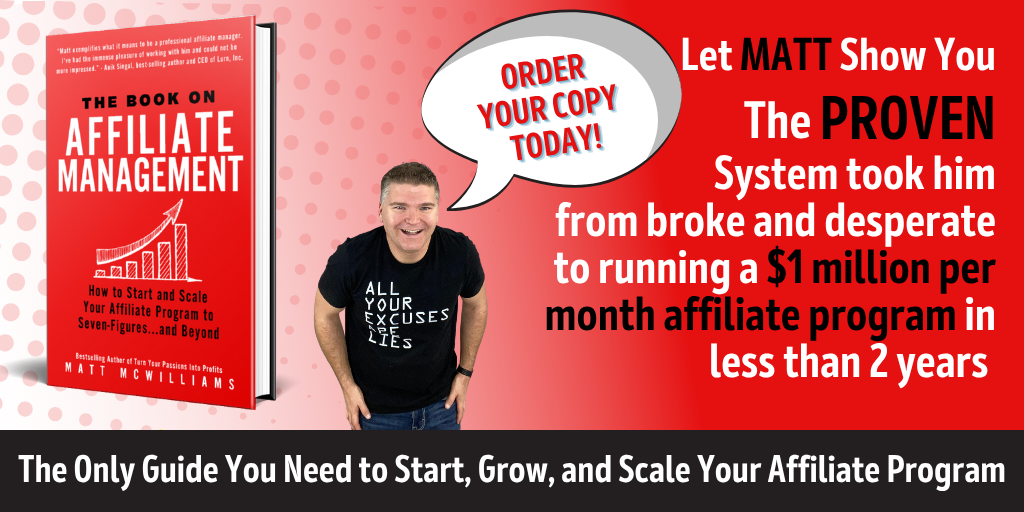
There’s nothing in that book that isn’t relevant. There’s just like you take AI and you layer it on top and you put it on steroids. When I talk about content creation at the end of the book, yeah, I don’t talk about how to use AI to create content because it didn’t exist when I wrote it. But you just take the principles in it and layer AI on top and now you can create 20 times more or create it 20 times faster. And so the thing is, from a data standpoint, it’s been around for three years and the industry has grown over 30% since AI, came around.
If it had only grown 5% I might seed that. Well it was growing at 10 to 15% a year and it slowed down because of AI. So that means it’s going to, it’s going to reverse course in certain getting smaller. It’s going to destroy the industry over the next 10 or 20 years. But it’s actually grown at the same pace that it was growing.
So it’s not an artificial bubble where it started growing way too fast and now, okay, it’s going to, you know, it’s going to bust. It just kept growing at roughly the same pace that it had been growing for the previous decade over the past three years since the release of, you know, the common AI tools. So I have every reason to believe that it’s going to continue to do that at some level. Every time I’ve seen that, the game changes, right? New social media, elimination of a social media New Panda, you know, new Google update.
Like Pander Penguin back in the day, most people freeze. They are paralyzed with fear or the of the unknown. They freeze, they quit. But a small group, this happens with every technology that comes along. A small group figures out how to win the new game.
That’s what this episode’s about. So I broke it down into three sections. Number one, why do some people believe that AI is the end of affiliate marketing and what they’re getting wrong there? So went out and found like one of the most common things that people are saying about why AI is the end of affiliate marketing? Number two, you know how that’s not true.
That is, you know, that’s, that’s not true at all. Well, I mean. Well actually really the first section’s more about how it’s changing it. The second one is what people are saying, you know, and how it just, it’s not true. And then the third section is what, what’s, what’s actually changing compared to kind of like the, what people are saying out there, right?
How to stay relevant no matter what the tech is doing. How to use AI. Not we’re not going to go in like I did a whole series on how to use AI, but more about like kind of the mindset that you need to have going into all this. So this is, it’s all about confidence and it’s all about the mindset of understanding how AI. It’s not a, I’m not going to give you very many, I’m probably mentioned a few but like tactical strategy because that’s what that whole series was about.
but it’s really more about kind of the mindset that you need to have. So let’s, let’s talk about first. How is AI actually transforming affiliate marketing? Well, number one, search. You know, obviously if you, even if you’re not into affiliate marketing and you just use Google, it is in it.
More and more Google is increasingly driven by AI models that, so if you look at up, up until about three, four years ago, everything was just about keywords. What keywords did they search. What we’re looking at now is intent, user intent. Now I’m not going to get into the whole background on Gemini and Google Alphabet, whatever and how they use how they use that technology like that, that’s a couple hour long podcast in and of itself that maybe I’ll do. Maybe I’ll do a series on that.
Not in the next like two episodes, but maybe I’ll do a series like that in Like February or March. I’m still learning a little bit about it myself, but it’s no longer about the keywords, it’s no longer about the long tail phrases. It’s content has to answer questions. Right? That’s really what it comes down to.
They have to solve problems. It’s not about just like identifying top protein powder for 20, you know, for bodybuilders, you know, for 20 year old bodybuilders, it’s things that it’s like how humans speak and think naturally. So again, instead of whatever I just said, best protein powder, 20 year old bodybuilder. affiliates now are going to answer questions like what should I look for in a protein powder if I’m a 20 year old bodybuilder that matches how someone might ask ChatGPT or do a search now or ask their voice assistant. So the key word, I asked a friend of mine to kind of sum this up and he said the key word in how search is done now is semantic relationships.
Semantic relationships, right. So post content videos that naturally reference related concepts like ingredients, timing, goals, flavors. If we’re talking about the protein powder or whatever, tend to rank better. So the key point here, key takeaway, think like an educator, think like a problem solver. It’s not, it’s no longer about SEO tactics.
And we’ll talk about this a little bit later. But that’s where like review Post Pro, which is my AI tool. When I first created it a couple years ago, it was all about the traditional SEO tactics, keyword density, blah, blah, blah, blah, blah. Right? It’s no longer about that.
Like you that, that does not apply in 20, 26 and beyond. That’s one of the big things that AI has completely shifted. So you got to think more naturally now. Again, think like an educator, think like a problem solver. That’s the big takeaway there.
The second thing is, it’s automated affiliate recruitment. We talked about that in the episode on how affiliate, affiliate managers can use AI to grow their affiliate program. So I’m not going to go into that here, but that’s a big, big way. It’s just, it’s made it so much easier. I can find 3 to 500 legit good targeted affiliates in a day now.
Used to take me do some quick math 10 days to be able to do that pre AI. Pretty cool. we talked about this again before, so I’m not going to get super into it, but fraud detection, fraud prevention, click. fraud, bot traffic, fake leads, all these like all the Stuff you used to be able to get away with if you were a black hat affiliate, or get away with for a period of time before you got caught by accident. I have so many examples of how I caught affiliates doing stuff wrong by accident.
just dumb luck. I noticed a weird thing. I investigated one sale. I remember years ago, I caught an affiliate who was our number two affiliate during a launch and was on Track for over $150,000 in commissions, not sales commissions. And I remember thinking, why have I never heard of this guy?
But I looked at it, and the year before, he had finished in like 17th, and he’d been in the affiliate program before I took it over. This was the first year I took over the affiliate program. He had been in the affiliate program for two previous years. He finished 17th the year before with like, you know, $7,000, $8,000 in commission, something like that. And the year before that, he made a few sales.
So it’s like, okay, it’s, you know, it’s, it’s not a, not a weird. That’s not out of the realm of possibility. And it passes the smell test. Even though I’m like, I can’t find this guy on social media, he doesn’t respond to any of my emails. just kind of weird.
Well, I had a student in one of our courses I was running. Let me back up. I was running this affiliate program, but I was also an affiliate and I was promoting it small time, you know, didn’t want to be like, what’s the word I’m looking for? I didn’t want to have any, conflict, of interest. But I’d been an affiliate for years for this program and I wanted to continue to promote it, but I’m also running it.
And one of my students emails me and says, I just bought through your link. And I’m like, hey, that’s awesome. And then I happened to look at, a list of buyers for just overall, and I saw that this buyer was associated with that affiliate, the one that I was a little bit suspicious about, but had no other reason to be suspicious other than the fact that he just was doing a lot more traffic and sales. And I couldn’t find him on social media. And so I was like, well, that’s interesting.
I’ll just click on curious why he got credit for it and not me. Because this person that bought is a savvy person. Like, she knows how cookies work. And, you know, she’s one of our students, she’s an affiliate marketer. Herself.
Right. I trained her on affiliate marketing and I looked at it and sure enough he, his click initially to his landing page was one second after she clicked on mine, you know, a week and a half before. And I’m thinking, well that’s weird. So I start going to look at all his clicks and sure enough, every one of his clicks is 1 second after they clicked on a, another affiliate’s sale, another affiliate’s link. Well, there’s no way that happens.
That’s impossible. Turns out that he worked, he had previously had worked at the company that created the software that my client used to create their landing pages and he put code on to redirect a percentage at random. You know, like every, it was like every 13th click or something that redirected to his affiliate link again. It was so fast that the consumer would never notice it. And so random, you know, it’s not like he’s pulling all the traffic from one affiliate and you know, it was low enough again.
Second, he was in second place, pretty decently far behind first place. You know, like he, like I said, he was on track to do about 150,000 in commissions and first place was going to do just a hair over 200. So not, you know, it’s not like she’s doing half a million or something. It was, it was, it was the perfect scam. Well now AI catches things like that.
AI catches high conversion rates from an IP address click, you know, stamps that would be off, geographic mismatches between the audience and traffic source. Like all these things, all these things. In 2022, according to Juniper Research, I found a number. Advertisers lost over $42 billion to ad fraud. And click fraud associated not just with affiliates but in general.
AI is cutting that down already. Estimates are they’re cutting it down to sub 10 billion. That still sounds like a lot. And it is, but you know, across hundreds of thousands of companies, it’s not a huge number. I mean it’s a 75 to upwards of 80% reduction already.
And then as the tools get better, we’re probably looking at a, you know, a virtual 95 to 100% reduction here pretty soon. So that’s a big one. The, fourth, you know, way it’s changing is just content creation again. We’ve got AI powered writing tools, Jasper Claude, GPTs. It’s gotten a lot better.
especially if you, if you change the settings, the personalization settings now and train it a little bit. It’s gotten pretty good. and so you can do some pretty cool stuff with GPT. Then there’s specific tools like I talked about with Review Post Pro, Affiliate Email Pro, Affiliate Terms wizard, where it basically writes your affiliate agreement for you. All these tools are, you know, they’re around now.
So content creation just makes things faster. I mean I can write you know, I can write six emails for affiliates. So for six different clients, something that I used to not even try to do in one day because it’s just my brain would hurt. I can write six emails in a half an hour now for six different clients using Affiliate Email Pro. Review Post Pro used to take me 12 to 15 hours to do a review post, a product review post.
I can turn one around in I don’t want to be unrealistic, but about 90 minutes. Now most of that is just, you know, double checking, adding links and things like that. Like it takes a little bit of time, but it does. Review Post Pro does 90 to 95% of the work for you. So we’re able to create a lot more content.
you know, automating, tracking, you know, is another big thing that’s like AI now is, has played a big part in like cross device tracking. So a person can go from their phone to their, you know, their computer and it still tracks, things like, you know, consumer discovery is a big one. Again people are asking questions, they’re asking for comparisons on AI. They’re asking like what, you know, what’s the best nootropic for focus. Right.
Smarter memory by the way, or sharper memory. Sorry, sharper memory. That’s the, you know, I’ll be telling you all about that pretty soon. and the thing is, and you got to think like, think like what people are asking so you can show up in AI overview. So you can show up, you know, even in, you know, ChatGPT results and things like that.
The seventh big way is just we talked about this messaging, communication automation, you know, things like Affiliate Email Pro. You can write personalized outreach emails, you can segment affiliates, automate follow ups, all these things. Like it makes it so easy. And to be clear, can you create your own tool? Absolutely.
Can you use GPT or Claude? Absolutely. Is it going to be as good as a tool that’s been trained? of course not. You know, that’s where something like Affiliate Email Pro comes in.
Again, it’s meant for people who want to be able to do it fast, do it today, start writing emails today if you want to take the time, you know, or if you’re an affiliate manager who’s written a thousand emails, over a thousand emails. Like you know, we trained it on thousands of emails. If you’ve already written even hundreds of emails and you want to dump those in to, you know, something like GPT or Claude and train it, do that. Don’t get Affiliate Email Pro, but if you’re new, you’ve only written a few, you know, emails to affiliates ever, you’ve never written one. Go get Affiliate Email Pro.
So again, messaging, communication automation, big data processing, demographic profiling. Like I’ll give you an example how I created a tool the other day, just internally, like I don’t plan on selling this. Like it’s not frankly, you can create your own in 15 to 20 minutes. It’s not that complicated. but it identifies like we basically dump, like here’s all of our orders for the month of June.
Identify as much information like demographically as possible, right? So it takes the name of the person and it says, okay, a name like Gregory, pretty much 100% of Gregory’s are male. Right? And a name like Laura, pretty much 100% of those are female. If it’s not like I think we, I think I said if it’s, if you have 90% certainty that it’s male or female, then you know, just go ahead and list that.
If it’s a name where there is a pretty close split, then just don’t count it, you know, just don’t count. Like if, like you know, I know, I know of four Ashton’s, two are female, two are male. I don’t know what the actual percentage is across the population, but it doesn’t have. So anyway, it does that, that it takes like it takes if they use a work email and this particular product that we created for is disproportionately they’re using work emails. So it created like looks at those, it looks at publicly available information and identifies maybe what their role is and things like that and creates a demographic profile of who’s buying the product.
And so that’s the kind of stuff that like pre AI, yeah, you could do it manually, but do you want to? I mean it was so hard. So again it’s allowing us to identify new customer bases, new consumers, which we can then in turn, you know, tell our affiliates about. all these things are things that have really leveled the playing field for smaller creators because nothing, I just said nothing that anything I just mentioned in that segment requires more than a single person to do all that stuff. Before you had to have a team of 3, 4, 5 people just to do just the stuff I named, let alone some of the other stuff.
Get my #1 affiliate recruiting email (the one I’ve personally used to recruit thousands of affiliates in dozens of niches). Grab your copy here!
And so it’s allowed these, small time affiliate marketers to kind of, you know, level the playing field a little bit. So why are people saying that AI is the end of affiliate marketing? Why the doom and gloom? Nope, number one, the number one reason for the doom and gloom is because it sells, it gets attention. I mean, this podcast episode is AI the end of affiliate marketing.
Let’s be honest. No, I’ve already said it’s not, but I didn’t say, I didn’t put the podcast episode title as why AI is not the end of affiliate marketing because, well, only 65% as many people would listen. So saying something is the end of something is. Or asking if it the end of something is really good marketing. People have been saying this is the end of affiliate or email marketing.
For go back and like look at on Google and change the search results to 2004 and look up death of email marketing or death of affiliate marketing. People have been saying such and such is the death of affiliate marketing. They said that the Panda update from Google back I think in 2009 or 10, the FTC rules back in 2010, the, or 2009, I think the, the Penguin update from Google, the, all these things, right? That, you know, the meta, like the new meta updates that they made post Cambridge Analytica, all these things, the death of affiliate marketing. Well, it’s a $17 billion industry and it’s growing literally every single year since the Panda update, since the Penguin update, since the meta update, since the FTC rules, you know, oh, the FTC stuff, that’s gonna, it’s gonna slow down affiliate marketing.
It grew over 30% in the next, in the next two years. I mean nothing has stopped it. So why do people say it though? Number one, like I said, good marketing, right? That’s the number one reason why people are saying that.
But if we get into like actual reasons, the big one is that AI driven purchases, right? Direct AI driven purchases. One of the biggest fears is that AI assistants aren’t just going to recommend products, but they’re going to complete the purchase. And so when someone says what’s the best? Let’s do one.
I, we just did about 60 days ago, what’s the best treadmill for a family of four? I think, and I gave it like, you know, I think we said like under $2,000, we’re going to be putting on 10 miles per day on average. And then AI compares the options, selects one, processes a transaction inside its own interface and there’s no affiliate link involved. Will that happen? Yes.
Will it happen anywhere close to the frequency at which the average person is suggesting? No, it’s not in the next five to 10 years. And so this closed ecosystem, right, where we go from a referral based model to this closed ecosystem that the affiliate gets left out. It’s not a hypothetical thing. It’s starting to happen.
But again, I just don’t see that becoming a huge thing. It’s a basic human psychology, especially on the bigger purchases. Yeah, if it’s like, hey AI, you know, I need this like thing that’s 25 bucks, just recommend one to me and go buy it for me. It’s 25. Yeah, sure.
But the bigger purchase, like I said, a treadmill. I would not do that. And I’ll talk a little bit later about how I used AI and affiliates in that transaction process. The second thing is, you know, the traffic collapse from AI search results. So we’ve all seen it, right?
You know, years ago, years ago, like a whole four years ago, affiliate marketing was a lot of it was based on organic search. You know, you write helpful content, you rank on Google. Boom, boom, boom. Right. AI driven search is completely changing that because there’s the AI overviews, right?
Instant answers, conversational responses. So now like we said, it satisfies that user intent without requiring a click. So when someone searches for, you know, tell you one, we’re looking at like best budgeting app for small businesses, AI summarizes the answer right there. So there’s no comparison table, there’s no affiliate link and nothing. And what we are seeing, and this is pretty like I’ve talked to people anecdotally and I’ve also done as much research as I can, we’re looking at about a 25% reduction in traffic so far for affiliates.
Because of this, when AI answers the questions directly, they no longer have a need to click on a link. I have noticed the same thing, I’ve noticed depending upon the search terms between as low as like a 5 to 10% reduction and as high as a 50% reduction with the average being about 20 to 25% for me. So affiliates who built business on SEO, they fear that the foundation for that is cracking. I’ll address this later. But traffic reduction doesn’t mean reduction in sales.
Just keep that in mind as you listen. Okay, so, but it is true. We’re seeing about a 20, 25 I think it could be end up getting as high as 50 to 60% in the next five to ten years. Reduction in traffic because of AI summaries. number three reason is that AI replaces a lot of the entry level affiliate work.
The grunt work that I felt like before was kind of a filter. So things like writing reviews, you know, creating captions, analyzing keywords, swipe, copy, things like that. What used to be like again, if you wanted to write a review and it would take, let’s just go on the low end and say 12 hours of actual work. That was a pretty big what’s the word I’m looking for? Barrier.
It’s not really a barrier to entry. That’s not the phrase. It was a pretty is a filter. You know, like, okay, if you got to produce 50 of these a year, who’s willing to spend 600 hours plus another hundred hours updating them? Who’s willing to do the work?
And a lot of people are like, I don’t want to. It was really hard to do affiliate marketing part time before because again might take you three weeks to write a post and you couldn’t do anything else while you were doing it or take you, you know, maybe not that long. It take you 5 days to write the post and you couldn’t do anything else for those five days. And so it became very hard and it was, it acted as that built in filter. Now it does it.
You can write a review post like it’d be part time. You can write a review post in an hour, maybe 90 minutes. Like I said, mine take about 90 minutes. And I mean mine are good. You can do it in about an hour.
You can create all these things. You do transcripts for YouTube videos up, you know, up until a few years ago. Holy crap. If you wanted an accurate one, there’s so much manual review now, they’re almost perfect. Unless somebody kind of slurs their speech a little bit, you know, or you got people talking over each other in an interview.
The transcripts are perfect. I mean, they are as darn close to perfect as you can possibly get. So that’s a big reason why it’s like we’re feeling like it’s making it harder because the number of competitors has increased as it’s gotten easier. The fourth thing is just again, visibility is unpredictable. Inside of AI, the reality is affiliates don’t know why one product is recommended over another.
They don’t know when, if they’re going to, if or when they’ll appear. What, what AI prioritizes you know, when do the rules change? So there’s no opaqueness, basically. And so it’s just, it’s uncertainty. Like uncertainty makes people feel powerless.
Powerlessness, powerlessness breeds fear. This is basic human psychology. It feels like we’re playing a game with no rulebook is what I’m hearing, you know, from affiliates. And so in the past it was like, hey, if I optimize for SEO, if I test, if I do this, I should rank top five, maybe number one. And sometimes like, why do I rank number two versus number three?
I don’t. We don’t know. Like, you can’t say there’s exact reason why, but now it’s like, why am I not appearing at all versus all the time? I have no idea. So like I said, uncertainty equals powerlessness, powerlessness equals fear.
So that’s one of the reasons why we’re seeing this fear right now. the other thing is that again I mentioned before, powerlessness breeds fear and when we don’t, you know, uncertainty equals powerlessness, and then powerlessness equals fear. One of the areas where affiliates are feeling powerless is we feel like the brands are going to prioritize partnerships with AI platforms instead of affiliates. You know, if a brand can feed product data directly into an AI system and optimize for AI recommendations and bypass affiliate payouts altogether, why would they maintain thousands of affiliate relationships? Right.
I mean, it’s a valid fear. And so as brands, especially these big brands, they start doing more direct integrations, data partnerships, AI optimized catalogs, affiliates worry they’re going to be replaced by these APIs. Valid fear. As we get into it a little bit more, I’ll tell you why I don’t believe that’s. Again, it’s not 100% thing.
is it going to shift things 5, 10%? Yeah. Is it going to replace affiliate marketing? No. And then the last reason is just the word trust, Right?
We are seeing trust shift from creators to machines on some level. And I’ll talk about why this is not fully true in a little bit. But this narrative suggests that the human layer, that creators are optional, or worse, they’re ignored. Because affiliate marketing thrives on trust. People buy because you recommend something.
But when consumers begin to trust AI more than influencers, then they’ll see, they’ll see AI as being the objective advisor. Right? It’s unbiased, it’s data driven, it’s neutral. If that trust shifts away from humans, then affiliates’ influence weakens. So the core fear behind all of this, like at its heart this, this fear isn’t about AI.
It’s. It’s about seeing a loss of relevance. Right? People are afraid. Affiliates are afraid that, you know, they see traffic going down.
They see content being less visible. They see, okay, they’re afraid that their relationships aren’t going to count. They’re afraid that the skills they spent years building. Huh? I mean, took me 20 years to learn SEO to the point, like 17 years or so to learn SEO to the point where I was like, I’m.
I can guarantee you a top three spot for any search term. It took me 17 years to do that. And then like four years after I figured it all out, I just like, poof. That doesn’t matter anymore. And so that’s why some say that AI is the end of affiliate marketing.
Now, the important part, this final section, I want to talk about why that’s not true and why AI actually might be the biggest opportunity affiliate marketing has ever seen. Again, I go back to the data. The data says AI, is not the grim reaper for affiliate marketing. It’s. Yes.
It’s changing old models. Yes. But it’s also opening doors. Again, we talked about speed and scale, and so this is why, like, what it’s doing, it’s, it’s weird because I mentioned it makes it easier for people to get in. So we have more affiliates than ever, and the industry is bigger than ever.
But the separation between the top and the bottom is bigger than ever, in part because it’s like the converse of what I talked about earlier. The easier you make it to get in, the bigger the separation between the top and the bottom. It used to be that, like, you know, an affiliate who spent 10 hours a week and an affiliate who spent 50 hours a week, well, it’s five times more time. There wasn’t unbelievably dramatic in terms of performance and like, the difference between an affiliate, say, at the bottom of the top 10% and the top of the bottom 10% was almost nil. Like, it was pretty close.
It’s just widened that gap. The gap is huge now because you got affiliates who are still spending 50 hours a week and using AI the right way. And then you got the guy doing, you know, like spending a couple hours a day. So this is why I believe it’s not the end of affiliate marketing. First of all, it’s evolution.
Like, this isn’t. It’s not death, it’s just evolution. Right. Affiliate marketing has never been static. If you go back to 2004 and then few years later and banner ads Died.
And we’re like, what’s the end of banner ads? That’s the end. No, again, banner ads died. Affiliate marketing still grew 10 to 15% annually. You know, Gmail, changed the rules.
The iPhone changed the rule. Well, I remember that one when the iPhone was like, they changed how emails are processed. And it’s like, it’s the end of affiliate marketing. It’s the end of email marketing. Okay?
Email marketing’s higher than ever. Affiliate marketing grew 10 to 15%. I mean, an asteroid could hit the earth tomorrow and I think affiliate marketing would still grow 10 to 15% next year. You know, that’s just the reality. So we use AI to increase outreach.
As an affiliate manager, we use AI to create. Yeah, traffic’s down 25% per piece of content. But if you can create five times more content, what’s the math on that? 500% more content and they’re each down 25%. that’s still what, three hundred and fifty percent growth?
Roughly. That’s how I see it. And so what AI is doing, the evolution here is that it’s removing those barriers to creating content. Transcripts, yada, yada, yada. Right?
And then we can focus on what really matters. Connection with our audience, Creativity, conversions, things. Oh, the things that only humans can do. Because number two is humans are not replaceable yet. All right?
Affiliate marketing is still relationship driven. It is still getting the products into the hands of a trusted influencer. It is still telling a compelling personal story. Human touch matters. Yep.
AI can mimic, tone, and generate articles. So I can take, you know, I’ve said this before, I can do a video, half hour video, and I can take that transcript and I can load it into the AI that I’ve trained and I can write an article based on that video. And it sounds just like me. Why? Because it was me.
It was me. The words are mine. It’s just cleaning it up and making it sound better and adding subheadings and bullet points and, you know, so that I don’t have to say on the video, bullet point number one. No, it just, it cleans it up. But AI can mimic my tone.
It can remember, it can generate articles and do those things. It can’t replicate trust. It can’t show up at a Mastermind event. It can’t speak from lived experience about how a product changed my life. It certainly can’t nurture a relationship with, an affiliate manager or an affiliate.
These human elements this is what remains. This is what will never be going away. So the third thing I talked about earlier, talked about the new search habits and I talked about why. Why, why are those bad? Why, why is it bad that people are using AI for search?
Ready to turn your passions into a profitable business? Check out my new book here!
Because now it’s not their, their first click. That’s an affiliate link. What? GPT? What perplexity?
What? Claude Anthropic. What Jim and I do, they help consumers filter, they help consumers discover, they help consumers eliminate and narrow down choices. So go back to the treadmill example. Here’s what I knew.
We did not want to spend more than $2,000. We did want it to have a 4 out of like an 80% rating or higher. We needed it to like, we wanted it to be, like to be able to handle a high load so that, you know, if it’s like 225 pound weight limit. Oh, that’s cutting it close. Like you don’t want it to, like, why do you want to do that?
Like, we wanted it to be rated to possibly be in a gym, although that wasn’t a deal breaker. And we did not want it to have a monthly subscription. And there were all these things. We wanted it to last a certain amount of time and to have certain features. We wanted a high incline.
Like some of them, they max out at like a 10 incline. We really wanted one that went up to at least a 12, preferably a 15. So we gave it, and it’s like, boom, here are eight results that work. And then I was like, okay, let’s narrow this down a little bit further and tell us, like, what are the top five and here’s why. And I gave it kind of the formula for creating that.
And it’s like, here are your top five. That’s the heavy lifting. That got me to the point where it was super easy. Then I read product reviews, I read actual people, I read actual stories, I read actual people’s results. You know, one of there was one treadmill where the guy said, you know, all of these treadmills went at a 12 or above.
But the one guy said that this one, when he put it at its max level, that the belt was like, kept, you know, doing something, right. I can’t remember what it was, but it kept like acting funny, when he put it at like close to its max level or its max level and it constantly would like, catch is what it was. And it was like, it felt like he was, you know, he’s going to fall off. And so I looked it up. Sure enough, there are other people saying the same thing.
AI never reported that even when I went back and was like, you know, is this a common thing? It was like, well, we found examples of that happening, but it doesn’t seem like it’s common. Well, okay, maybe it’s not common, but I’m reading multiple people whose human things are saying that this is what they’re experiencing. So AI does that heavy lifting when the buyer then needs validation, reassurance, proof. This is where you step as an in, as an affiliate, a review, a comparison post, a story.
That’s why I created Review Post Pro. Right. That’s why again, you own the decision making moment. Persuasive, human driven content that ranks high, that’s what you want. And so this, what I, ultimately, what I’m saying here is, goes back to what I said before.
Yeah, traffic’s down, 25%. Conversions are not down. It’s just you’re getting 25% less traffic to generate the same number of conversions. And so anecdotally and from my own experience, what I am seeing is that if before, you know, you had a post that generated a thousand clicks a month and 25 sales, what you’re seeing now is 700, 750 views a month and 25 sales. Same number of sales.
So who cares if traffic’s down? Doesn’t matter. The fourth thing is that these ao, these AI ecosystems, they still need humans, they still need content creators. All right, affiliates who learn how to feed the, the AI systems with the right content are going to be the ones that, you know, you see this when you, when you ask the right questions. Like I asked one the other day, we need a, we need a rental car in Phoenix.
And you know, we don’t want to pay over a certain amount, but we wanted it to be like this type of car or big, you know, an SUV or bigger and all these things. And I used GPT to get it down to like, what, what am I looking for? Well then it’s just linking to where to book it. That’s a lot of those are affiliate links. So if you learn how to actually feed the ecosystem properly, then you’re still, you’re actually going to get more traffic than you would have before.
It’s different traffic, it’s final click, it’s, you know, last leg of the race. But it’s about, you know, adaptation, right? It’s no different than when Penguin, you know, or Panda. When the big updates from Google years ago, some affiliates got slapped. It didn’t mean that you couldn’t rank high, just meant that the rules were different.
So adaptation is the name of the game here. The fifth thing is just, you know, one of the things that, And we talked about this throughout, why AI is not the end of affiliate marketing is simply that it’s making us more efficient. You know, ab split, testing, analyzing results, consumers, onboarding, affiliates, whatever. It’s. It’s not replacing affiliate managers, it’s not replacing affiliates.
It’s just making us more efficient. It’s also really leaning into kind of the sixth point is like, it’s. It’s positioning creativity as like the superpower. I use AI for the technical stuff, the tactical stuff. When I use AI for those things, the strategic and creative side is so much more valuable.
AI is not a great storyteller. It can help identify ideas, but it’s not a good storyteller. In fact, this was one of the things I, mentioned loading audio into AI or the transcript and having it rewrite it. I remember, in my book I told the story of Joe Don Rooney, and I’ve told the story on the podcast. I’m not going to repeat it here, but it’s a really cool story about the lead guitarist in the band Rascal Flats and how I introduced an affiliate to him even though I didn’t know him, blah, blah, blah.
Right. Well, I told that story on a video and I loaded it into write that section of the book and I was like, the story is just kind of weak. It was just missing that, like, it was missing a cut, like two or three parenthetical asides that made the story funnier because I wanted the story to be funny and I wanted the story to powerfully illustrate the concept of taking risks. And it didn’t do it. AI sucked at it.
And it. I mean, it doesn’t matter if it’s Claude and, you know, GPT or whatever. It’s. It’s just missing that, like. It’s missing that 2%.
That what the. Ah, the je ne sais quoi, I think is the French term. Right. It’s just missing that, That’s not even the word. I may be getting my French, I think I’m getting my, my French words mixed up there.
That probably means like, like pate or something. It means like, you know, goose liver. but it’s missing that. Somebody help me. Text me.
I’ll mention my number at the end. Text me and let me know what the word I’m looking for is not savo fuer, whatever that is. But yeah, I can tell. I did not take French, but it’s. It’s missing that thing.
Right? That’s the. That’s the new superpower for. For affiliates. Now, the other thing is just, you know, the core principles still work.
The core principles still work. That’s why I mentioned earlier with M. You know, my book. This isn’t an advertisement for my book. I’m just saying, like, oh, yeah, I don’t talk about GPT.
I don’t talk about any AI in it. I don’t even know if I mentioned the word artificial intelligence because it wasn’t on my radar. But the principles still work. The fundamentals of affiliate marketing have not changed. Build trust, offer value.
Recommend great products. Tell them why you recommend them. Tell your story, talk about transformation. And when you use it, right, AI, it’s, well, it’s. It’s fuel.
It’s fuel. It’s not fire, it’s fuel. And it becomes something you can layer on top that makes it easier to do those things. You know, you can use AI to say, recommend a. here’s what I’m the podcast I’m talking about.
Recommend some good titles. Oh, that’s a good one. I still pick the one. Some, you know, I ask it to recommend 10. I usually have to ask it to recommend another 10 because all 10 of the first batch sucked.
I asked it to recommend 20. Eighteen of them are horrible, but I can identify that one. That’s the title. So, again, that’s the core principle. Yeah, I eventually could have come up with it myself.
It just would have taken me three hours. And now I can come up with it in 45 seconds. So is A. I. the end of affiliate marketing?
No, it is the end of affiliate marketing as we’ve known it. We talked about why people are sounding the alarm. They’re valid in their concerns, but why others are others quietly doubling and tripling their revenue. So if you got questions about this or anything else, again, M. How can you adapt and thrive in the middle of all this disruption?
Like, that’s why I say, text me 260-217-4619. If you take away one thing from today’s episode, take away just one thing. Let it be this. The affiliates who win in this next chapter of the affiliate marketing story. You know, the story that’s only about 30 years old now.
they’re not going to be the ones who ignore A. I. you know, they’re not gonna be ones who plug their and go, la, la, la, la, la, la, la. Ah, it doesn’t exist, ain’t going away. They’re going to be the Ones who, who.
Well, they’re not going to be the ones who rely on it blindly either, to be clear. So it’s not the ones who ignore it. It’s not the ones who just blindly, you know, rely on it. It’s going to be the ones who collaborate with it strategically, intentionally. A focus on serving people.
That again, the basics, the principles, the fundamentals, that’s who’s going to win with AI. That’s who’s going to win overall. Because you can’t not use AI and you can’t rely on it completely makes sense. Hopefully it does. So if you got value out of today’s episode, make sure you’re subscribed so you don’t miss what’s coming next.
I’ve got some good stuff coming up. If you’re enjoying the show, make sure you leave a rating and review, wherever you’re listening. It helps more people discover. The podcast helps me keep bringing you this kind of content. So also, don’t forget to mention or don’t forget to grab the resources mentioned in today’s episodes.
I’ve got, I’ve got links in the show notes and there’s there for you. Listen, thank you for listening to this. It’s a longer episode than normal. You’re doing meaningful work. Like what you’re doing matters.
Being an affiliate matters. You’re helping others make better buying decisions. If you ask me, affiliate marketing’s future is brighter than ever. It’s not going anywhere, just like AI’s not. Affiliate marketing is not going anywhere.
It’s only going to grow. And you’re a part of that. You’re a part of something that matters. So keep it up and I’ll see you in the next episode. Thank you so much for listening today.
If you know someone who would benefit from hearing this episode, make sure to share it with them. And if you have a question, you can ask it at asktheaffiliateguy. com Questions make my best episode, and it’s a great way to get featured right here on the podcast. If you’re loving what you’re hearing, please take a moment to leave a rating and review that helps others find this content so we can all benefit from it. See you soon.