The best Post Affiliate Pro alternative is AffiliateHQ, if your problem is affiliate performance rather than tracking. Post Affiliate Pro tracks clicks and commissions reliably. It was never built to activate quiet affiliates, host your affiliate training, or hold partners to a launch promo plan. AffiliateHQ does all three inside the platform.
 I’ve used somewhere north of a dozen affiliate platforms over 20 years. Post Affiliate Pro is one of the good ones, and I want to say that up front, because most “alternative” posts open by trashing the incumbent and it’s lazy. PAP has been around since 2004. Its tracking works. When I hear from a manager who wants out, tracking is almost never the reason.
The reason is usually some version of this: 400 affiliates signed up, 40 have ever sent a click, and the software has no opinion about the other 360.
What does Post Affiliate Pro do well?
Post Affiliate Pro does tracking and commission math better than most of the market. It handles multi-tier structures, several link formats, coupon-based attribution, banner rotation, and a long list of integrations. Capterra reviewers rate it 4.7 out of 5 across 686 reviews, and the recurring theme in those reviews is reliability. One reviewer who’d run it for close to a decade described it as something that just works once it’s set up.
That matches what I’ve seen. If you need commissions calculated correctly across a complicated structure, PAP will do it.
Two knocks show up consistently. Ease of use scores lower than everything else on the card, at 4.3, and reviewers describe the interface as dated with a real learning curve. And the pricing is metered by tracking requests, which count clicks and impressions, so a banner-heavy program can burn through a tier faster than the plan names suggest.
Neither of those is why managers switch, though. Interfaces get old. You learn them anyway.
Why do affiliate managers look for a Post Affiliate Pro alternative?
 Managers leave Post Affiliate Pro when they realize the platform tracks their program but doesn’t help them run it. Tracking is a scoreboard. It tells you what already happened. It doesn’t move a single affiliate from signed-up to promoting.
So the work gets pushed outside the software. You export a list of inactive affiliates and paste it into ConvertKit. You build affiliate training in Kajabi, or a Google Doc, and you have no idea who opened it. You email a promo plan as a PDF two weeks before launch and hope somebody reads it. Every one of those is a manual job that has to happen again next quarter.
Three specific gaps come up over and over in the conversations I have with managers. There’s no built-in way to activate an affiliate who signed up and went quiet. There’s nowhere inside the platform to train affiliates. And there’s no structured promo plan for a launch.
Those aren’t tracking problems, which is why buying better tracking doesn’t fix them.
If you’re not sure which of these three is costing you the most, start by looking at what your program is worth today and where the revenue concentrates. I broke down the numbers that matter in Affiliate Program KPIs: The Metrics Every Affiliate Manager Should Track. Run those before you shop for software.
How do you activate an affiliate who signed up and went quiet?
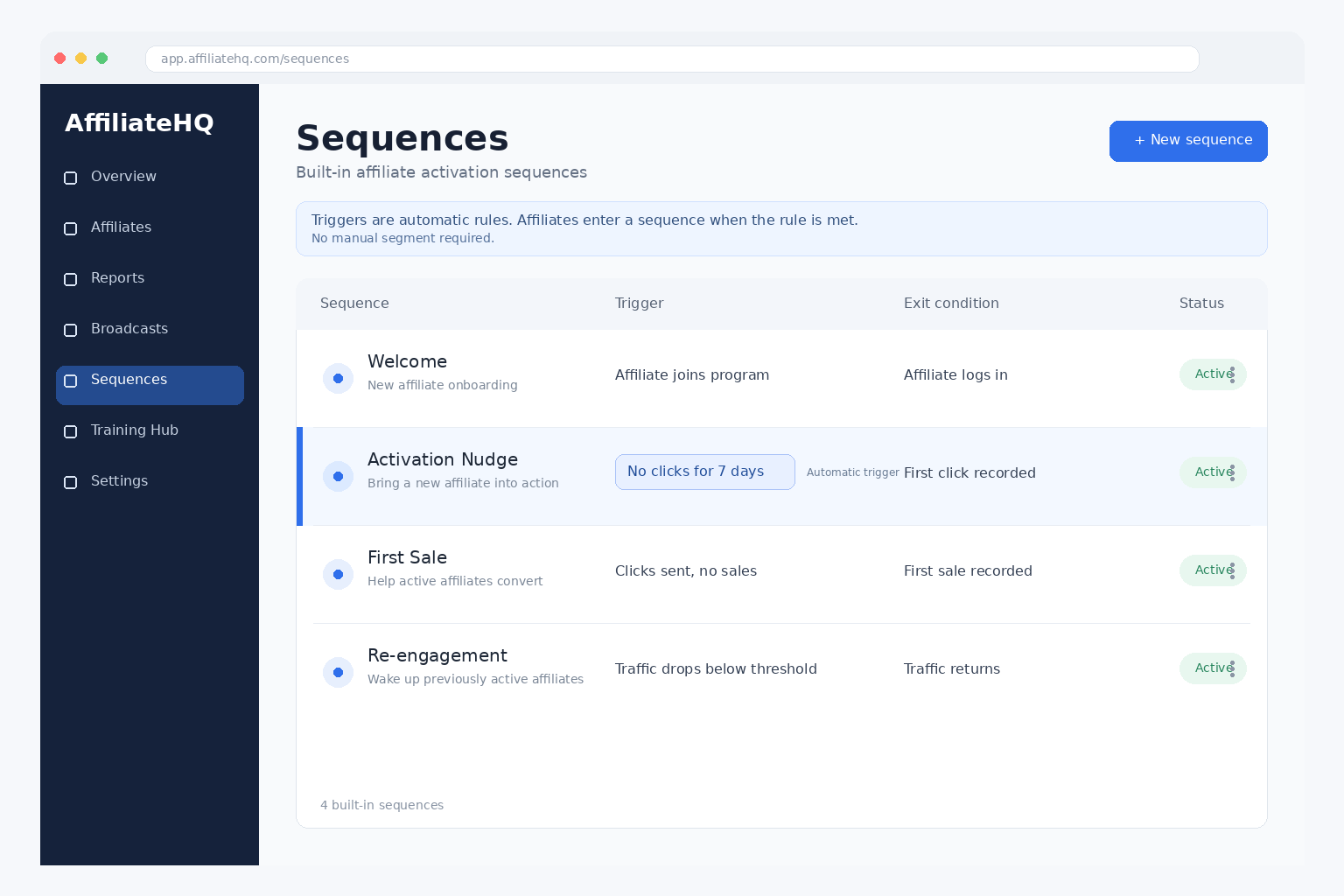 You reach them on a schedule tied to their behavior, not yours. An affiliate who joined 11 days ago and has never generated a click needs a different message than one who sent 300 clicks last year and has gone silent for six months. Post Affiliate Pro can send a mass email to a segment you build. It won’t watch for the behavior and fire on its own.
That distinction sounds small until you’re managing 400 partners. Building the segment is the part nobody does on a busy week, and the affiliate who joined in March is still sitting there in September.
In my own programs, the window that matters most is the first two weeks. An affiliate who never sends a click in the first 14 days rarely becomes a producer without a direct nudge. I’ve written about the pattern in why affiliates don’t promote, and the short version is that they’re not lazy. They’re stuck on the first step and nobody noticed.
AffiliateHQ ships with four activation sequences built on those thresholds, so the trigger fires whether or not you remembered to look. A joined-but-never-clicked alert surfaces the affiliate before they go cold. The Activation Nudge runs at seven days. Sequences support 11 trigger types and honor exit conditions, so an affiliate who starts promoting on day three drops out of the sequence instead of getting an email asking why they haven’t promoted.
The result is that activation happens on a Tuesday when you’re doing something else. That’s the whole point of putting it in the software.
Whatever platform you land on, you still need the words. My Affiliate Activation Templates are the exact emails I use to get affiliates who signed up but never promoted off the bench. Free, and they work in any tool that sends email.
If you want the manual version first, how to activate inactive affiliates walks the full process, and how to reactivate dormant affiliates covers the partners who used to produce and stopped. Do it by hand once so you know what you’re automating.
Where do you train your affiliates inside the platform?
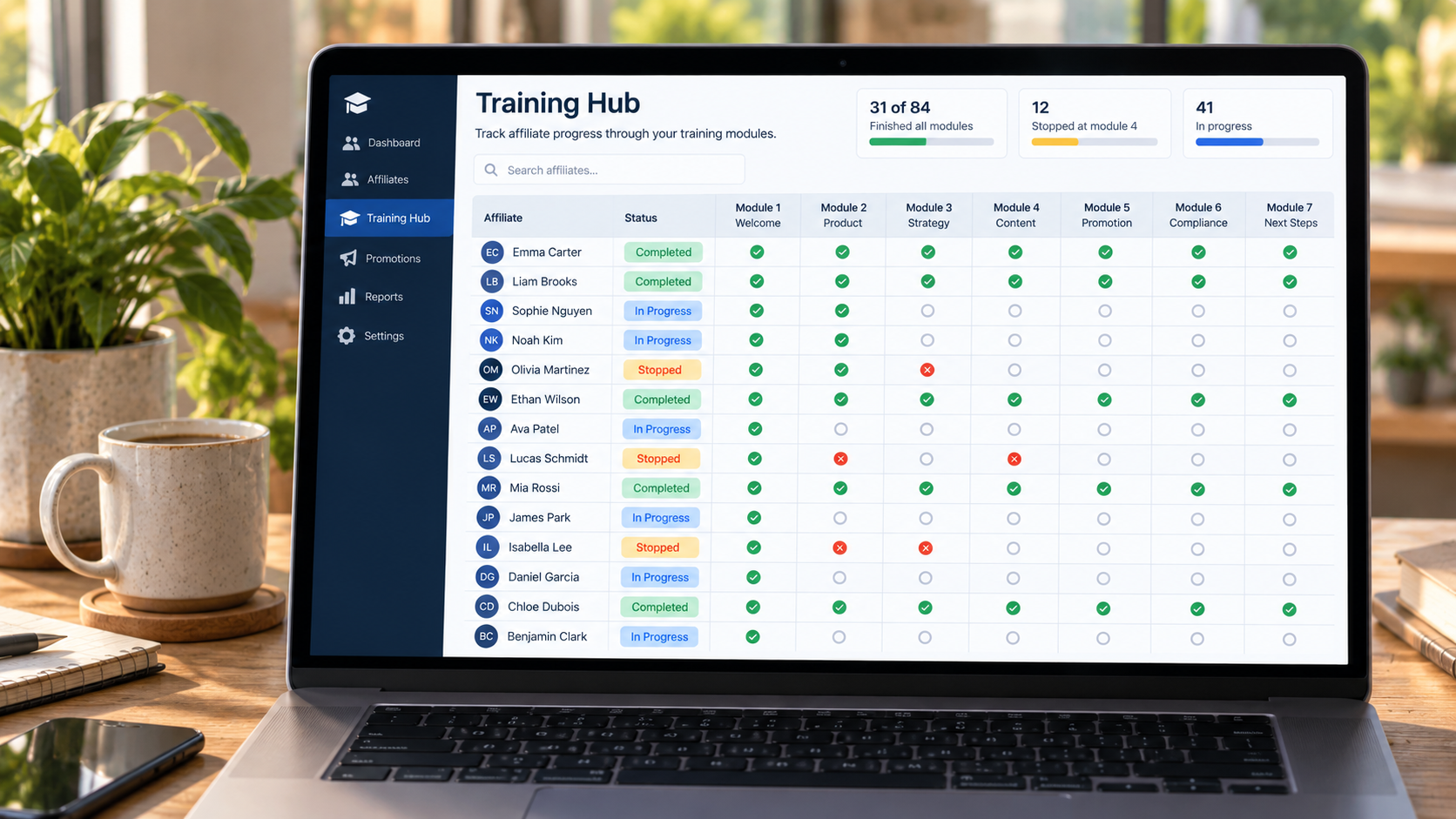 In Post Affiliate Pro, you don’t. You get a materials section for banners, links, and creatives, which is asset delivery rather than training. So the training lives somewhere else, usually Kajabi, Teachable, a Google Doc, or a Loom link buried in a welcome email.
Splitting it across tools costs you the one thing that makes training useful: knowing who finished it. When an affiliate emails you the day before a launch asking how the commission tiers work, you have no way to check whether they ever opened the module that explains it.
Trained affiliates outproduce untrained ones by a margin that’s hard to overstate, and I’ve watched it happen across hundreds of launches. An affiliate who understands your offer, your audience, and your promo calendar sends better emails to better-matched people. Training affiliates so they promote isn’t a nice-to-have. It’s most of the gap between a $40,000 launch and a $400,000 one.
AffiliateHQ has a Training Hub built in. You host modules inside the platform, and it tracks completion per affiliate, so you can see who finished what. There’s a readiness view that shows you, before a launch, which of your partners are prepared and which ones need a call this week. That’s a list you can act on. A Google Doc gives you nothing.
It also changes onboarding. New affiliates hit training in the same place they get their link, instead of chasing a separate login they’ll never use again. If you’re building that flow now, how to properly onboard affiliates with a welcome sequence lays out what to send and when.
Want to see what good affiliate training looks like before you build yours? I released a real one. Sample Affiliate Training is an actual training webinar we ran for a client’s affiliates, slides included. Steal the structure.
How do you get affiliates to commit to a launch promo plan?
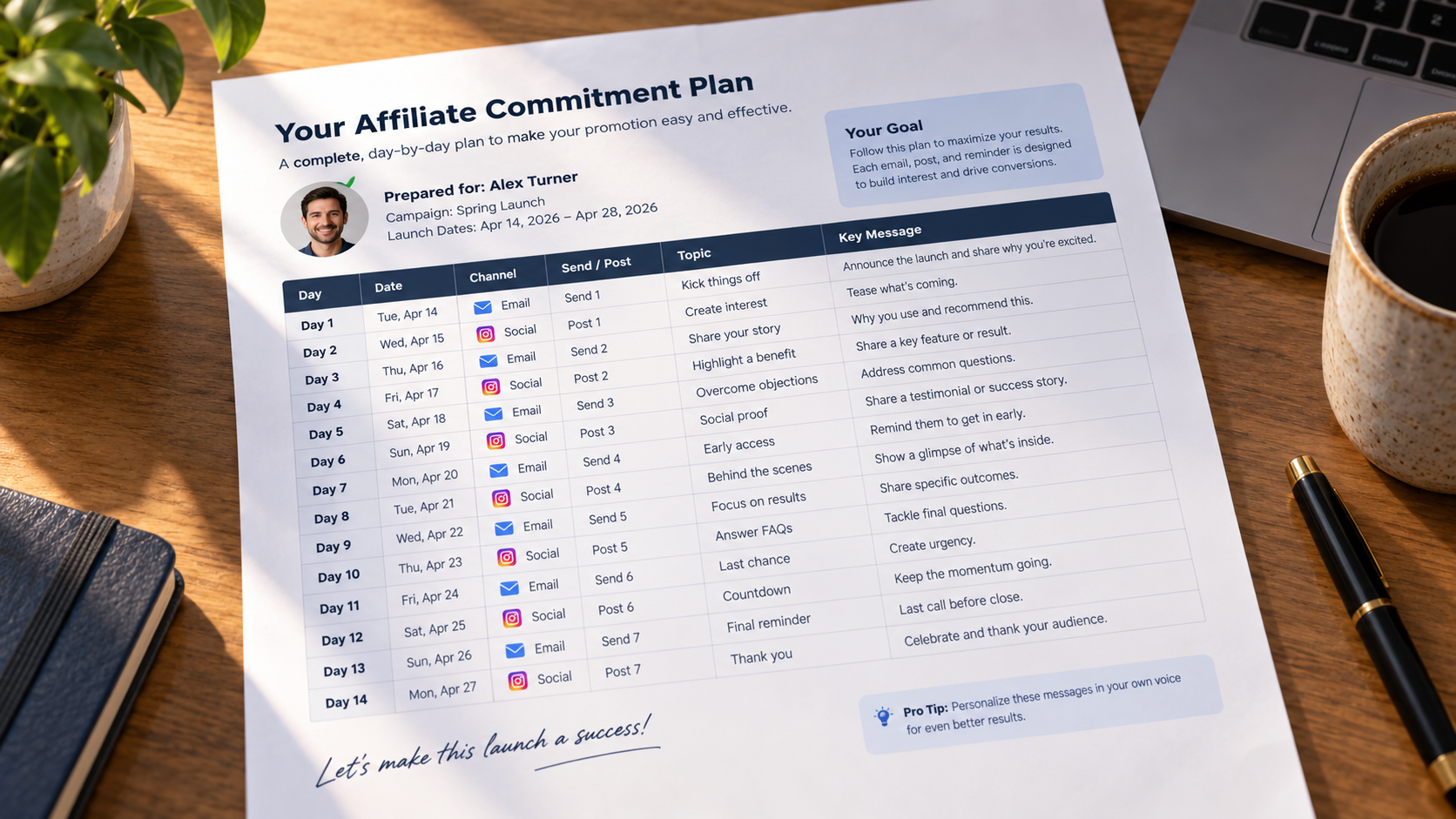 You put the plan in writing, tie it to a specific number of emails on specific days, and get the affiliate to agree to it before the launch opens. Post Affiliate Pro has no feature for this. Most platforms don’t, which is why the majority of programs run launches on a vague promise to “support the launch.”
A vague promise produces one email on day four. I’ve seen it a thousand times.
The fix I’ve used since my Michael Hyatt days is a commitment plan. You sit down with an affiliate, look at their list size and their history with your offers, and map out exactly what they’ll send: three emails during open cart, one on cart close day, two social posts, a bonus page. Then they say yes to that specific plan. Affiliates who commit to a written plan send five to twenty emails instead of one. Building an affiliate promotional calendar is the program-level version of the same idea.
AffiliateHQ builds this in as Commitment Plans. You generate a day-by-day promo calendar for each affiliate, and the platform runs ABC email-count formulas based on their tier, so a 50,000-person list gets a different plan than a 2,000-person list without you doing the math. You export the plan as a PDF and send it. The affiliate has their dates. You have a record of what they agreed to.
That record matters after the launch too, when you’re deciding who gets your best bonus offer next time.
Here’s the plan I hand affiliates who go on to earn tens of thousands in commissions. Sample Affiliate Promo Plan is a free download of the real thing, and it’s the fastest way to see the day-by-day structure I’m describing. Copy it for your next launch.
For the wider picture of how the plan fits into a launch, using affiliate marketing to launch a new product covers the timeline from recruiting through cart close.
How does AffiliateHQ compare to Post Affiliate Pro?
Both track clicks, sales, and commissions. That’s table stakes and neither one loses there. The difference is what happens after the tracking.
Post Affiliate Pro gives you the scoreboard: links, cookies, multi-tier commission rules, coupon attribution, banner management, payouts, and an integration list built up over 20 years. If your program is large, technically unusual, or already deeply wired into PAP, that depth is real.
AffiliateHQ gives you the scoreboard plus the coaching staff. Activation sequences that fire on affiliate behavior. A Training Hub with per-affiliate completion tracking. Commitment Plans with a day-by-day calendar. Twenty-two alert types that tell you an affiliate is slipping while you can still do something about it. I built it because every platform I ran a program on had been designed by someone who’d never had to hit an affiliate revenue number.
Every feature in it maps to something I teach in The Book on Affiliate Management and have run for two decades. That’s the entire design brief.
Who should stay on Post Affiliate Pro?
 Some programs should stay put, and I’d rather say so than pretend otherwise.
Stay if you’re running a network with multiple merchants underneath you, since that’s a specific architecture PAP supports and most alternatives don’t. Stay if you’ve built heavy custom integrations or plugin work on top of it, because rebuilding that is a real project with real cost. Stay if your commission structure is unusual, four levels deep with lifetime referral rules, and forced matrix logic. And stay if your affiliates are already producing, your activation rate is healthy, and your partners promote hard without you chasing them. In that case the gaps I described aren’t costing you anything.
The switch pays off when you’re spending hours every month doing by hand what the software should do, or when a majority of your roster has never sent a click. Choosing the right affiliate platform walks through the full evaluation if you want to compare more than these two.
How do you switch affiliate platforms without losing tracking?
You run both platforms at the same time for two to four weeks, then cut over. Skipping the overlap is how programs lose commissions and trust in the same week.
The sequence I recommend: export your affiliate roster, commission history, and outstanding balances from Post Affiliate Pro first. Install the new tracking on your site while PAP is still live, so both systems record the same sales and you can compare the numbers. Any gap between them is a setup problem you want to find now, not after you’ve turned the old system off.
Then tell your affiliates before anything changes. Give them the date, the new login, and the new links, and set up redirects from old links to new ones so the affiliate who wrote a blog post in 2021 keeps getting paid. That last piece is the one programs forget, and it’s the one affiliates notice.
Pay out every balance on the old platform before you close it. Don’t carry a partial balance across systems and try to reconcile it later. A manager’s job here is mostly communication, which is a big part of what an affiliate manager does in the first place.
Frequently asked questions
Is AffiliateHQ a full replacement for Post Affiliate Pro?
Yes for most direct-to-consumer programs, courses, SaaS, and service businesses running their own affiliate program. It handles tracking, commissions, multi-level structures, payouts, and reporting, plus the activation, training, and commitment tools PAP doesn’t have. If you’re running a multi-merchant network, PAP’s network architecture is the stronger fit.
What does Post Affiliate Pro cost compared to alternatives?
Post Affiliate Pro publishes tiers starting around $79 to $89 per month for the entry plan, rising through mid and top tiers, with network plans well above that. The pricing meters tracking requests, which include impressions, so a banner-heavy program consumes its allowance faster than click volume alone suggests. Check current pricing on their site before budgeting.
Can I keep my affiliate links if I switch platforms?
Not identically, but you can redirect them. Set up 301 redirects from your old affiliate link structure to the new one so existing content keeps tracking. AffiliateHQ also supports vanity aliases on your own domain, which means links your affiliates place today survive any future platform change without another redirect project.
How long does migrating an affiliate program take?
Plan on three to six weeks end to end. Roughly one week for setup and testing, two to four weeks running both platforms in parallel to verify tracking matches, and a few days for affiliate communication and final payouts on the old system. Programs that rush this in a weekend are the ones that end up reconciling commissions by hand.
Will my affiliates be upset if I change platforms?
Only if you surprise them. Affiliates care about two things: getting paid correctly and not having to redo work. Tell them three weeks ahead, redirect the old links, pay every balance before you close the old account, and record a five-minute walkthrough of the new dashboard. Handled that way, most affiliates barely notice.
What to do next
Pull two numbers from your current platform this week. First, the percentage of your affiliates who have never generated a single click. Second, how many of your partners you could name as having completed your training. If the first number is above 60 percent and the second is a shrug, tracking isn’t your bottleneck.
Then decide which of the three gaps costs you the most revenue, and fix that one first. Activation is usually the fastest win, since those affiliates already raised their hand.
I built AffiliateHQ after running programs from $0 to $1M a month and from $15M to $325M a year on software that kept letting me down. Activation sequences, a Training Hub, and Commitment Plans are in the platform, not bolted on. Take a look and see whether it closes the gaps your current tool leaves open.