Your affiliate program terms and conditions only work if your software enforces them. A 60-day cookie window in your agreement and a 30-day setting in your platform means you owe affiliates money your software will never pay, and you find out when they email you about it.
 Your affiliate program terms and conditions are a promise about how your software behaves. That’s the part almost nobody writes about. Every clause you put in that document, the attribution rule, the cookie window, the refund policy, the payout schedule, describes something a computer has to do on your behalf a thousand times a month. If the document says one thing and the platform does another, the document wins in a dispute and your budget loses.
I’ve written terms for programs at Shutterfly, Adidas, and dozens of smaller companies, and the expensive mistakes I’ve seen almost never come from bad legal language. They come from good legal language nobody configured. Someone copies a solid agreement, publishes it, and never opens the settings panel to make the software agree with it. Six months later an affiliate reads the terms more carefully than the owner did, and now there’s a bill.
Why your affiliate program terms and your software have to match
An affiliate agreement is enforceable in both directions. You can use it to remove a bad actor or claw back fraudulent commissions. Affiliates can use it to demand money your platform didn’t credit them. Most program owners think about the first direction and forget the second one exists.
Here’s the common version. Your terms say last-click attribution with a 90-day cookie. Your software was installed with the default 30-day, first-click setting because that’s what the box was set to when you signed up. An affiliate sends a customer who buys on day 47. Your platform pays nothing. The affiliate checks your published terms, screenshots the clause, and emails you. You pay it manually, because the clause is public and you wrote it. Multiply that by however many affiliates read carefully.
If you haven’t written the document yet, start with how to write an affiliate program agreement without hiring a lawyer, then come back here to wire each clause to a setting. The two jobs are separate and both matter.
Writing the terms from scratch is the part people put off for months. The Affiliate Terms Wizard is an AI tool trained on more than 1,000 attorney-written affiliate agreements, and it produces a full set of terms in 4 to 15 minutes instead of the hours a lawyer bills for. It’s $49 once, which is a fraction of the $300 to $1,000 most attorneys charge for the same document.
What should your affiliate attribution clause say?
 Your attribution clause names who gets paid when two affiliates touch the same sale. Sample language: “Commissions are awarded on a last-click basis. When a customer clicks multiple affiliate links prior to purchase, the affiliate whose link was clicked most recently within the cookie window receives the commission.”
That sentence commits you to a specific setting. Last-click, first-click, and split attribution pay different people different amounts on identical sales, and the difference shows up in your top affiliates’ checks. Affiliate attribution models is worth reading before you pick one, because switching later means telling affiliates their earnings math changed.
Full disclosure before I use it as the example throughout: I built AffiliateHQ, so I know exactly which settings sit behind which clauses. In AffiliateHQ, attribution lives in your program settings and gets set during the seven-step setup wizard, so you choose it before your first affiliate signs up rather than discovering the default six months in. Write the clause after you’ve made the choice, not before.
How long should your cookie window be in your terms?
Sample language: “Affiliate cookies remain active for 60 days from the initial click. Purchases completed after the cookie expires do not generate a commission unless the customer clicks a new affiliate link.”
Pick the number based on your sales cycle, then match it. A $27 ebook converts in a day and a 30-day cookie is fine. A $2,000 coaching program takes weeks of consideration and a 30-day window quietly steals commissions from affiliates who did the work. What is a good affiliate cookie duration walks the ranges by product type.
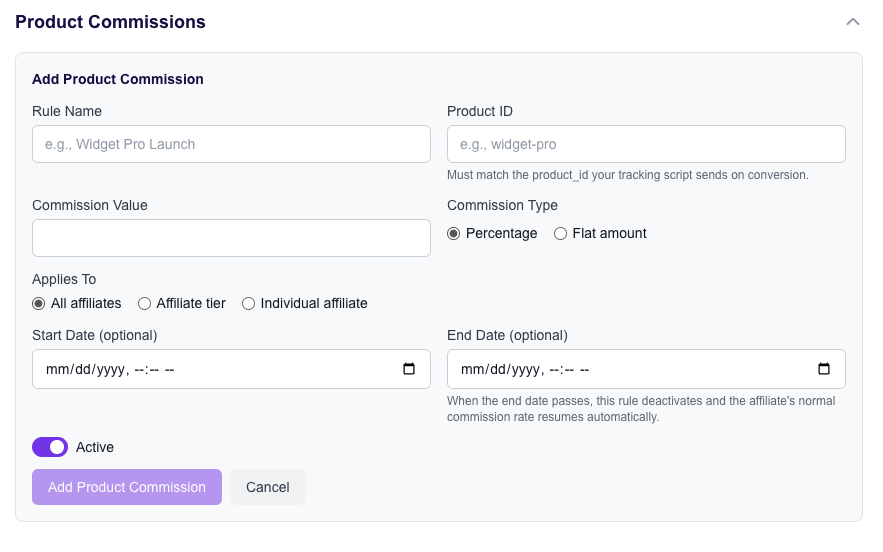
The mismatch here is the single most common one I find when I audit a program. Owners write 90 days because it sounds generous, then leave the platform at whatever it shipped with. AffiliateHQ lets you set the cookie window per program, and because you can run unlimited programs on one account, a 30-day window on your low-ticket offer and a 90-day window on your high-ticket one can coexist without you managing two logins. Your terms then need two numbers, not one.
What should your refund and clawback policy say?
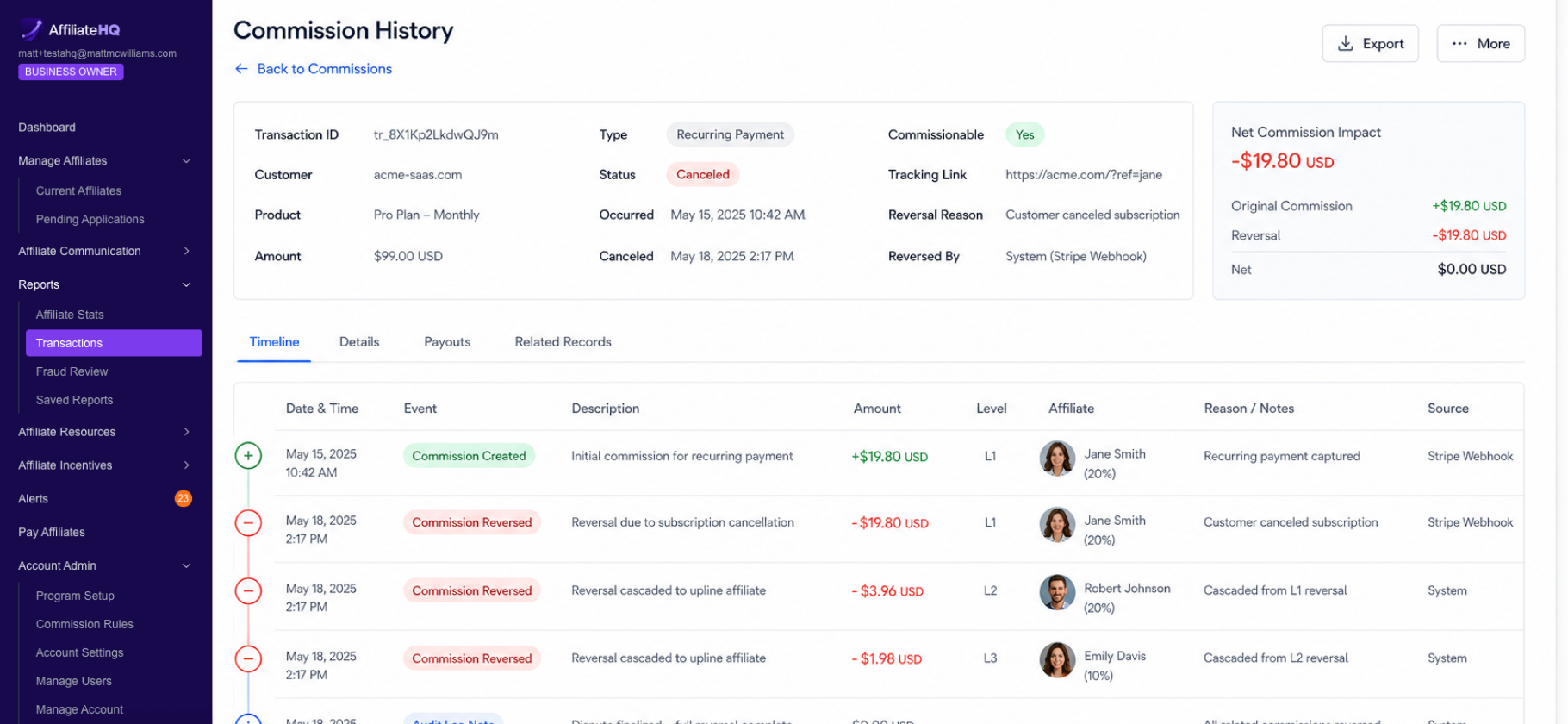
Sample language: “Commissions on refunded, charged back, or canceled orders are reversed. Reversals are deducted from the affiliate’s next scheduled payout. If no future payout covers the balance, the affiliate agrees to repay the amount within 30 days of written notice.”
Two things break here. The first is subscriptions. If you sell a recurring product and a customer cancels in month two after you paid a commission on months one through twelve upfront, your terms need to say what happens. Most don’t, and the owner eats it. The second is timing. A 30-day refund policy and a 15-day payout schedule means you’re paying commissions on sales that can still reverse, which is a math problem you created for yourself.
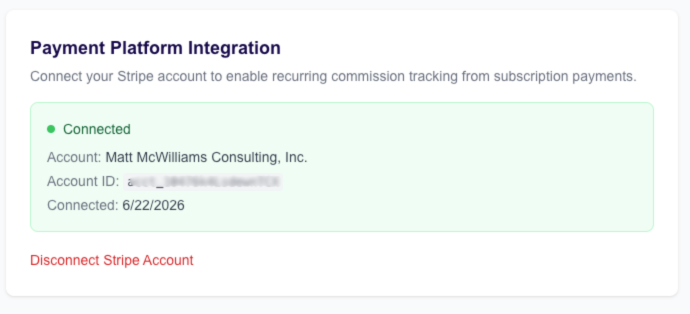
AffiliateHQ handles the subscription side through direct Stripe integration, so renewals, upgrades, downgrades, cancellations, and clawbacks flow into commission records without you reconciling two dashboards by hand. Your clause should describe what that integration does. If you’re on a platform that doesn’t watch Stripe, write a clause you can enforce manually, and be honest with yourself about whether you’ll do it.
Refund rates in affiliate promotions are usually a symptom of how affiliates sold the product, not a legal problem. How to reduce refunds in your affiliate promotions covers the promotional habits that drive returns up and what to tell affiliates before a launch.
What should your payout schedule and hold period say?
 Sample language: “Commissions are paid on the 15th of each month for sales that cleared the previous calendar month and have passed the 30-day refund window. A minimum balance of $50 is required for payment. Balances below the minimum roll to the following month.”
Three numbers in that clause have to exist as settings: the payout date, the hold period, and the minimum threshold. Affiliates plan around all three. Get the hold period wrong and you’re either paying on reversible sales or sitting on money long enough that affiliates assume you’re stalling. Sixty days is the outside edge of what good affiliates tolerate without asking questions.
The minimum threshold is the clause people forget to publish. If your platform holds balances under $50 and your terms don’t mention it, a small affiliate with $31 in commissions thinks you didn’t pay. How to pay affiliates covers the schedules and methods that keep this quiet.
Which promotional methods should your terms prohibit?
Sample language: “Affiliates may not bid on the Company’s brand name or misspellings thereof in paid search. Affiliates may not use cookie stuffing, forced clicks, iframes, adware, toolbars, or unsolicited email. Affiliates may not create coupon codes not issued by the Company or advertise discounts that do not exist.”
Brand bidding is the clause that costs the most money to leave out. An affiliate bids on your company name, intercepts customers who were already coming to buy, and collects a commission on a sale you would have made for free. Should affiliates be allowed to bid on your brand keywords makes the case for both positions, since some programs allow it deliberately.
Coupon abuse is second. Sites that rank for “your brand + coupon code” catch buyers at checkout and add nothing. Read should you allow coupon sites in your affiliate program before you write a blanket ban, because the answer depends on your margins.
Prohibitions need monitoring, not settings. That’s the honest version. No platform automatically detects a Google ad bidding on your brand. What software can do is surface the patterns that suggest something’s wrong, which is what the AI Program Analyzer in AffiliateHQ is built for, and give you the leaderboard and traffic data to spot an affiliate whose conversion rate is impossible. Affiliate fraud prevention tools covers what detection realistically looks like.
What should your termination clause say?
Sample language: “The Company may terminate an affiliate’s participation at any time, with or without cause, upon written notice. Commissions earned prior to termination and not subject to reversal will be paid on the next scheduled payout date. The Company may withhold commissions earned through activity that violates these terms.”
The second sentence is the one that saves you. Without it, an affiliate you removed for fraud can argue you owe them everything in their balance. With it, you have written grounds to withhold. Write the notice requirement in whatever form you’ll actually use, which for most programs is email.
The setting side is access control. When you terminate someone, their links have to stop crediting immediately, and whoever handles that on your team needs permission to do it without waiting for you. AffiliateHQ’s role-based permissions split access into Full Access, Account Manager, and View Only, so your affiliate manager can deactivate an account at 9 p.m. on a Friday without holding your admin password.
Terminating an affiliate is rarely the first move. Most disputes come from a misunderstanding about attribution or a payout that looked wrong. How to handle affiliate disputes walks the conversations that resolve these before anybody gets removed.
What should your terms say about FTC disclosure?
 Sample language: “Affiliates must clearly and conspicuously disclose their material connection to the Company in any content promoting the Company’s products, in a manner consistent with the FTC’s Guides Concerning the Use of Endorsements and Testimonials in Advertising. Disclosures must appear before any affiliate link and must be readable without clicking or scrolling past the link.”
The FTC pursues advertisers, meaning you, for what affiliates say. A clause alone doesn’t protect you. You need the clause plus evidence you enforced it, which means sending disclosure requirements to affiliates in writing and keeping a record that they got it. Affiliate link disclosure and what you’re required to say has the specific wording that passes.
The enforcement mechanism is training and communication records. AffiliateHQ’s Training Hub tracks per-affiliate completion, so you can show which affiliates completed your compliance module and when. Segmented broadcasts let you send the disclosure reminder only to affiliates who haven’t finished it, instead of emailing your whole list about a problem twelve people have.
How do you audit your terms against your software?
Open your published terms in one window and your platform settings in another. Read the terms clause by clause. Every time you hit a number or a rule, find the setting that produces it. Write down mismatches. It takes about 30 minutes and it’s the highest-value half hour in affiliate management.
The numbers to verify: cookie duration, attribution model, payout date, hold period, minimum payout threshold, commission rate by product, and recurring commission duration if you sell subscriptions. The rules to verify: whether your platform can even track the thing your clause promises. How affiliate tracking works explains what’s technically possible, which matters when your clause describes cross-device attribution and your software uses cookies alone.
When you find a mismatch, change the software to match the terms rather than the other way around. Your terms are published and affiliates have read them. Quietly editing a public agreement to pay people less is how you lose your best partners.
If your terms describe rules your current platform can’t enforce, the software is the problem. I built AffiliateHQ after 20 years of running programs on tools designed by people who’d never managed one, and every setting in it maps to a decision I teach in The Book on Affiliate Management.
What to change this week
 Three things, in order. Pull up your published affiliate program terms and conditions and verify the cookie duration and attribution model against your platform settings, because those two cause the most disputes. Add a clawback clause covering subscription cancellations if you sell anything recurring, since that’s the gap that costs real money. Publish your minimum payout threshold if your software has one and your terms don’t mention it.
If you don’t have terms yet, write them before you recruit your first affiliate. Recruiting people into a program with no agreement means you have no grounds to remove anyone, no matter what they do.
Want a starting point you can edit rather than a blank page? The Affiliate Terms Template is a free download covering the standard clauses, and it gives you something to compare your current agreement against in about ten minutes.