The best affiliate software for course creators handles three jobs that generic tracking software ignores: getting affiliates to promote after they sign up, training them on your offer before cart opens, and running a contest that holds attention across a five-day launch window. AffiliateHQ was built around those three jobs.
 Most course creators pick affiliate software the same way they pick a payment processor. They look at the pricing page, check whether it connects to Kajabi or Teachable, confirm it tracks a click, and move on.
Then launch week arrives. You recruited 84 affiliates. Nine of them mail. Six of those nine send one email on day one and go quiet. And the software you picked did its job perfectly. It tracked every click from all nine of them.
That’s the gap. Tracking is table stakes. I’ve run affiliate programs for course creators for two decades, and I’ve never once lost a launch because a link didn’t fire. I’ve lost plenty because affiliates who said yes in March never mailed in May.
What does affiliate software for course creators need to do that generic tracking can’t?
It needs to move affiliates from signup to promotion without you sending 300 manual emails. Course launches compress everything into a short window, so the software has to do the follow-up, the training, and the motivation on a schedule you set once.
Course launches work differently than evergreen affiliate programs. An ecommerce brand with a year-round program can afford a slow drip. If an affiliate takes four months to send their first sale, fine. Your cart is open for five days. An affiliate who warms up slowly is an affiliate who missed the launch entirely.
So the three requirements are activation, training, and motivation. Every course creator I work with hits all three problems, usually in that order, and usually about eleven days before cart open when it’s too late to fix any of them by hand.
Choosing between the main categories of affiliate software matters less than whether the one you pick does these three things. A platform with perfect tracking and no activation tooling will lose you more money than a platform with adequate tracking and a working activation sequence.
Why do affiliates who sign up during pre-launch go cold before cart open?

Because nothing happens between the signup and the launch. An affiliate applies in week one, gets an approval email, and then hears from you six weeks later when you need them. By then they’ve forgotten your offer, filled their calendar with someone else’s launch, or lost the login.
I’ve watched this play out on programs doing seven figures a year. The recruiting works. Course creators are good at recruiting because they already have an audience of students who love the product. Building pre-launch momentum gets people to raise their hands. The failure comes after the hand goes up.
The reason affiliates stall is boring. They don’t know what to do next. Affiliates who don’t promote almost never made a decision to skip your launch. They just never got a nudge at the moment they had bandwidth.
AffiliateHQ runs four activation sequences on thresholds I’ve set from twenty years of running these programs. A new affiliate who hasn’t logged in gets one message. An affiliate who logged in but never grabbed a link gets a different one. An affiliate who pulled a link and sent zero clicks gets a third. An affiliate who sent clicks and made no sales gets a fourth, and that one points them at what to fix.
You set it up once. It runs on every affiliate who joins, in the right order, without you tracking who’s in which bucket on a spreadsheet at 11 p.m.
If your affiliates have already gone quiet and you need to bring them back before your next launch, the sequence matters more than the copy. How to reactivate dormant affiliates walks through the exact order to send those messages and what to say in each one.
How do you train affiliates on a course offer in the time you have?
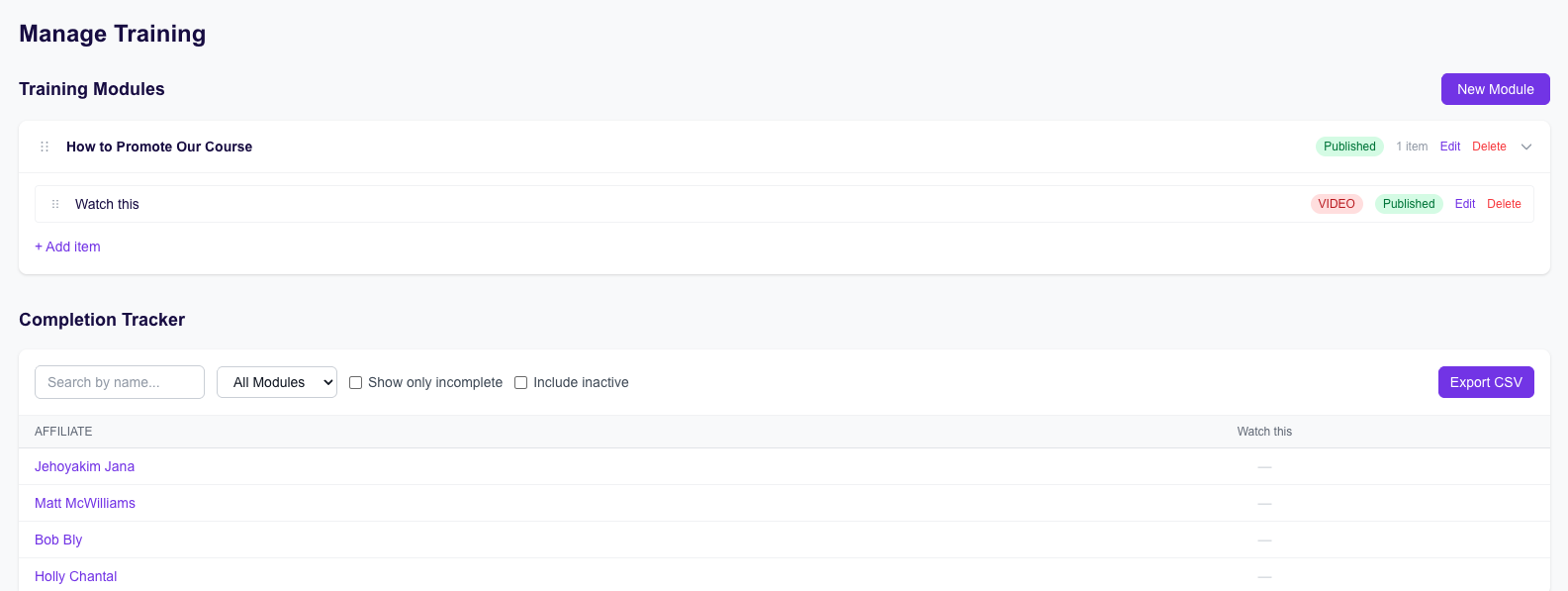
You put the training somewhere affiliates can reach it on their own schedule and you track who finished it. A live training call reaches the people who show up. Everyone else needs the replay, the swipe file, and the checklist sitting in one place they can find at 6 a.m. on a Saturday.
Course creators usually have the raw material already. You’ve recorded a launch overview. You’ve written swipe emails. You have a promo calendar with your webinar dates on it. The problem is distribution. Those assets end up scattered across a Google Drive folder, three emails, and a Facebook group post from April.
The Training Hub in AffiliateHQ holds all of it in modules. Launch videos, swipe files, promo checklists, graphics, and your calendar live in one place, organized in the order an affiliate should work through them. Affiliates see a progress bar. You see a completion tracker.
That completion tracker changes how you spend launch week. Instead of guessing which affiliates are ready, you sort by completion and see it. The affiliate who finished all six modules and scheduled her emails needs nothing from you. The affiliate who watched module one in March and stopped needs a phone call.
I’ve said for years that training affiliates so they promote is the hour that pays a program owner back the most. The completion data tells you where to spend the next hour.
Not sure what a real affiliate training should cover? I recorded one for a client and made it available with the slides. Grab the sample affiliate training and model your launch training on it instead of building from a blank page.
Why does one leaderboard stop working by day two of a launch?
Because on day two, the affiliate sitting in 14th place does the math and realizes she can’t catch the person in first. A ranked contest motivates the top five and quietly tells everyone else to stop trying. Your top five were going to promote anyway.
Course launches make this worse than most promotions. Five days is long enough for a leader to build a gap and short enough that nobody can close it. By Tuesday afternoon your leaderboard has calcified. The affiliates in positions 8 through 40, who collectively represent more of your list reach than your top three, have already checked out.
The fix is running threshold prizes alongside the ranked prizes. Anyone who hits five sales gets a bonus. Anyone who hits fifteen gets a bigger one. Now the affiliate in 14th place has a target she can hit on her own, and she’s competing against a number instead of against a person she’ll never beat.
AffiliateHQ runs both at once. Ranked prizes for the top finishers, threshold prizes for anyone who clears a bar you set, live in the same contest. Affiliates see both on the same leaderboard, so the person in 14th sees she’s two sales from a bonus even while she’s eleven sales out of the top ten.
This is the mechanic behind performance bonuses that get affiliates to go all in. It’s also why some of the best launches I’ve run had a boring leaderboard and a wildly active middle tier.
What about the affiliate tools built into Kajabi, Teachable, and Thinkific?
They track sales and they’re free with your plan, which makes them a reasonable starting point for your first launch. They stop being reasonable the moment you have more than about twenty affiliates, because none of them do activation, training delivery, or contests.
Kajabi’s affiliate feature gives each partner a link and a dashboard. Teachable’s does the same. Thinkific’s does the same. All three answer the question “did this person refer a sale,” and none of them answer “which of my 84 affiliates is ready to promote on Monday.”
The other limit is that your affiliate program lives inside your course platform. If you ever move platforms, or if you sell a second offer through a different checkout, your affiliate roster and history stay behind. I’ve helped course creators through that migration and it’s a bad week.
My general rule: run the built-in tool for your first launch while you’re proving the offer converts. Move to dedicated software before your second one. Starting an affiliate program as a course creator covers the commission math and recruiting side of that first launch.
Recruiting is the other half of this. I put together a free report on how we recruited 604 affiliates and built a program doing $1.1 million a month in 18 months, including the email templates. Download Your First 100 Affiliates before you pick a platform, so you know how many partners you’re building for.
What should a course creator look for when comparing platforms?
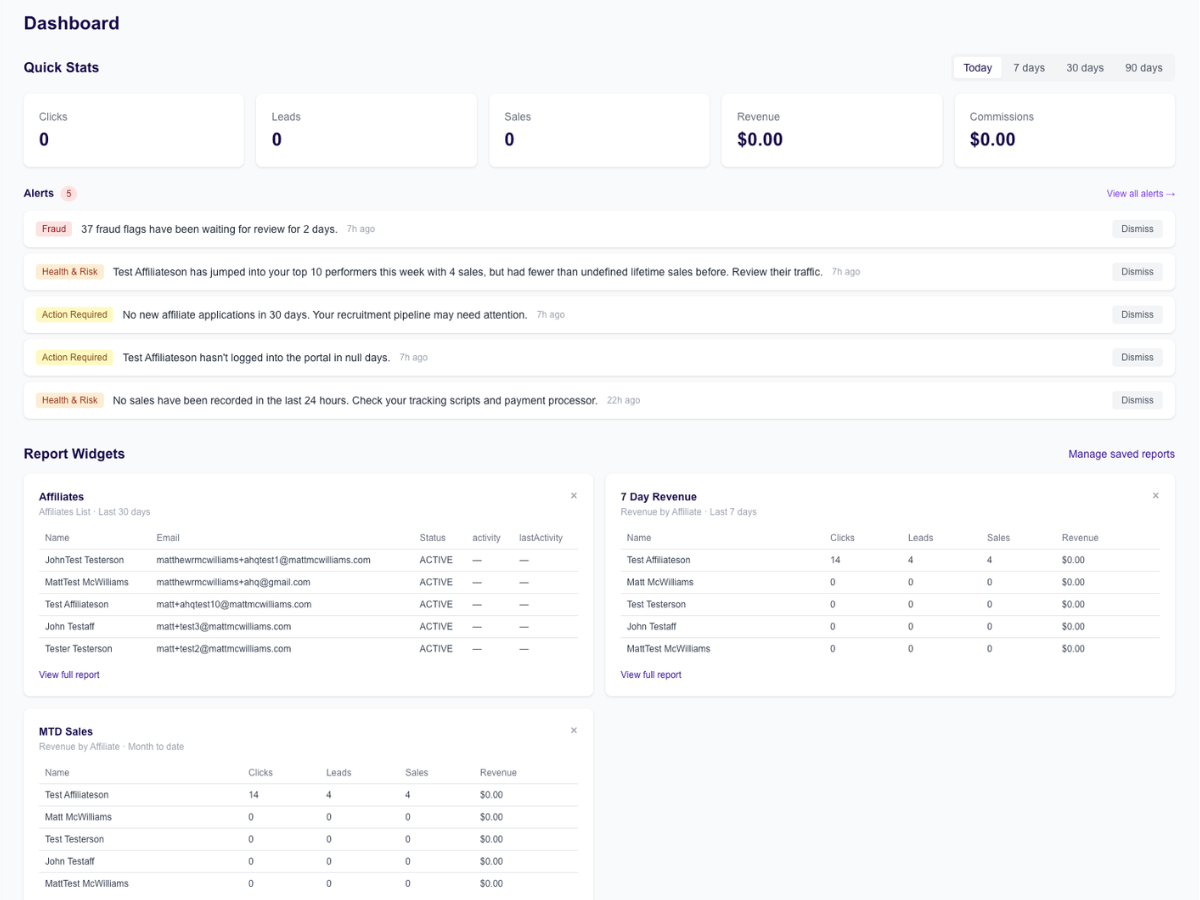
Ask what happens in the ninety days between signup and cart open, and make the vendor answer with a feature instead of a philosophy. Tracking, payouts, and a partner dashboard are in every platform on the market. The differences live in what the software does when nobody’s watching.
Four questions I’d ask any vendor:
- What automatically happens to an affiliate who signs up and never grabs a link?
- Can I see which affiliates finished my training and which ones stopped halfway?
- Can I run a ranked contest and a threshold bonus in the same promotion?
- Does my affiliate roster and commission history belong to me if I change course platforms?
If a vendor answers the first question with “you can send a broadcast,” they mean no. Broadcasts go to everyone. Activation means the right message reaches the right affiliate on a trigger, and you built it once in February.
One more thing worth checking: how fast a new affiliate gets to a first sale. Getting affiliates to that first sale is the strongest predictor of whether they promote your next launch. Software that shortens that window pays for itself across two launches.
Every feature in AffiliateHQ maps to something I teach in my book, because I built the software after twenty years of watching other platforms miss the point. The Book on Affiliate Management covers the system, and AffiliateHQ runs it for you.
What to do next
Pull up your last launch and count two numbers: how many affiliates signed up, and how many sent at least one email. If the second number is under 30 percent of the first, your problem is activation, and no amount of better tracking will fix it.
Then look at your training. If you can’t tell me which affiliates finished it, you’re guessing about your entire roster during the week when guessing costs the most.
Then look at your contest from that launch. If you ran a ranked leaderboard only, go find where affiliate number 14 stopped sending. I’d bet money it was day two.
Fix those three and your next launch runs on the affiliates you already recruited. Running a contest that motivates the whole roster and using affiliate marketing to sell more courses both go deeper on the tactics. AffiliateHQ is where I put all three into one platform so course creators stop rebuilding this by hand every launch.
Frequently asked questions

Do I need dedicated affiliate software for my first course launch?
No. If you’re launching for the first time with fewer than twenty affiliates, the built-in tool in Kajabi, Teachable, or Thinkific will track sales fine. Move to dedicated software once recruiting outpaces your ability to email every affiliate personally, which for most course creators happens somewhere between the first and second launch.
Can affiliate software connect to Kajabi?
Yes. Dedicated affiliate platforms connect to Kajabi, Teachable, Thinkific, ThriveCart, and Stripe checkouts, so tracking fires on the same purchase your course platform records. Running your affiliate program outside the course platform also means your roster and commission history stay with you if you change platforms later.
How many affiliates should a course creator have before launch?
Aim for enough active promoters rather than a big roster. Thirty affiliates who finished your training and scheduled emails will outsell 200 who signed up and forgot. Recruit widely, then measure readiness by training completion and first-sale activity in the weeks before cart open.
What’s the difference between an activation sequence and a broadcast?
A broadcast sends one message to everyone at once. An activation sequence sends a specific message to a specific affiliate based on what they’ve done, like signing up without grabbing a link or sending clicks without making a sale. Broadcasts inform. Sequences move people to the next step.
Should I run a contest for a five-day launch?
Yes, and run ranked prizes and threshold prizes together. A ranked-only contest motivates your top five and loses the middle of your roster by day two. Threshold prizes give every affiliate a target they can hit regardless of where they sit on the leaderboard.
How do I know if my affiliates are ready to promote?
Track training completion. If your software shows which affiliates finished your launch modules and which stopped partway, you can spend launch week calling the ones who stalled instead of emailing your entire list and hoping. Without that data, you’re guessing during the week guessing costs the most.