Price your product with the affiliate commission built in before you launch, not deducted from the margin you already have. If you plan to pay 30 to 50 percent out, your price has to cover that payout plus your product cost, refunds, and platform fees, and still leave a profit worth keeping. Set the price first around the commission you want to offer, and the program stays sustainable.
 Most business owners set their price, run the numbers on their own margin, feel good about it, and then bolt on an affiliate program later. That’s when the math breaks. You built a price that assumes you keep most of the revenue, and now you’re handing 40 percent of it to someone else on every sale. The product that made sense at a 70 percent margin makes no sense at a 30 percent margin, and you find that out after affiliates are already promoting.
I’ve built affiliate programs that paid out tens of millions in commissions, and the profitable ones shared one trait: the owner priced the product knowing affiliates were coming. Here’s how to run that math before you launch, so your payouts stay profitable and your affiliates stay interested.
How affiliate commissions change your pricing math
A 40 percent commission on a $100 product costs you $40 in payout on every affiliate sale, before you cover your product cost, refunds, and platform fees. That single number reshapes the whole equation. Your margin on an affiliate sale is never the margin you calculated for a direct sale, because a direct sale doesn’t pay a partner.
Say your $100 product costs $20 to deliver. On a direct sale you keep $80. On an affiliate sale at 40 percent, you pay $40, keep $60 in gross revenue, subtract the same $20 cost, and land at $40 in profit. Half your margin walked out with the commission. That’s fine if you priced for it. It’s a slow bleed if you didn’t.
The commission percentage and the commission structure both feed this. A flat 30 percent behaves differently than a tiered rate that climbs to 40 percent for top performers. Before you settle on a price, decide roughly how you’ll structure the commission tiers and partner types, because a program that rewards volume with higher rates needs a price that survives the top tier, not just the base one.
Build the commission into the price, not out of your margin
 Add the commission to the price you need, rather than subtracting it from the price you set. Start with the profit you want to keep per sale, add your product cost, then add the commission on top, and let that total become your list price.
Work it backward. You want to keep $50 in profit on each sale. Your delivery cost is $20. You plan to pay affiliates 30 percent. If you price at $100, the 30 percent commission is $30, leaving you $50 after the $20 cost. The math holds. If you’d priced at $80 first and then tacked on a 30 percent commission, you’d pay $24, cover $20 in cost, and keep $36. The commission ate into the profit you wanted because you set the price before you accounted for the payout.
The order matters more than it looks. Business owners who price for direct sales and add affiliates later almost always end up with a program that’s technically running but quietly unprofitable. Deciding your target commission early is part of the same decision as choosing a commission rate affiliates will promote.
The commission rate and the product price are two halves of the same equation, and getting them wrong on either side breaks the program. For a full breakdown of what affiliates expect at each price point and product type, read What is a Good Affiliate Commission Rate?
Why underpricing kills affiliate interest
Affiliates evaluate an offer on earnings per click, not on the commission percentage, and a low price wrecks that number even at a generous rate. A 40 percent commission on a $27 product that converts at 1 percent pays about $10.80 per 100 clicks. A 25 percent commission on a $297 product that converts at 3 percent pays $222.75 per 100 clicks. Same effort sending traffic, wildly different paycheck.
That gap is why a serious affiliate looks at a $19 product, does the math, and moves on. They can send the same email to their list for your offer or someone else’s, and the higher-priced product with a real payout wins their attention. Underpricing doesn’t only shrink your margin. It removes the incentive that makes affiliates promote you at all.
This is the trap of the low-ticket offer. A cheap product can still run a program, but the price has to be high enough for the commission to matter to the person promoting it. If your product sits at a low price point, you have to solve the earnings-per-click problem another way, which I cover in how to run an affiliate program with a low-priced product. Raising the price is often the cleanest fix.
The margin math that keeps a program profitable
 Your affiliate-adjusted margin decides whether the program survives, and it’s your price minus your product cost minus the commission minus your refund and fee load. Run that calculation before you launch, not after your first commission report lands.
Physical products and digital products behave differently here. A digital course that costs almost nothing to deliver can support a 40 to 50 percent commission and still keep a healthy margin. A physical product with a 35 percent cost of goods can’t. Pay a 30 percent commission on a physical product that already costs you 35 percent to make and ship, and you’re at 65 percent gone before refunds, chargebacks, and payment processing. That’s how affiliate margins work for e-commerce brands, and it’s why physical product commissions usually land in the 5 to 15 percent range while digital products can pay 30 to 50 percent.
Refunds deserve a line in this math. If you refund 8 percent of orders after paying commission on them, you’re clawing back or eating that cost. A clawback provision in your terms helps, but price with a refund buffer so a normal return rate doesn’t erase the sale’s profit.
The pricing math is one piece of a larger system for building a program that scales without collapsing on margin. Everything I learned running programs from zero to a million dollars a month is in The Book on Affiliate Management, including how commission structure and product price work together.
How to price a product for affiliates from day one
Price a product you intend to run affiliates on by starting with three numbers: your target profit per sale, your delivery cost, and your target commission rate. Add them, and the sum is your floor price. Anything below it puts the program in the red.
Here’s the sequence. Decide what you need to keep on each sale. Add what it costs to deliver one unit. Add the dollar commission at your target rate, calculated against a draft price and adjusted. Then pressure-test the total against your market. If the floor price lands above what your customers will pay, you have a product or positioning problem to solve, not a pricing trick to paper over it.
Owners who do this early avoid the most common failure, which is discovering the program can’t be profitable only after affiliates are already selling. Deciding whether a program even fits your business and your price point is worth doing first. If you’re not sure your numbers support one yet, work through whether your business needs an affiliate program before you commit.
Pricing a subscription when you pay commission every month
 Recurring products need a price that survives paying commission on more than the first payment, because most subscription affiliate programs pay for the life of the customer or for a set number of months. A 30 percent recurring commission on a $50 per month subscription costs you $15 every month that customer stays, not $15 once.
That recurring payout changes the calculation. On a subscription with a 20-month average customer lifetime, a 30 percent lifetime commission on a $50 plan pays out $300 total. Your price and your retention have to support that. Many subscription businesses cap recurring commissions at 12 months, or pay a higher first-payment rate and a lower recurring rate, which keeps the acquisition incentive strong without bleeding margin forever.
Escalating commissions can also motivate your best affiliates without wrecking the recurring math, especially if the higher rate only kicks in after real volume. That’s the logic behind using tiered affiliate commissions to reward top performers. Price the base subscription so even the top tier stays above your margin floor.
Pricing mistakes that make an affiliate program unsustainable
The mistake that kills the most programs is setting the commission as a fixed dollar amount without checking it against your margin at every price and discount level. A $50 flat commission looks fine on a $200 product at full price. Run a 40 percent off promotion, sell it for $120, and that same $50 commission is now 42 percent of the sale.
Three pricing mistakes show up again and again. Pricing the product before deciding on the affiliate program, so the commission comes out of margin you already committed elsewhere. Ignoring refunds and fees in the margin math, so the program looks profitable on paper and loses money in practice. And discounting heavily without adjusting commission logic, so your best promotions become your least profitable sales. Each of these is fixable, but only before you’ve built a price you can’t move.
None of this shows up in the obvious costs like software or setup. Those matter too, and I break them down in how much it costs to start an affiliate program. But the pricing mistakes cost more than any tool, because they compound on every sale.
Should you raise your price to fund the affiliate program?
 Raising your price to cover the commission is often the right move, and a modest increase usually costs you fewer sales than the affiliate program brings in. If you sell a $97 product and raise it to $127 to fund a 30 percent commission, you’re adding $30 to cover a $38 payout, and the affiliate’s traffic more than covers the small gap.
The reason this works comes down to customer acquisition cost. An affiliate only gets paid when they generate a sale, which makes affiliate marketing one of the lowest-risk acquisition channels you have. Compare it to paid ads, where you pay whether or not the click converts. When you weigh affiliate marketing against paid ads for customer acquisition, the affiliate commission starts to look like an acquisition cost you’d happily pay, and pricing to fund it is smarter than protecting a lower price that generates fewer sales.
A price increase also filters your customers slightly upward, and higher-priced buyers tend to refund less and complain less. You’re often improving the economics of every sale, affiliate or direct.
Should affiliates earn on the full price or the discounted price?
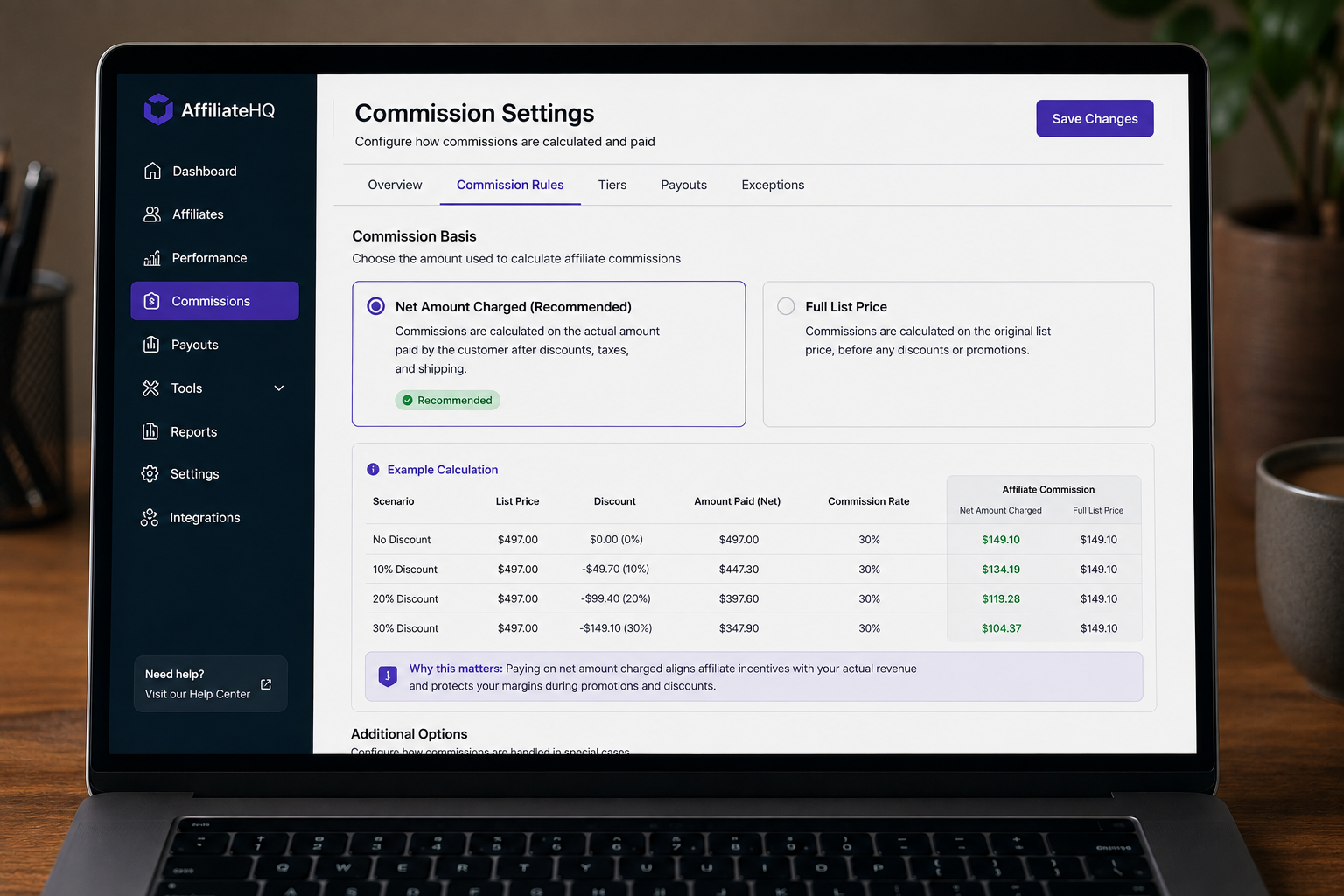 Pay affiliate commission on the actual amount the customer pays, the discounted price, not the full list price, unless you’ve deliberately decided otherwise and priced for it. Paying on the full price during a heavy discount can flip a promotion into a money-loser.
Here’s the risk. You list a product at $200 and pay 30 percent, which is $60. You run a 50 percent off sale, the customer pays $100, and if your terms pay commission on the $200 list price, you’re handing the affiliate $60 on a $100 sale. After product cost, you’ve lost money on a sale you were supposed to celebrate. Paying the $30 commission on the actual $100 charged keeps the promotion profitable.
Set this rule in your program terms from the start, and make sure your platform calculates commission on the net amount charged. If you want to reward affiliates during a sale, a temporary rate bump on the discounted price is safer than paying full-price commission, because you stay in control of the actual dollars going out.
How to model your affiliate-adjusted margin before you launch
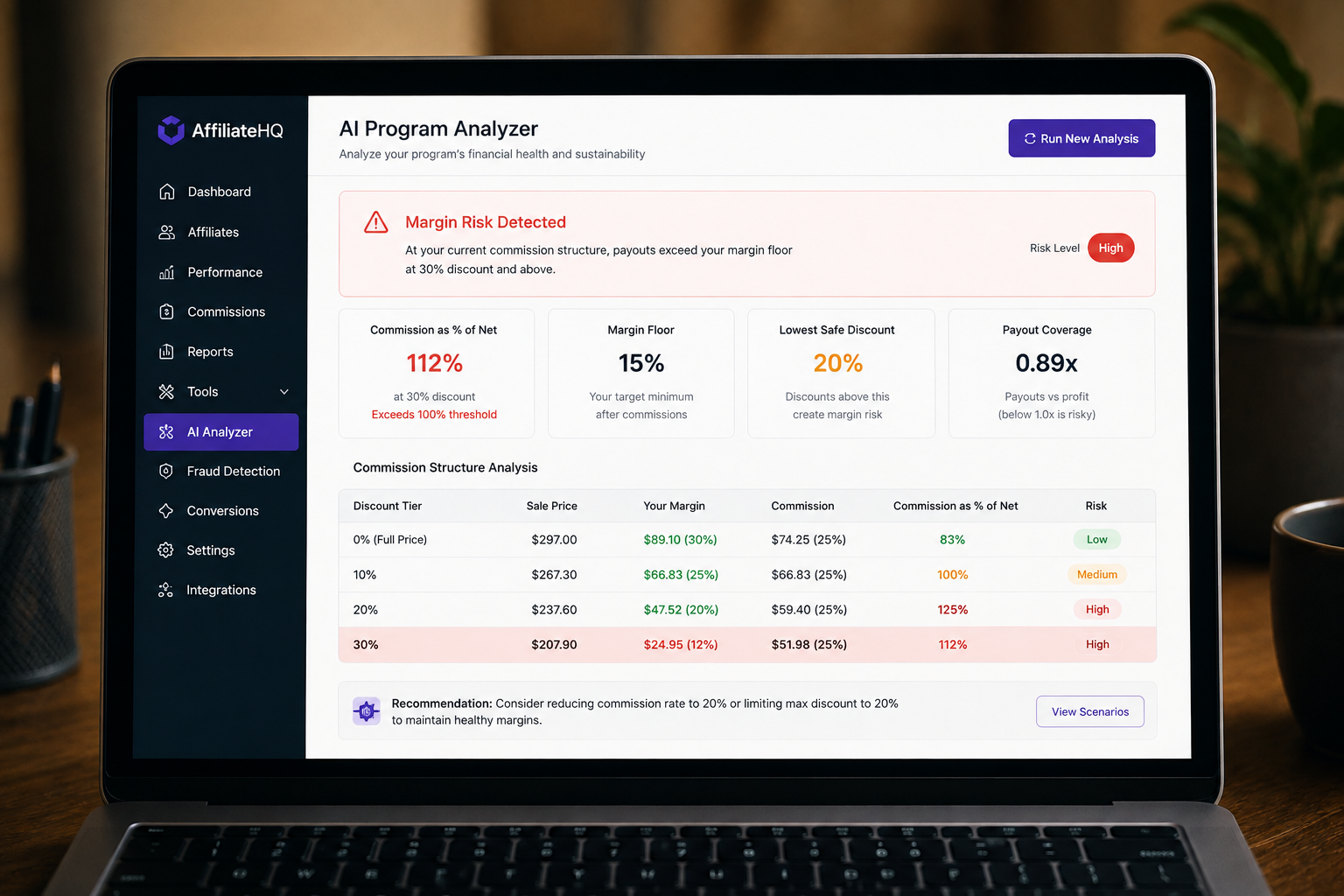 Model your worst-case affiliate sale before you launch, meaning the sale at your highest commission tier, during your deepest planned discount, with a refund buffer applied. If that sale still clears your margin floor, your pricing is safe. If it doesn’t, fix the price now.
Build the model with real numbers. Take your list price, apply your steepest planned discount, subtract your top-tier commission on the discounted amount, subtract your product cost, then subtract a percentage for refunds and payment fees. What’s left is the profit on your worst affiliate sale. Most owners never run this scenario, which is why so many programs look fine at launch and hurt six months in when top affiliates hit the top tier during a big promotion.
The same discipline pays off after launch, when you’re tracking whether the program returns more than it costs. Measuring that clearly is its own skill, and I cover it in how to measure what your affiliate program is worth. Good pricing gives the ROI math a fighting chance. Bad pricing guarantees the numbers never work.
Modeling your margin by hand works, but software that runs the scenarios for you catches problems faster. The AI Program Analyzer inside AffiliateHQ reviews your commission structure and flags where your payouts and pricing put margin at risk, so you can adjust before it costs you.
What price point works best for an affiliate program?

The sweet spot for most affiliate programs sits between $97 and $997, because that range pays affiliates enough per sale to be worth their effort while staying affordable enough to convert. Below $50, the commission rarely justifies an affiliate’s time. Above a few thousand dollars, conversion drops and the sale gets harder to close on referred traffic.
This doesn’t mean cheaper or pricier products can’t run programs. It means the price point shapes the strategy. A $27 product works if you have order bumps and upsells that raise the average order value the affiliate earns on. A $5,000 program works if you pay a flat referral fee large enough to motivate real promotion. The price and the payout have to make the affiliate’s earnings per click competitive with the other offers fighting for their audience’s attention.
If you’re recruiting your first partners while you settle your pricing, the two decisions feed each other. The price determines the payout, and the payout determines who’s willing to promote you. Getting both right early separates a program that grows from one that stalls.
Once your pricing supports a real commission, the next job is finding affiliates who’ll promote at that payout. My free report Your First 100 Affiliates covers where to find top affiliates and the exact email templates I used to recruit 604 partners and build a $1.1M per month program in 18 months.
Frequently asked questions
Do I need to raise my price to run an affiliate program?
Not always, but often. If your current margin can absorb a 20 to 30 percent commission and still leave the profit you need, you can keep your price. If it can’t, a modest increase to fund the commission usually costs you fewer sales than the affiliate program generates. Model your margin at your target commission first, then decide whether the price needs to move.
What commission can I afford on a low-margin product?
On a physical product with a 30 to 40 percent cost of goods, commissions usually work best in the 5 to 15 percent range, because higher rates erase your margin after refunds and fees. If that rate is too low to attract affiliates, the fix is usually raising the price or increasing average order value with upsells, not paying a commission you can’t sustain.
Should affiliates get commission on the discounted price or the full price?
Pay commission on the actual amount the customer pays, which is the discounted price, unless you’ve deliberately priced to pay on full list. Paying full-price commission during a deep discount can push the payout above your margin and turn a promotion into a loss. Set this rule in your terms and confirm your platform calculates on the net amount charged.
How do I price a subscription product with affiliates?
Price it to survive paying commission on more than the first payment, since most subscription programs pay recurring or lifetime commissions. Calculate the total payout across your average customer lifetime, not just month one. Many businesses cap recurring commissions at 12 months or pay a higher first-payment rate and a lower recurring rate to keep acquisition strong without draining margin indefinitely.
Can I run an affiliate program on a $17 product?
You can, but the commission alone won’t motivate serious affiliates, because even a 50 percent rate pays only $8.50 per sale. Make it work by raising the effective payout with order bumps and upsells the affiliate earns on, or by treating the cheap product as a front-end offer that leads to a higher-priced backend the affiliate also gets credited for.
What to do next
Start with three numbers before you touch your price: the profit you need per sale, your delivery cost, and the commission you want to pay. Add them, and that sum is the floor your price can’t drop below. Then model your worst-case affiliate sale, the one at your top commission tier during your deepest discount with a refund buffer, and confirm it still clears that floor.
If your current price can’t support a commission affiliates will promote, raise the price rather than shrinking the commission. A higher price that funds a real payout beats a lower price no affiliate will touch. Get the pricing right first, and every other part of the program has a chance to work.