Yes, most affiliate programs should allow paid ads, with written rules about which channels affiliates can use, whether they can link directly to your site, and what they cannot bid on. Programs that stay silent on paid traffic end up paying commissions on clicks they were already buying themselves.
 I’ve watched a lot of program owners handle this badly. They launch the program, an affiliate starts running Facebook ads, sales jump, and the owner celebrates. Three months later they figure out that affiliate was retargeting people who had already visited the sales page, and the program was paying 30% commissions on customers who were one email away from buying anyway.
The fix isn’t banning paid ads. Some of the best affiliates I’ve worked with over 20 years run paid traffic exclusively, and they bring in customers who had never heard of the product. The fix is writing down what you’ll allow before someone spends a dollar.
What counts as affiliate paid traffic?
Affiliate paid traffic is any promotion where the affiliate pays a platform for placement and sends that click through their tracking link. Google Ads, Meta ads, YouTube pre-roll, TikTok, native placements on Taboola or Outbrain, Reddit ads, newsletter sponsorships, and display buys all count.
Most program owners think about Google and Facebook and forget the rest. An affiliate buying a $2,000 sponsored slot in a newsletter is running paid traffic. So is an affiliate paying a podcaster for a read. Your policy should cover the category, not a list of two platforms.
Why do most programs allow paid ads with restrictions?
Paid affiliates reach people your organic channels don’t touch. An affiliate running cold Facebook traffic to a review page is finding buyers who have never seen your name. That customer is incremental. You pay a commission only after the sale, and the affiliate carries the ad risk.
The restrictions exist because the same tracking link works for cold traffic and for traffic you already paid to generate. An affiliate can build a lookalike audience off your site visitors, run ads to people who abandoned your cart, and collect commissions on a group you were about to convert with a $0.02 email.
Same commission, wildly different value. Your rules should separate the two.
If you’re still deciding whether affiliates or ads deserve the bigger slice of your budget, I compared the two channels on cost, risk, and speed in How Affiliate Marketing Compares to Paid Ads for Customer Acquisition. Short version: affiliates cost you nothing until a sale happens, which changes how you should think about the paid traffic your affiliates run on top of that.
Which paid channels should you permit?
 Permit non-brand search, paid social, YouTube, native, and sponsored newsletter placements by default. Restrict or prohibit brand-term search, display retargeting pointed at your own site visitors, and any channel where you can’t verify the creative.
The test I use: can this affiliate reach someone who wouldn’t have found you this week? Cold Meta traffic passes. A Google Ads campaign on your exact product name fails. Native placement on a finance site passes. Retargeting your cart abandoners fails.
One more category worth naming in your terms: incentivized traffic. Cashback sites, loyalty apps, and reward-point networks buy paid placement and then hand part of the commission back to the buyer. Some programs love them. Others find they train customers to hunt for a discount before every purchase. Decide on purpose, not by accident.
Should affiliates be allowed to direct link?
Prohibit direct linking in most programs. Direct linking means the affiliate points the ad straight at your sales page through a tracking redirect, with no page of their own in between.
Two problems. First, you lose control of the message, because the ad copy is the entire pitch and you never see it until the sale posts. Second, direct-link affiliates compete with your own campaigns for the same auctions, on the same platforms, targeting the same audiences, using copy that may promise things your product doesn’t do.
Require a bridge page. The affiliate sends paid clicks to a review, comparison, or presell page they own, and that page links to you. You get a reviewable asset, the affiliate builds something durable, and the FTC disclosure lives somewhere you can point to.
The exception: a small number of trusted partners running high-volume campaigns you’ve reviewed personally. Grant that by request, in writing, one affiliate at a time.
What landing page rules should you set?
 Require a clear affiliate disclosure, accurate income and results claims, no fake countdown timers, no imitation of your own site design, and no use of your logo in a way that suggests the page is yours.
Brand impersonation is the one that gets people sued. An affiliate builds a page that looks like your official site, ranks an ad against your name, and now your customers can’t tell who they’re buying from. The FTC has gone after this pattern, and the merchant gets named alongside the affiliate.
Put the disclosure rule in plain language. Something like: every page running paid traffic to our offer must state that the page owner earns a commission, above the fold, in text a reader can see without scrolling.
Disclosure rules changed for AI-generated endorsements too, and a lot of affiliates haven’t caught up. I broke down what program owners need to change in FTC’s new AI endorsement rules.
How does retargeting overlap cost you money?
You pay twice. Your own retargeting pixel fires on a visitor, your ads chase them for a week, and an affiliate running their own retargeting on a lookalike or shared audience catches the last click. Under last-click attribution, the affiliate gets full credit for a customer your ad spend warmed up.
The number that exposes this: new-customer rate by affiliate. Across a healthy program, cold-traffic affiliates bring 70% or more first-time buyers. An affiliate whose sales are mostly returning visitors or people who already opted in to your list is harvesting, not recruiting.
Pull that number monthly. If one affiliate’s new-customer rate sits far below the rest of your program, look at their traffic source before you look at anything else.
Last-click is the default in most affiliate software, and it’s the reason retargeting affiliates look like superstars. I explained the alternatives and when each one makes sense in Affiliate Attribution Models Explained.
What about bidding on your brand name?
 Prohibit it in almost every program. A customer typing your brand name into Google already decided to buy from you, and an affiliate who intercepts that search collects a commission on a sale you had won. Worse, they drive up the cost of your own brand-term ads by bidding against you in the same auction.
Brand bidding is its own decision with its own exceptions, and I covered the economics, the network rules, and the detection methods in detail in Should Affiliates Be Allowed to Bid on Your Brand Keywords?. Read that one before you write the clause.
What clauses belong in your affiliate terms?
Six clauses cover the ground for most programs:
- Permitted channels, named specifically, with a catch-all for anything not listed requiring written approval
- A direct-linking prohibition with a request process for exceptions
- Brand-term and trademark restrictions, including misspellings and your URL
- Landing page requirements covering disclosure, claims, and brand impersonation
- A rule against retargeting audiences built from your own site traffic
- An enforcement clause spelling out warning, commission reversal, and termination
Write these in the terms, not in a welcome email. An email isn’t enforceable. Your terms are the document you point to when you reverse $4,000 in commissions and the affiliate threatens to sue.
Writing this from scratch takes hours. Grab my Affiliate Terms Template for free and edit the paid traffic section to match the rules above. It’s the same structure I’ve used for programs doing seven figures a month.
How do you spot paid ads violations in your reporting?
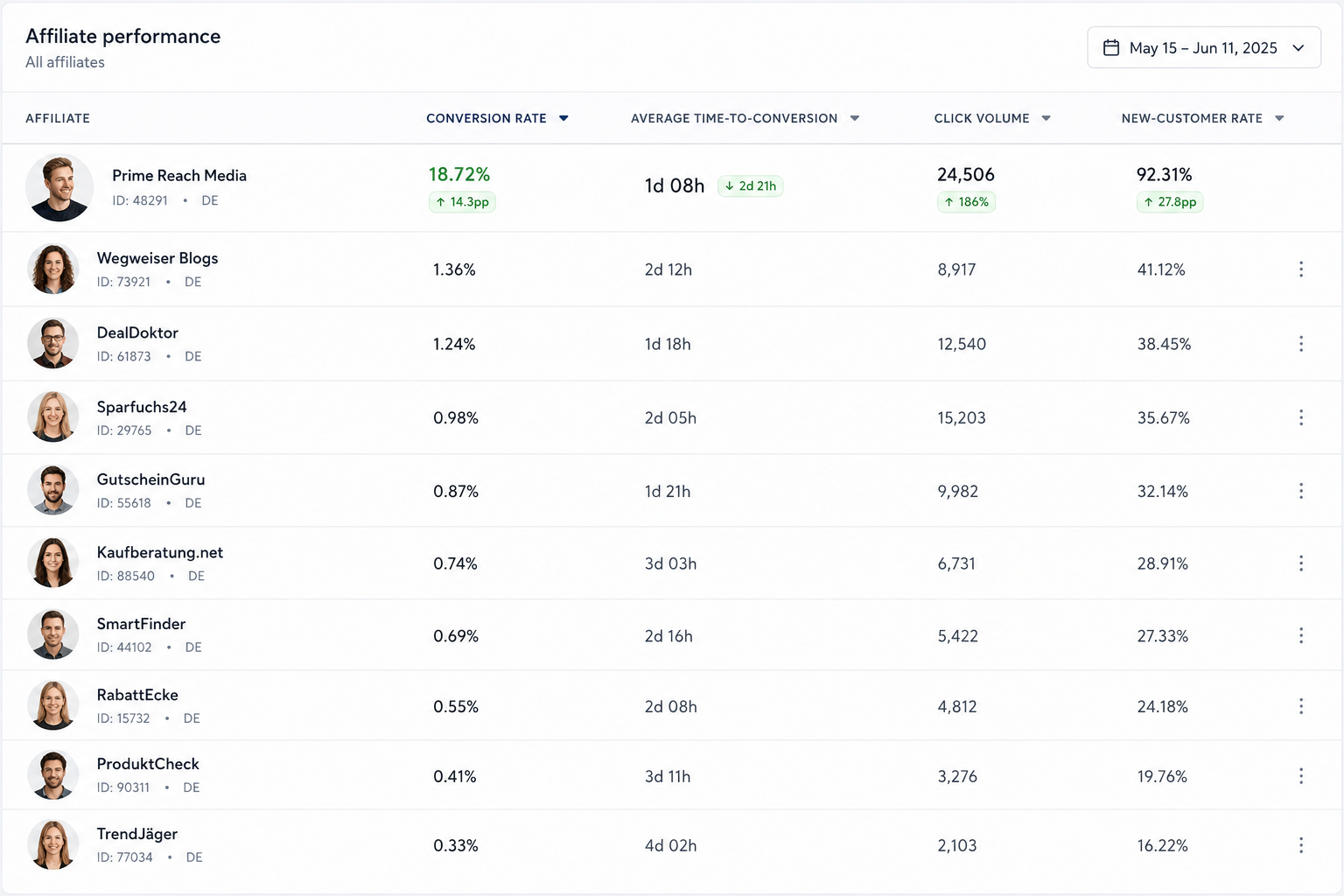 Four signals show up in per-affiliate reporting before anyone tells you anything.
Conversion rate anomalies come first. Your program average might sit at 3%. An affiliate converting at 14% is either extraordinary or catching people who had already decided. Both deserve a conversation.
Time-to-conversion is the second. Cold traffic takes days. If an affiliate’s clicks convert in under two minutes on average, those clicks came from someone at the end of the buying process.
Traffic concentration is the third. A blog affiliate produces clicks across weeks. A paid affiliate produces clicks in a tight burst that starts and stops with a campaign budget.
Referring URL patterns are the fourth. A missing or generic referrer on high volume usually means an ad redirect rather than a content page.
Pull all four in the same view and the pattern is obvious. That’s the part most affiliate software makes hard, because it reports program totals instead of per-affiliate behavior.
Per-affiliate reporting in AffiliateHQ, which I built.
I built AffiliateHQ because I got tired of exporting CSVs to answer questions like this. Per-affiliate reporting, the AI Program Analyzer that flags conversion anomalies, and segmented broadcasts with live-stat merge tags all exist so you can spot a bad traffic source in a few minutes instead of a weekend.
What do you do when an affiliate breaks the rules?
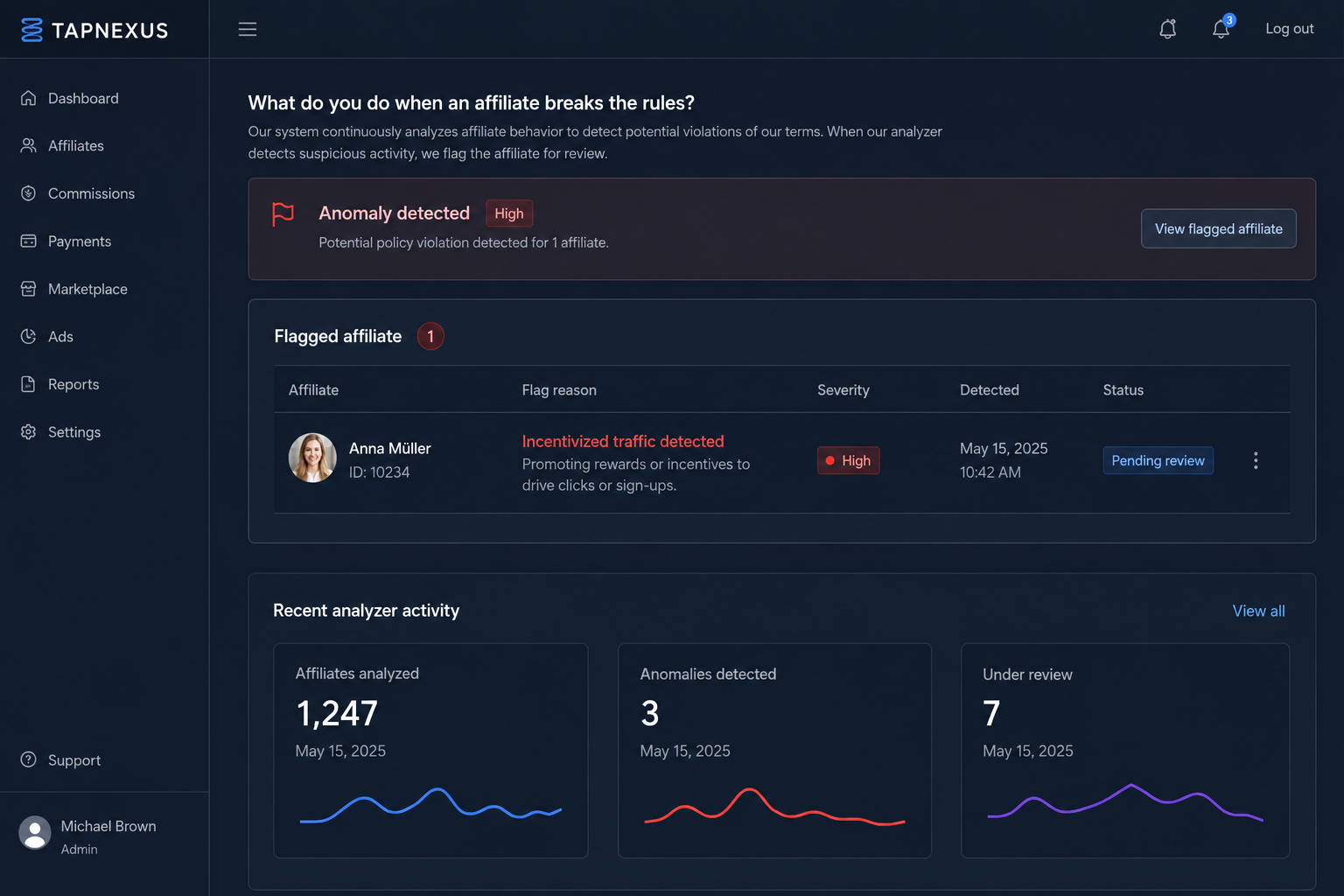 Send a warning first, unless the violation involves brand impersonation or a false claim, in which case pause the affiliate immediately.
Most violations come from affiliates who never read the terms. I’d guess three out of four paid traffic problems I’ve handled ended with the affiliate saying some version of “I didn’t know.” A short, specific email fixes those. Name the campaign, quote the clause, give a deadline, and confirm what happens if it continues.
Reverse commissions on the sales generated during the violation. Say so in the email, and cite the enforcement clause. If the affiliate fixes the campaign and stays clean, keep them. Terminating a producer over a first offense costs you more than the reversal is worth.
Document all of it. Screenshot the ad, save the landing page, note the date. Affiliates dispute reversals, and a screenshot ends the argument.
How do you tell affiliates what’s allowed?
Put the paid traffic rules in three places: the terms, the approval email, and the affiliate dashboard. Repeat them before every launch.
The approval email matters most. An affiliate reads that one. Give them four bullets, not four pages. Something like: bridge pages required, no bidding on our brand name, no retargeting our site visitors, disclosure above the fold. Link to the full terms underneath.
Before a launch, send a paid traffic reminder as its own email. Launches are when affiliates spend the most and read the least.
Frequently asked questions
Can affiliates use Google Ads?
Yes, on non-brand keywords, sending traffic to a bridge page they own. Prohibit bidding on your brand name, brand misspellings, and your URL, and prohibit direct linking from the ad to your sales page. Google’s own policy also limits how many advertisers can appear for the same domain, which means a direct-linking affiliate can block your ad.
Should I let affiliates run Facebook ads?
Yes, with a landing page requirement. Meta traffic is where the strongest cold-traffic affiliates work, and those customers are usually incremental. Require a bridge page, a visible disclosure, and accurate claims. Ask to see creative from any affiliate spending meaningfully, because Meta holds the advertiser responsible for claims and your brand shows up in the funnel.
What is direct linking in affiliate marketing?
Direct linking is running a paid ad that sends the click straight to the merchant’s page through a tracking redirect, with no affiliate-owned page in between. Most programs prohibit it because the merchant never sees the ad copy, has no disclosure page to point to, and competes with the affiliate in the same ad auctions.
How do I know if an affiliate is running paid ads?
Look at conversion rate, time-to-conversion, click concentration, and referring URLs in per-affiliate reporting. Paid affiliates convert faster and in tighter bursts than content affiliates. You can also search your brand and product terms on Google and Bing from a clean browser, and run your offer name through Meta’s Ad Library.
Can I reverse commissions for a paid traffic violation?
Yes, if your terms say so before the violation happens. Include an enforcement clause that names commission reversal as a remedy, along with warning and termination. Document the violation with screenshots, cite the specific clause in your email, and process the reversal on sales generated during the violation window.
Should new affiliates be allowed to run paid ads immediately?
Make paid traffic permission-based for new affiliates in programs where you can’t review every campaign. Approve the affiliate, let them promote through content and email, and grant paid traffic access after they’ve produced clean sales. That one change removes most of the enforcement work before it starts.
What to do this week
Three things, in order.
Open your affiliate terms and check whether a paid traffic section exists. If it doesn’t, add the six clauses above.
Pull new-customer rate and average time-to-conversion for your top 10 affiliates. Anyone far outside the program average gets a conversation, not a termination.
Rewrite your approval email to include four bullets on paid traffic rules. Most of your enforcement problems disappear once affiliates read the rules at the moment they care about them.
If you want a second set of eyes on your program before you rewrite anything, grab a free 20-minute call through Your Affiliate Launch Coach. We’ll look at your current rules, your reporting, and what to change in the next 30 days.
One last thing. Paid traffic rules work only if you enforce them consistently, and consistency is easier when you can see what your affiliates are doing. If your affiliate tracking doesn’t show you per-affiliate behavior, fix that before you write another clause. I cover the full system for structuring, staffing, and policing a program in The Book on Affiliate Management.
Related reading: how to write an affiliate program agreement, whether to allow coupon sites, how to screen affiliate applications, affiliate fraud prevention tools, the KPIs worth tracking, and how to handle affiliate disputes.