The best affiliate software for a SaaS company is whichever platform creates a new commission on every renewal payment, not just the first one. Most tools track the initial signup and stop there. For subscription businesses, that single design choice decides whether your affiliates earn $30 once or $30 every month for two years.
 I’ve watched SaaS founders sign up for affiliate software, run it for four months, and quietly shut the program down because their best partners stopped promoting. In almost every case the platform paid on the first invoice and nothing after that. The affiliate did the math, saw a $24 payout on a customer worth $1,700 in lifetime revenue, and moved on to a program that paid them for the whole ride.
So before you compare feature lists, ask one question of every vendor on your shortlist: when my customer pays their sixth monthly invoice, does an affiliate commission get created?
Does affiliate software pay commissions on renewals or only the first payment?
It depends entirely on the platform, and a surprising number of them only pay on the first transaction. Some tools were built for one-time digital products and bolted subscription support on later, which usually means they record the signup as a conversion and never look at your billing system again.
The distinction sounds small. It isn’t. Take a $99/month product with an average customer life of 18 months. At a 25% commission, first-payment-only pays your affiliate $24.75. Recurring pays them $445.50 on that same customer. An affiliate deciding where to spend their next launch email will pick the program paying $445.50, and they’ll pick it in about four seconds.
The mechanical question is where the commission gets created. Platforms that pay on renewals listen to your billing system for payment events, and every successful charge generates a new commission record. Platforms that don’t listen only fire once, on the checkout event, and go silent.
Before you pick software, settle what you can afford to pay. The commission rate you can sustain on a subscription product depends on churn and lifetime value, not gut feel. How to Structure Affiliate Commissions For a SaaS Product walks through the LTV math and shows why flat fees push out your best partners over time.
Why do most affiliate platforms handle SaaS renewals badly?
 Most affiliate platforms were designed around a single conversion event, and subscription billing produces dozens of events per customer. A one-time-purchase model needs the software to answer one question: who sent this buyer? A subscription model needs it to answer that question again on every invoice, every plan upgrade, every downgrade, every failed payment retry, and every cancellation.
Here’s where the difference shows up in practice. When a customer upgrades from your $49 plan to your $149 plan, does the commission amount change? When a payment fails and retries successfully three days later, does the affiliate get paid once or twice? When a customer cancels in month seven, does the platform stop creating commissions or keep generating them forever against a subscription that no longer exists?
Platforms that read your billing system directly get these right because they’re reacting to the same events your accounting sees. Platforms that rely on a checkout-page pixel can’t answer any of them, because they never see the invoices. That’s a tracking architecture problem, not a settings problem, and no amount of configuration fixes it. If you want the underlying mechanics, How Affiliate Tracking Works explains what the software is doing between the click and the payout.
The second failure mode shows up in reconciliation. If your affiliate platform and your billing platform maintain separate records of what a customer paid, they drift. Every month you spend an hour matching two spreadsheets, and every quarter you find a commission that should have been reversed six weeks ago.
How does AffiliateHQ handle recurring commissions on Stripe?
AffiliateHQ connects to your own Stripe account and creates a commission on every renewal, upgrade, and cancellation event, so affiliates earn on every payment a customer makes. You aren’t syncing two systems or importing a CSV once a month. The commission records come from the same payment events Stripe already generates.
You set the duration rule program-wide. Pay affiliates for the first 12 months, the first 24, or for the life of the customer. Then you override it per affiliate, which matters more than founders expect. Your top three partners will eventually ask for lifetime commissions while everyone else stays on the standard 12-month term, and you want that conversation to end with a settings change instead of a spreadsheet workaround.
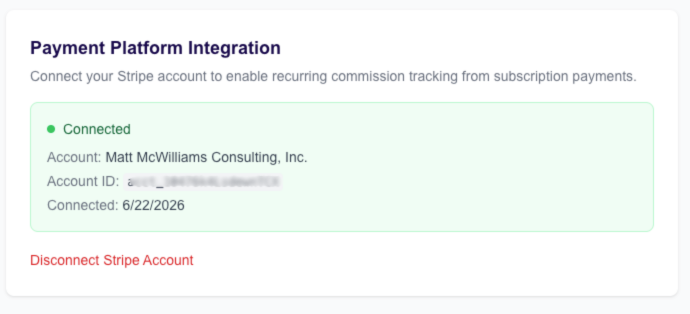
Because the commission ties to a payment event rather than a checkout, the amount tracks the actual charge. A customer who upgrades mid-year generates a larger commission on the next invoice without anyone touching the affiliate’s record. A customer who downgrades generates a smaller one. Your affiliate’s earnings move with the revenue they created, which is the whole point.
I built AffiliateHQ after two decades of running programs on software that kept letting me down. Every feature maps to what I teach in The Book on Affiliate Management, including the Stripe-native recurring commission engine SaaS founders need on day one.
What happens to the commission when a SaaS customer cancels or refunds?
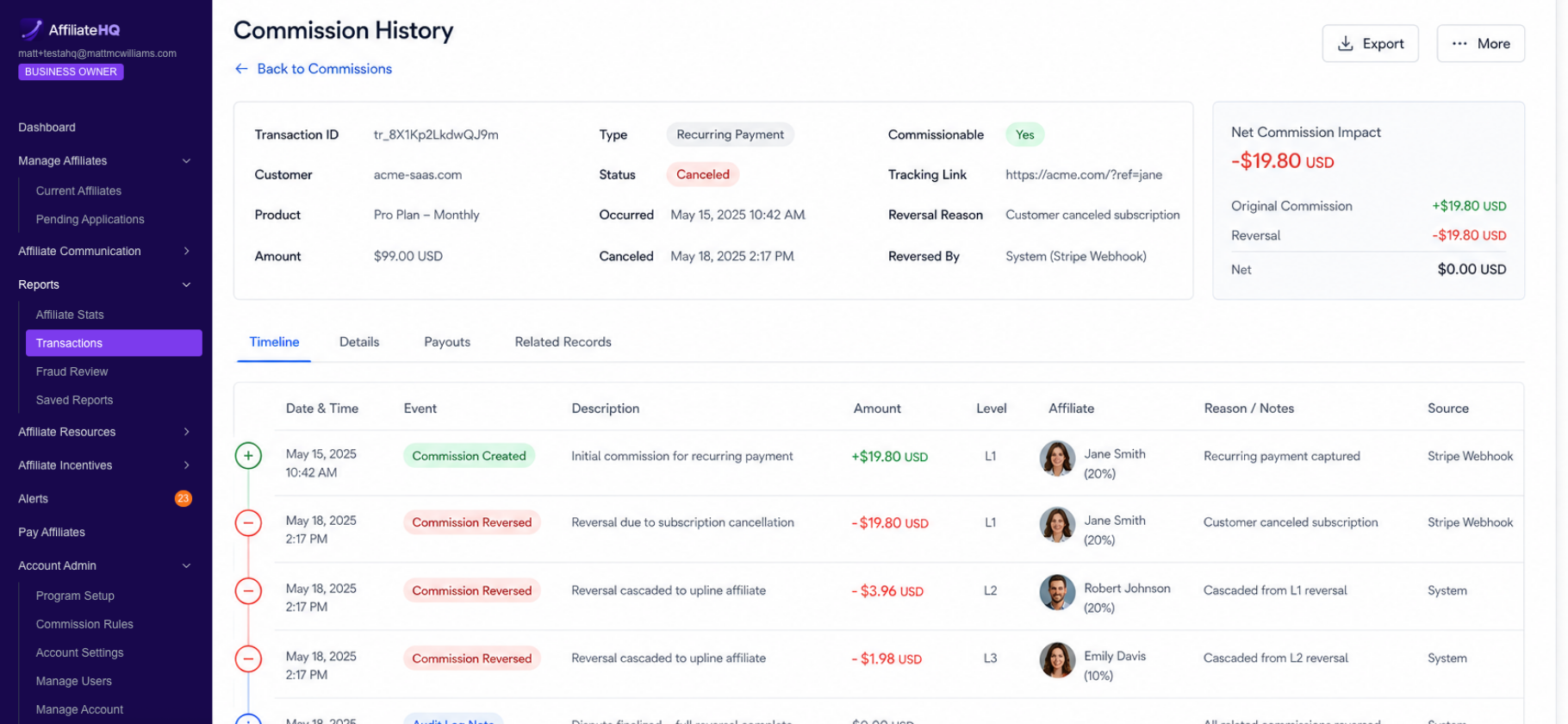
In AffiliateHQ, cancellations and refunds reverse the commission automatically and cascade the clawback through every level of a multi-level structure, with a full audit log. Nobody hunts through Stripe for the refunded charge and then hunts through the affiliate dashboard for the matching commission.
Clawbacks are the part of SaaS affiliate management that founders underestimate. A one-time product has a refund window of 30 or 60 days and then you’re done. A subscription generates refund risk on every invoice for as long as the customer stays. If your software doesn’t reverse commissions on its own, you’re either eating the loss or clawing it back by hand, and the manual version is where affiliate relationships go to die.
Multi-level structures make it worse. If Affiliate A recruited Affiliate B, and Affiliate B’s customer refunds, both commissions need to reverse together. AffiliateHQ supports multi-level structures up to four levels deep, and the clawback cascades through all of them.
The audit log is the piece that saves you when an affiliate emails asking why their balance dropped $340 overnight. You pull up the reversal, show the refunded charge and the date, and the conversation ends in two minutes. Without a log, you’re asking a partner to trust your memory. How to Handle Affiliate Disputes covers how to run those conversations without torching the relationship.
Reversals are one flavor of affiliate risk. Fake signups and self-referrals hit SaaS programs hard because free trials make the entry cost zero, so read Affiliate Fraud Prevention Tools before your program gets big enough to be a target.
How do you set different commission rates for different SaaS pricing tiers?
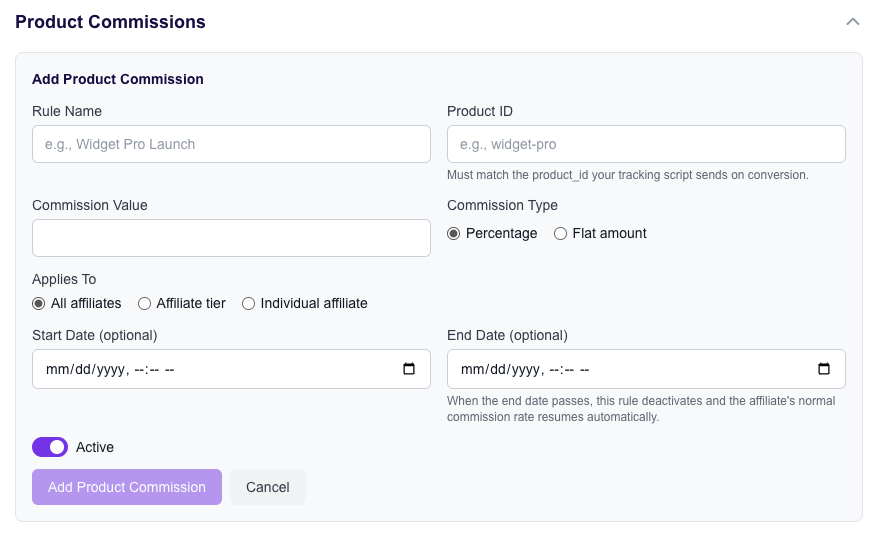
You set product-specific rates, which lets you pay one percentage on your entry plan and a different one on your enterprise plan. Most SaaS companies sell three or four tiers with wildly different margins, and paying a flat 25% across all of them means you’re either overpaying on the plan with thin margins or underpaying on the one with fat ones.
Say your Starter plan runs $29/month with heavy support load and your Pro plan runs $199/month with almost none. A flat rate treats those as the same sale. They aren’t. Product-specific rates in AffiliateHQ let you pay 15% on Starter and 30% on Pro, which does two things at once: it protects your margin on the cheap plan, and it points affiliates at the customers you want.
That second effect is underrated. Affiliates read your commission structure as a signal about what you value. Pay more on Pro and your partners will write content aimed at Pro buyers. I’ve seen a rate change like that move a program’s average deal size by 40% inside a quarter without a single conversation about it.
You can layer tiered affiliate commissions on top of product-specific rates, so an affiliate who crosses 25 active subscriptions moves to a higher bracket across the board. And if you’re still deciding what your base numbers should be, What is a Good Affiliate Commission Rate? gives the benchmarks by category.
How long should a SaaS affiliate keep earning on a customer?
 Twelve to 24 months covers most SaaS programs, and lifetime commissions belong to a small group of partners who earned them. Anything shorter than 12 months tends to read as stingy to experienced affiliates, who know your average customer sticks around longer than that.
Run the math on your own numbers before you commit. If your median customer life is 14 months, a 12-month commission window pays affiliates on about 85% of the revenue they generated. That’s generous enough to recruit well and cheap enough that your CAC stays sane. If your median customer life is 40 months, a 12-month window pays them on 30% of what they created, and your best affiliates will notice.
Lifetime is the strongest recruiting tool you have, which is exactly why you shouldn’t hand it out at signup. Hold it back as the thing an affiliate unlocks at 50 active customers, or offer it to the three partners you’d hate to lose. AffiliateHQ’s per-affiliate overrides make that a two-click change instead of a migration project.
There’s a churn consideration too. If your product churns at 8% monthly, a lifetime commission costs you very little because almost nobody reaches month 20. If you churn at 1.5%, lifetime is a real long-term liability and you should price it accordingly. How To Run An Affiliate Program For Monthly Subscription Services goes deeper on how churn changes what you can afford.
What should a SaaS founder check before choosing affiliate software?
Check six things, in this order: renewal commission creation, refund and cancellation reversal, product-specific rates, per-affiliate overrides, the audit trail, and how the platform connects to your billing system. Everything else on a features page is secondary for a subscription business.
Renewal commission creation is the disqualifier. If a platform can’t create a commission on invoice number seven, stop the evaluation there regardless of how good the rest looks.
Reversal handling comes second because it’s the thing you’ll deal with weekly forever. Ask whether reversals happen automatically, whether they cascade through multi-level structures, and whether there’s a log you can show an affiliate.
Billing connection matters more than the integration count on the marketing page. A platform that connects to your own Stripe account reads the same events your finance team reads. A platform that sits between you and your processor gives you a second source of truth to reconcile, and two sources of truth means one of them is wrong.
Then look at flexibility. Product-specific rates and per-affiliate overrides sound like advanced features until month four, when your best partner asks for a custom deal and your top-tier plan needs a different rate than your entry plan. Both requests arrive faster than founders expect. If you want the broader platform comparison outside the SaaS-specific criteria, Best Affiliate Program Software breaks down the main categories.
Software is one decision out of a dozen you’ll make in the first 90 days. The Book on Affiliate Management covers the full system I used to build a $1 million per month program in under two years, including commission design, recruiting, and activating the 95% of affiliates who sign up and never promote.
What do you do after the software is running?
 Recruit affiliates, because the platform won’t do it for you. This is where most SaaS affiliate programs stall out. The founder spends three weeks evaluating software, picks well, sets up the commission structure, and then waits for partners who never show up.
Start with your existing customers. In SaaS, the people already paying you are the most credible promoters you’ll ever get, because they can write about the product from real use instead of a demo video. Wait until they’ve been active for 30 to 60 days so they have something to say, then invite them personally.
Then go after the people already writing comparison content in your category. Search your product name plus “alternative” and see who ranks. Those writers have the traffic and the intent, and half of them are already mentioning you without a link. How To Find Affiliates For a SaaS Business has the full recruiting playbook.
Get your payout process settled before your first payment cycle, too. Deciding your payout schedule and threshold after affiliates have earned money is a bad look, and How to Pay Affiliates covers the choices worth making up front.
Recruiting is the part that decides whether your program works. Your First 100 Affiliates is a free report showing the strategies I used to recruit 604 affiliates and build a $1.1 million per month program in 18 months, including where to find partners and the emails that get replies.
Frequently asked questions about SaaS affiliate software
Can affiliate software track free trials that convert to paid later?
Yes, if the platform ties the commission to the payment event rather than the signup. The affiliate’s referral gets recorded at trial start, and the commission gets created when the first real charge goes through. Platforms that fire on the signup event alone tend to either pay on trials that never convert or miss the conversion entirely when it happens 14 days later.
What commission rate do most SaaS affiliate programs pay?
Recurring programs commonly pay 20% to 30% of each monthly payment. One-time structures usually run 50% to 200% of the first month’s revenue, paid once. Your sustainable number depends on your gross margin, your churn rate, and what you currently spend to acquire a customer through paid channels. Work backward from CAC rather than copying a competitor’s rate.
Do I need a developer to connect affiliate software to Stripe?
Usually not. Platforms built for subscription businesses connect to Stripe through an authorization flow that takes a few minutes, and the tracking script drops into your site the same way an analytics tag does. You’d need engineering help if you run a custom-built checkout, use a payment processor the platform doesn’t support, or want commissions tied to usage-based billing events.
What happens to affiliate commissions if a customer downgrades their plan?
On a platform that reads payment events, the commission on the next invoice reflects the smaller charge automatically. On a platform that recorded the original signup amount, it keeps paying the old rate until someone notices and fixes it by hand. Ask specifically about downgrades during your evaluation, because it’s the case vendors skip in demos.
Should a SaaS company use an affiliate network instead of its own software?
Running your own program usually makes more sense for SaaS. Networks charge a fee on top of your commissions and own the affiliate relationship, which hurts more in a business where partners earn for years off a single customer. Networks help most when you can’t recruit on your own, and for SaaS you can recruit from your customer base and your comparison-content competitors.
How do multi-level affiliate structures work for SaaS?
An affiliate who recruits another affiliate earns a smaller percentage of that person’s commissions. AffiliateHQ supports this up to four levels deep, and clawbacks cascade through every level when a customer refunds or cancels. It works well in SaaS because recurring revenue makes the second-level earnings meaningful enough to motivate recruiting, rather than a rounding error.
What to do next

Three things, in order.
First, ask every vendor on your shortlist whether their software creates a commission on invoice number seven and reverses it automatically on refund. If they hedge, cross them off.
Second, decide your commission duration before you decide your rate. Twelve to 24 months for the standard program, lifetime reserved as something affiliates unlock. That single decision affects your recruiting pitch more than the percentage does.
Third, set your product-specific rates so your affiliates aim at the plans with the margin to support them. Then go recruit, because the best software on the market tracks zero sales until someone promotes you.
If you’d rather talk it through than read another comparison chart, grab a free 20-minute call at Your Affiliate Launch Coach. I’ll review your current setup and give you an action plan for the next 30 to 60 days.