Your affiliate software checklist should have fourteen questions on it, and demo reps will happily answer thirteen of them. The fourteenth is usually the one that bites you eighteen months later. Below are the questions I ask now, the answer you want to hear for each, and how AffiliateHQ handles it.
 I’ve bought affiliate software five times. I’ve been wrong about it four times. Not because the platforms were bad, but because I evaluated them on the wrong things. I looked at the pricing page and the feature grid, watched a 30-minute demo, and signed up. Six months in, I’d find out the thing I needed most was either missing or buried behind a $400/month tier.
So I wrote down the questions. Every time a platform burned me, I added the question that would have caught it. This is that list. Ask all fourteen before you hand anyone a credit card, and ask them in a live demo where somebody has to click through and show you, because “yes, we support that” covers an enormous amount of ground.
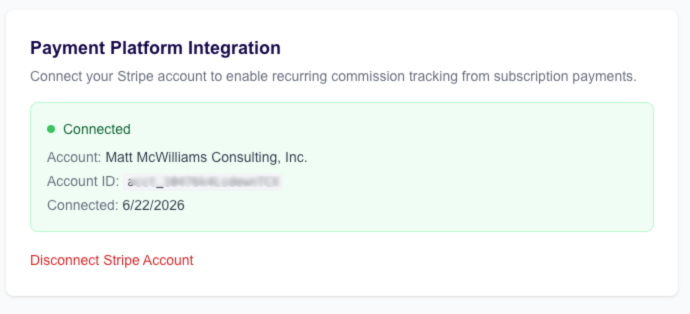
Does it pay commission on renewals and rebills?
Ask this first if you sell anything recurring. Plenty of platforms track the initial sale beautifully and then go silent on month two. Your affiliate sends you a customer worth $1,200 over their lifetime, and the platform pays out on the $49 first charge and calls it done.
The answer you want: recurring commissions are configurable per program, per affiliate tier, and per duration. You should be able to say “pay 30% for the first 12 months, then 10% for life” and have the system handle it without you touching a spreadsheet. Also ask what happens when a customer downgrades mid-cycle, because that’s where the math gets ugly. I wrote about how to structure affiliate commissions for a SaaS product if you want the commission-design side of this.
AffiliateHQ calculates renewal commissions automatically off the billing event, so a rebill in month seven pays out the same night it processes.
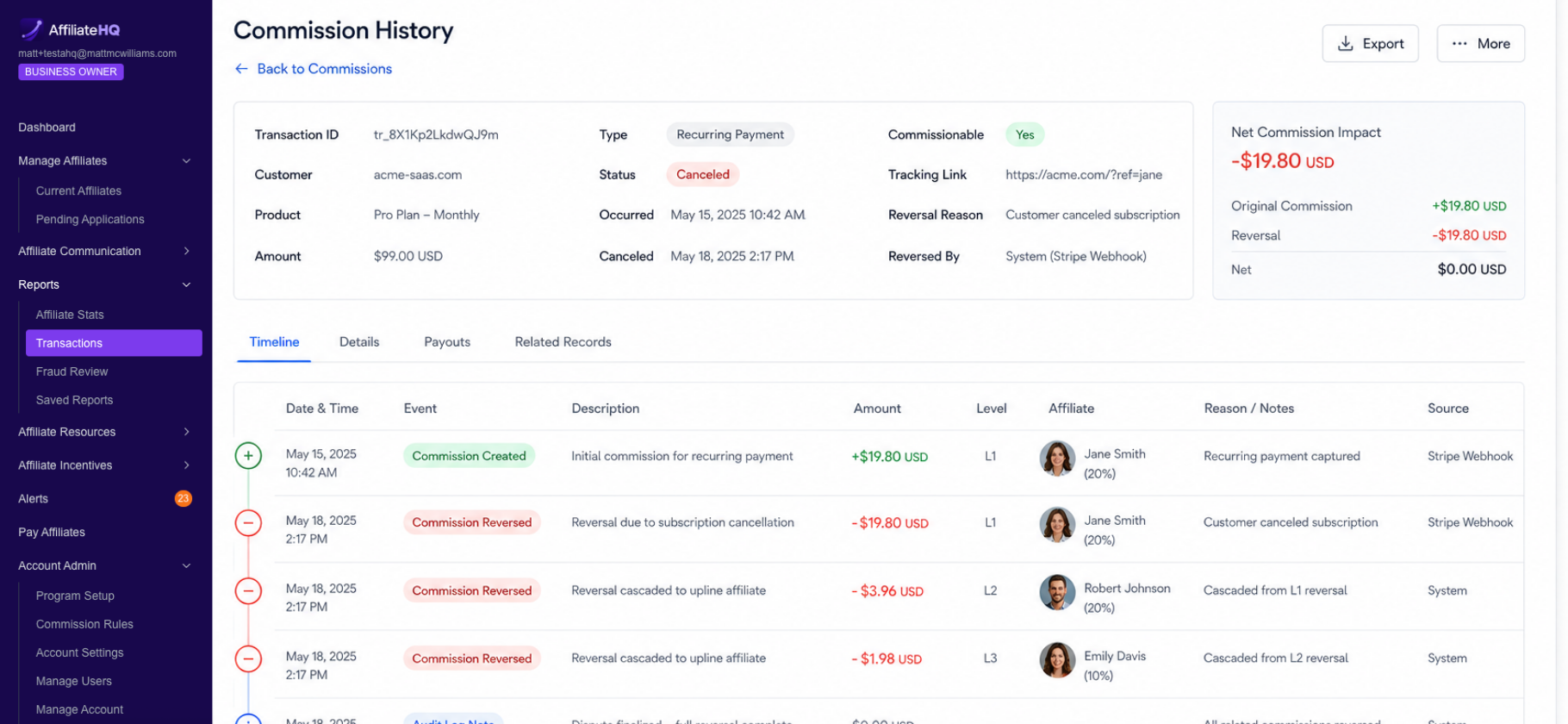
What happens to the commission when a customer refunds?
This one costs real money. If your platform doesn’t reverse commissions automatically, somebody on your team is reconciling refunds by hand every month. I did this manually for two years on one program. It ate about six hours a month and I still got it wrong sometimes.
The answer you want: automatic clawback tied to the refund event in your payment processor, with a configurable hold period before payout so most refunds land before the money leaves. Ask specifically what happens if the refund comes in after you’ve already paid the affiliate. Does the system carry a negative balance forward, or do you have to email somebody and ask for money back? Carrying it forward is the humane version.
AffiliateHQ reverses the commission when the refund hits and nets it against the affiliate’s next payout, so nobody gets an awkward email.
Can I email a filtered segment of affiliates from inside the platform?
Most platforms let you email everybody. Far fewer let you email the 43 people who promoted last launch but haven’t clicked into their dashboard in 60 days. That second group is where your revenue is hiding.
The answer you want: filter by any behavior in the system, then send to that filtered list without exporting a CSV and importing it somewhere else. If the vendor’s answer is “you can export to Mailchimp,” that’s a no. Export-and-import means you’ll do it twice and then stop.
AffiliateHQ lets you build a segment on any combination of activity, earnings, join date, and program, then broadcast to it directly.
Can affiliates see their own EPC?
Experienced affiliates evaluate your program on earnings per click, not commission rate. If your platform hides EPC from them, they’ll calculate it themselves, and they’ll calculate it wrong, and they’ll conclude your program pays worse than it does.
The answer you want: EPC visible on the affiliate’s own dashboard, calculated over a selectable date range, alongside clicks, conversions, and conversion rate. Bonus points if they can see it per link or per creative, because that’s how good affiliates optimize.
AffiliateHQ shows EPC on the affiliate dashboard by default and breaks it out by link.
EPC is one of six numbers I check every week, and most managers track the wrong four. I broke down which metrics predict program growth and which ones just make the dashboard look busy in Affiliate Program KPIs: The Metrics Every Affiliate Manager Should Track.
How does it handle two affiliates touching the same sale?
A customer clicks Sarah’s link on Tuesday, doesn’t buy, clicks Mike’s link on Friday, and buys. Who gets paid? Your platform has an opinion about this, and you need to know what it is before somebody writes you an angry email.
The answer you want: the attribution model is a setting you control, not a hardcoded assumption. Last click is the default in most systems and it’s fine for most programs, but you should be able to see the full click path on any given sale so you can settle a dispute with evidence instead of a shrug. I explained the tradeoffs between models in Affiliate Attribution Models Explained, and the mechanics underneath it in How Affiliate Tracking Works.
Ask about the cookie window in the same breath, and whether you control it per program. Thirty days is the common default. The number matters less than whether you can change it without a support ticket, and my take on the right one is in What is a good affiliate cookie duration?
AffiliateHQ stores the full click path on every conversion, so you can open a sale and see every affiliate who touched it and when. Cookie duration is set per program, with account-level matching as a fallback when the cookie is gone.
Can I run more than one program on the same account?
You will eventually launch a second product. Or a second brand. Or you’ll want a separate program for your high-touch partners with different terms. If your platform charges you a second full subscription for that, your costs double the day you grow.
The answer you want: multiple programs under one account, each with its own commission structure, terms, creatives, and affiliate roster, with the option to let one affiliate join several. Ask whether reporting rolls up across programs, because managing four separate dashboards gets old fast.
AffiliateHQ supports unlimited programs on one account with roll-up reporting across all of them.
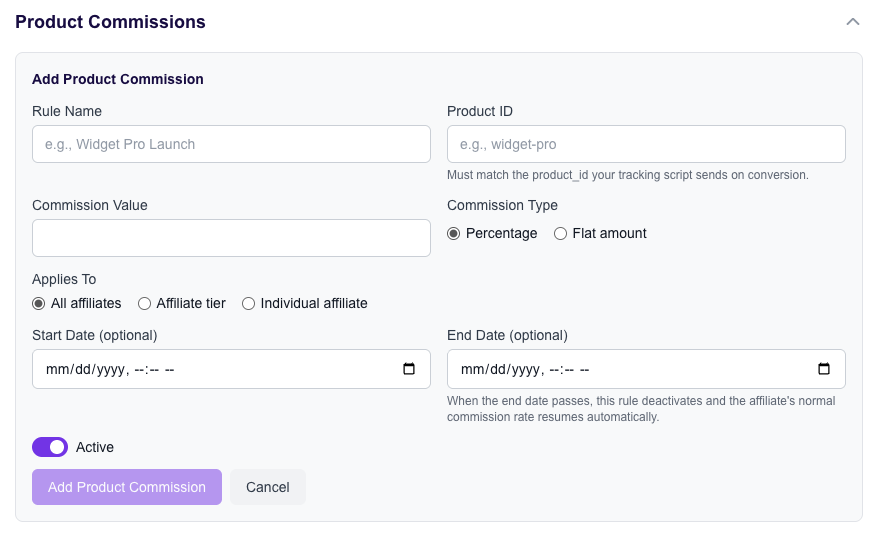
Can I set different commission rates for different affiliates?
Your top affiliate does $50,000 a month. The person who joined yesterday has sent two clicks. Paying them identically is a strange choice, and yet plenty of platforms make custom rates painful enough that managers skip it.
The answer you want: per-affiliate overrides that take about four clicks, plus tier rules that promote people automatically when they cross a threshold. If you have to email support to change one affiliate’s rate, you’ll never do it. For the design side of this, see How To Structure An Affiliate Program.
AffiliateHQ handles both, and the automatic tier promotion fires without you watching for it.
What does the affiliate see the first time they log in?
Ask the rep to log in as an affiliate during the demo. Not the admin view. The affiliate view. This is the single most revealing thing you can do in a software demo, and almost nobody does it.
The answer you want: a dashboard where the affiliate can find their link, their creatives, their stats, and their payout history in under ten seconds without a tutorial. If the affiliate experience looks like a 2011 admin panel, your affiliates will log in once and never return, and dead affiliates cost you the entire program.
AffiliateHQ puts the tracking link, current earnings, and available creatives on the first screen after login.
The affiliate experience is one chapter of a much bigger system, and the software is only the container it runs in. I laid out the full process I used to build a $1 million per month program in under two years in The Book on Affiliate Management.
Can I find every affiliate who has never sent a click?
 Roughly 80% of the people who sign up for your program will never send a single click. That’s normal. The question is whether your software makes that group visible and reachable, because reactivating even 5% of them changes your revenue.
The answer you want: a saved filter for zero-click affiliates, another for affiliates who converted once and went quiet, and the ability to email either group directly. Ask whether the system flags an affiliate going dormant on its own, or whether you have to remember to check.
AffiliateHQ surfaces both groups as standing segments and sends you an alert when a previously active affiliate stops producing.
Finding the dormant affiliates is step one. Getting them to promote is step two, and it’s mostly a writing problem. Grab the emails I use for it in Affiliate Activation Templates.
Does it run contests and leaderboards, or do I build that myself?
Contests are the cheapest revenue lift in affiliate management. I’ve watched a $500 prize move $40,000 in extra sales. But if your platform doesn’t run them, you’re building leaderboards in Google Sheets at 11pm during a launch, and I’ve done that, and it’s miserable.
The answer you want: live leaderboards affiliates can see, sortable by whichever metric you’re rewarding, plus threshold prizes alongside ranked prizes. Ranked-only contests kill motivation by day two for everyone outside the top five.
AffiliateHQ runs ranked and threshold prizes at the same time, with live leaderboards and milestone badges that award themselves.
How does it catch fraud, and what does it do about it?

Self-referrals, coupon hijacking, cookie stuffing, and traffic from click farms all cost you money quietly. Most program owners find out months later during an audit.
The answer you want: automatic flags on suspicious patterns like a spike in conversions from one IP range, self-referral detection tied to customer email, and the ability to hold a commission for review before it hits a payout. Ask what the system does on its own versus what it expects you to notice. I covered the specific patterns to watch in Affiliate Fraud Prevention Tools.
AffiliateHQ flags the common patterns and holds flagged commissions for your review rather than paying them out and hoping.
Can I pay affiliates without exporting a spreadsheet?
Payout day is where affiliate management goes from strategy to bookkeeping. If your platform hands you a CSV and wishes you luck, you’re spending three hours a month in PayPal.
The answer you want: mass payouts from inside the platform, minimum payout thresholds you set, a hold period for refunds, and tax form collection handled automatically. Ask about payout methods for international affiliates, because PayPal-only shuts out a real slice of your roster. My full breakdown of methods and schedules lives in How to Pay Affiliates.
AffiliateHQ processes mass payouts with thresholds, hold periods, and tax forms in one pass.
Who do I talk to when something breaks?
At some point your tracking will stop working during a launch. This is the question that separates platforms, and it’s the one people skip because it feels rude to ask.
The answer you want: a named support channel with a stated response time, staffed by people who have run affiliate programs. Ask what the average first-response time is. Ask whether support is available on weekends, because launches happen on weekends. If the answer is a chatbot and a help center, price that into your decision.
AffiliateHQ was built by people who manage programs for a living, and support goes to a human who understands what you’re asking.
What happens to my data if I leave?
Ask this out loud, on the demo, and watch the reaction. You want your affiliate list, their contact details, their historical earnings, and your click and conversion history in a usable export, on demand, without asking permission.
The answer you want: full export of affiliates and transaction history in standard formats, available from your own account. If the vendor gets cagey about it, you’ve learned something important about how they plan to keep you. Your program agreement should reflect that you own the relationship, not the platform.
AffiliateHQ exports affiliates, transactions, and payout history on demand.
How to use this list
Print the fourteen questions. Take them into every demo. Make the rep click through and show you rather than nod, and log in as an affiliate at least once. When you’re comparing two platforms and they both say yes to everything, the fourteen answers will still be different, and the differences are where your next two years of work either gets easier or doesn’t.
One thing that isn’t on the list, because it isn’t a yes-or-no question: ask the rep to price out your program at four times its current size and get it in writing. A platform taking a percentage of every commission charges you more precisely when you’re winning.
Three of these matter more than the rest for most programs. Renewal handling, if you sell anything recurring. Segmented emailing, because dormant affiliates are your biggest untapped revenue. And data export, because it determines whether this is a decision or a marriage. Get those three right and you can live with compromises on the other eleven.
Then run the list against AffiliateHQ. I built it after five platforms let me down on exactly these questions, and every feature in it maps to something I needed and couldn’t find. If you’d rather talk through your specific program before you buy anything, grab a call and I’ll tell you honestly whether you need new software or just a better process.
Not sure whether your platform is the problem or your process is? Bring your program to a free 20-minute call and I’ll give you an action plan for the next 30 to 60 days. Book it at Your Affiliate Launch Coach.